

Table of Contents
ToggleAs the financial year draws to a close, business owners across the UAE face a familiar challenge: preparing for the annual audit. But with the introduction of Corporate Tax and evolving VAT regulations, the stakes have never been higher.
Gone are the days when a year-end audit was simply a box-ticking exercise. Today, regulators expect accuracy, transparency, and full compliance. One mistake in your financial statements can trigger penalties, delays, or even a tax investigation.
At Fandeez, we help UAE businesses navigate this complex landscape every single day. This guide walks you through everything you need to know about year-end audit preparation UAE, including a practical checklist, common pitfalls, and how to stay ahead of compliance requirements.
Understanding UAE Audit Requirements
Before diving into preparation, it helps to understand what the law actually requires. UAE audit requirements vary depending on your business structure and location.
Mainland Companies
Under UAE Commercial Companies Law, all mainland companies must appoint an auditor and have their financial statements audited annually. The audited financial statements must be submitted to the relevant authorities, including the Department of Economic Development (DED).
Free Zone Entities
Free zone audit requirements differ by jurisdiction. Some free zones require audited financial statements every year. Others only require them if your annual turnover exceeds a certain threshold. However, with Corporate Tax now in effect, most free zone companies should prepare audited statements regardless of their free zone’s specific rules.
Regulatory Expectations
Beyond legal obligations, banks, investors, and suppliers increasingly request audited financial statements. If you plan to secure financing, win government contracts, or attract partners, a clean audit report is non-negotiable.
According to Fandeez audit professionals, one of the most common mistakes we see is businesses waiting until the last month before their audit deadline to start preparing. That almost always leads to stress, errors, and unnecessary costs.
Year-End Audit Preparation UAE: Why It Matters
The year-end audit preparation UAE process is not just about satisfying a legal requirement. It serves several critical purposes for your business.
Risk Reduction
A well-prepared audit identifies weaknesses in your financial controls before they become serious problems. Detecting an error in your books internally is far cheaper and less damaging than having an auditor find it.
Compliance Protection
With Corporate Tax now active, the Federal Tax Authority (FTA) expects accurate financial records. Poor audit preparation can lead to incorrect tax filings, which carry penalties of up to 30% of the tax due.
Operational Clarity
The audit process forces you to review every aspect of your finances. Many business owners discover inefficiencies, duplicate payments, or missed revenue during this review.
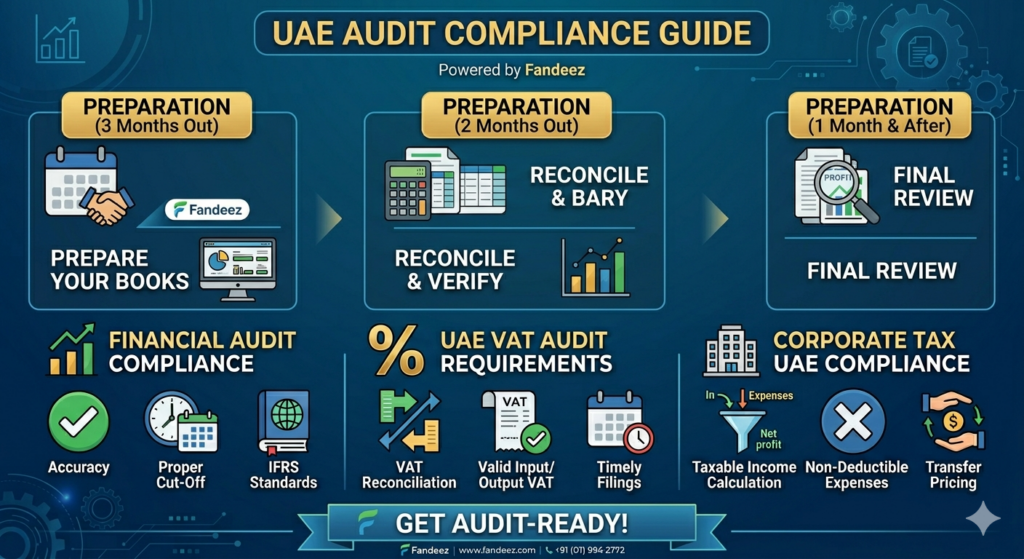
At Fandeez, we recommend starting your audit preparation at least three months before your financial year ends. This gives you enough time to clean up books, gather documents, and address any discrepancies.
Audit Preparation Checklist UAE
To help you stay organised, here is a practical audit preparation checklist UAE businesses can follow.
Three Months Before Year-End
- Confirm your financial year-end date (most UAE businesses use December 31st)
- Notify your audit firm and schedule the audit timeline
- Review last year’s audit findings and ensure prior issues are resolved
- Update your accounting software and verify all active accounts
Two Months Before Year-End
- Complete all pending bank reconciliations
- Review accounts receivable and follow up on overdue payments
- Confirm accounts payable and request outstanding supplier invoices
- Verify fixed asset register and calculate depreciation
- Review inventory records and schedule a physical count if needed
One Month Before Year-End
- Close all sub-ledgers (sales, purchases, inventory, payroll)
- Post all adjusting entries (prepayments, accruals, provisions)
- Review intercompany transactions and eliminate balances
- Prepare draft financial statements (profit & loss, balance sheet, cash flow)
- Conduct an internal review of all major account balances
After Year-End (Before Audit Starts)
- Gather all supporting documents (invoices, contracts, bank statements)
- Prepare VAT returns and reconcile with financial statements
- Compile corporate tax working papers (if applicable)
- Provide your auditor with a complete data package
- Schedule an opening meeting with your audit team
Following this audit preparation checklist in the UAE will save you significant time and reduce the risk of last-minute surprises.
Financial Audit UAE Compliance: What Auditors Look For
Understanding financial audit UAE compliance expectations helps you prepare more effectively. Auditors focus on several key areas.
Accuracy of Records
Your books must be complete and accurate. Auditors will test a sample of transactions to verify that revenue is recorded correctly, expenses are supported by documentation, and balances match bank statements.
Proper Cut-Off
Transactions around the year-end date must be recorded in the correct period. For example, a December sale should not be recorded in January. Auditors will review cut-off procedures for revenue, purchases, and cash.
Compliance with Accounting Standards
UAE companies must follow International Financial Reporting Standards (IFRS) or IFRS for SMEs. Your financial statements should apply the correct accounting policies consistently.
Internal Controls
Auditors assess whether your business has adequate controls to prevent or detect errors and fraud. Weak controls may result in audit qualifications or additional testing.
At Fandeez, we advise clients to conduct a pre-audit internal review before the formal audit begins. This helps identify and fix issues early, leading to a smoother audit process.
UAE VAT Audit Requirements
VAT compliance is a major focus of any UAE audit. The UAE VAT audit requirements demand that businesses maintain proper records and reconcile their VAT returns with financial statements.
VAT Reconciliation
Your auditor will compare your VAT returns filed with the FTA against your accounting records. Any differences must be explained and corrected. Common discrepancies include:
- VAT claimed on personal or non-business expenses
- Output VAT not recorded because of unreported sales
- Timing differences between invoice date and payment date
Input and Output VAT Validation
Auditors will test a sample of transactions to verify that:
- Input VAT claimed is valid and supported by tax invoices
- Output VAT charged matches the correct tax rate (0%, 5%, or it’s exempt)
- Credit notes and debit notes are properly recorded
Invoice Compliance
Standard tax invoices in the UAE must include specific information: supplier details, customer details, VAT amount, and a unique sequential number. Missing or incorrect invoice data is a common audit finding.
VAT Returns and Payments
Your auditor will verify that all VAT returns were filed on time and that any VAT due was paid in full. Late filings or unpaid VAT attract automatic penalties from the FTA.
If your business has been notified of a VAT audit by the FTA, proper year-end preparation becomes even more critical. Your auditor may need to provide supporting documentation to the tax authorities.
Corporate Tax UAE Compliance
Corporate tax came into effect for financial years starting on or after June 1, 2023. This means most businesses now need to consider corporate tax UAE compliance as part of their year-end audit preparation.
Determining Taxable Income
Your auditor will calculate taxable income by starting with your accounting net profit and making adjustments. Common adjustments include:
- Adding back non-deductible expenses (fines, certain entertainment costs, dividends)
- Excluding exempt income (certain categories may be tax-free)
- Adjusting for depreciation differences between accounting and tax rules
Non-Deductible Expenses
Not every expense reduces your taxable income. Under UAE corporate tax law, certain expenses are specifically disallowed. These include:
- Fines and penalties paid to government authorities
- Dividends distributed to shareholders
- Entertainment expenses exceeding prescribed limits
- Interest on loans used to earn exempt income
Transfer Pricing Basics
If your business transacts with related parties (for example, selling goods to a shareholder’s other company), you must comply with transfer pricing rules. Transactions must be at arm’s-length prices supported by documentation.
Tax Loss Relief
If your business makes a loss, you may be able to carry that loss forward to offset future taxable income. However, specific conditions apply, including ownership continuity requirements.
Fandeez recommends that businesses maintain a separate corporate tax working paper file alongside their regular accounting records. This makes the audit and tax filing process much more efficient
Common Audit Risks and Mistakes
Even well-prepared businesses make mistakes. Being aware of common issues helps you avoid them.
Poor Bookkeeping Throughout the Year
Waiting until audit time to organize your books is a recipe for disaster. Incomplete or messy records lead to delays, higher audit fees, and increased risk of errors.
Missing Supporting Documents
Auditors rely on invoices, contracts, bank statements, and approvals. If documents are missing, the auditor may be unable to verify transactions, leading to audit qualifications.
VAT Mismatches
If your VAT returns do not match your financial statements, expect questions from your auditor. Reconciling VAT early prevents last-minute panic.
Inconsistent Accounting Policies
Switching how you record revenue or value inventory from year to year without justification raises red flags. Apply the same accounting policies consistently unless there is a valid reason to change.
Ignoring Related Party Transactions
Transactions with shareholders, directors, or affiliated companies must be disclosed. Hiding or ignoring these transactions is a serious audit issue and may violate tax laws
Benefits of Proper Audit Preparation
Investing time in proper year-end audit preparation delivers tangible benefits for your business.
Faster Audits
When your records are clean and organized, auditors work faster. A quick audit means you receive your audited financial statements sooner, which helps with bank facilities, tax filings, and investor reporting.
Lower Compliance Risk
Proper preparation reduces the likelihood of errors that could trigger regulatory scrutiny or penalties. This is especially important with the FTA actively enforcing VAT and Corporate Tax compliance.
Better Financial Credibility
Audited financial statements that are clean and timely enhance your reputation with banks, suppliers, customers, and potential investors.
Reduced Audit Fees
Auditors charge based on the time they spend. Disorganized records mean more hours, higher fees. Well-prepared records mean lower fees.
According to Fandeez, clients who follow a structured audit preparation process typically reduce their audit fees by 20-30% compared to those who provide disorganized or incomplete records.
Why Choose Fandeez for Audit and Compliance
At Fandeez, we are more than just an audit firm. We are a long-term compliance partner for UAE businesses.
What we offer:
- Audit and assurance services tailored to mainland, free zone, and offshore entities
- VAT compliance support including return filing, reconciliations, and representation during FTA audits
- Corporate Tax advisory from registration through to filing and ongoing compliance
- Accounting and bookkeeping to ensure your records are audit-ready year-round
- End-to-end financial advisory to help you make informed business decisions
Our team understands the specific UAE audit requirements for different business types and industries. We work with you throughout the year, not just at audit time, to ensure a smooth and efficient process.
Frequently Asked Questions (FAQs)
Q1: What are the UAE audit requirements for free zone companies?
UAE audit requirements for free zones vary by jurisdiction. Some free zones mandate audited financial statements annually regardless of turnover. Others only require audits above a specific revenue threshold. However, with corporate tax now in effect, most free zone companies should prepare audited statements to support their tax filings.
Q2: Can you provide an audit preparation checklist UAE businesses can use?
Yes. A basic audit preparation checklist for the UAE should include completing bank reconciliations, gathering all supplier and customer invoices, reviewing accounts receivable and payable, calculating depreciation, reconciling VAT returns, and preparing draft financial statements. See the detailed checklist earlier in this article.
Q3: What does financial audit UAE compliance involve for a small business?
Financial audit UAE compliance for a small business involves verifying that your books follow IFRS or IFRS for SMEs, that all transactions are supported by documentation, and that your VAT and corporate tax filings are accurate. The auditor will issue a report on whether your financial statements are free from material misstatement.
Q4: How do UAE VAT audit requirements affect my year-end preparation?
UAE VAT audit requirements mean your auditor will compare your VAT returns against your accounting records. You need to reconcile your input and output VAT, ensure tax invoices are compliant, and explain any differences between VAT returns and financial statements. Failing to do so may result in audit adjustments or penalties.
Q5: What should I know about corporate tax UAE compliance during an audit?
Corporate tax UAE compliance during an audit requires you to demonstrate that your taxable income is correctly calculated, non-deductible expenses are identified, and related party transactions are at arm’s length. Your auditor will review your tax working papers and may require additional documentation for certain items.
Q6: How can Fandeez help with my year-end audit preparation?
Fandeez provides full support for year-end audit preparation in the UAE, including bookkeeping cleanup, VAT reconciliation, corporate tax working papers, and coordination with auditors. We help you prepare a complete audit package that reduces stress and lowers fees.
Conclusion
Year-end audit preparation is not something to leave until the last minute. With VAT and corporate tax now firmly established in the UAE, the cost of poor preparation has never been higher.
A structured approach—starting months before your year-end, following a clear checklist, and addressing compliance issues early—will save you time, money, and frustration.
If you want to ensure your audit goes smoothly, consider working with professionals who understand the UAE audit requirements inside and out. At Fandeez, we help businesses across the UAE prepare for their audits, file their taxes, and stay compliant year-round.
Contact Fandeez today to discuss your year-end audit preparation needs. Whether you need a full audit, VAT support, or corporate tax advice, our team is ready to help.