

Table of Contents
ToggleAudited Financial Statements for Bank Loans in UAE: Requirements, Benefits & Loan Approval
Introduction
When a UAE business applies for a bank loan, financing, or credit facility, banks need confidence that the business is financially stable and capable of repaying the debt. One of the most effective ways to demonstrate this credibility is through audited financial statements.
Audited financial statements are financial reports that have been independently reviewed and verified by a licensed external auditor. They provide banks with reliable, objective information about a company’s financial health, performance, and repayment capacity. While not every bank loan requires audited accounts, having professionally prepared and independently verified financial statements can significantly strengthen a business’s loan application.
This guide explains what audited financial statements are, why UAE banks may request them, what banks look for, how they improve loan applications, and how businesses can prepare for bank financing successfully. If your books need cleaning up before you approach a bank, our bookkeeping and accounting team can help you get there.
What Are Audited Financial Statements in the UAE?
Audited financial statements are financial reports that have been examined, reviewed, and verified by an independent external auditor. The auditor assesses whether the financial statements present a true and fair view of the company’s financial position and performance in accordance with applicable accounting standards.
Key Components of Audited Financial Statements
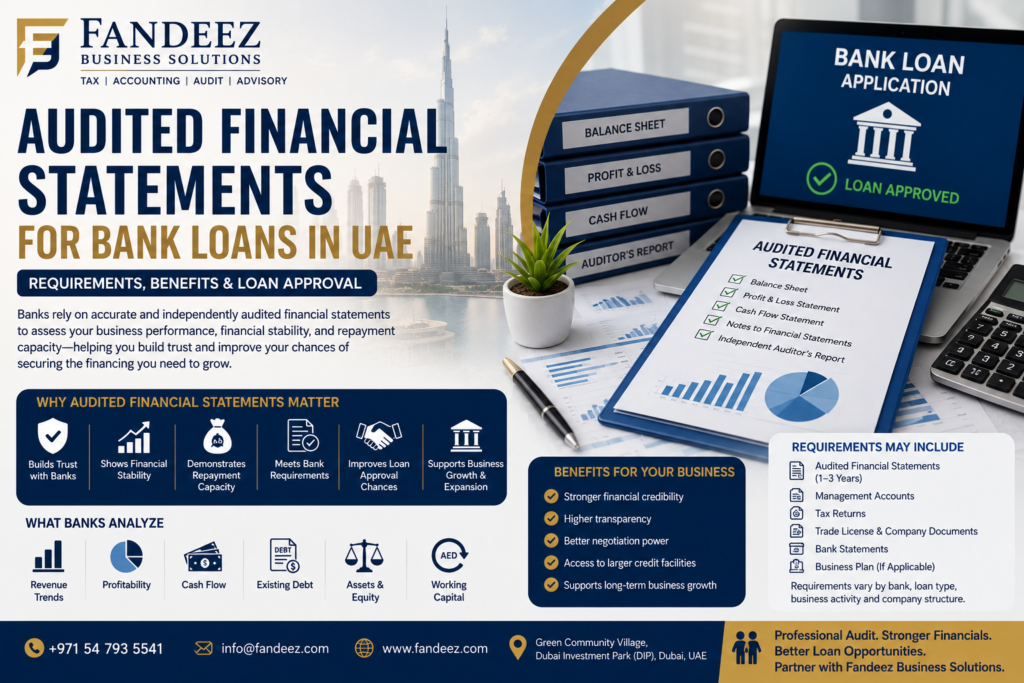
Balance Sheet (Statement of Financial Position) Shows the company’s assets, liabilities, and shareholders’ equity at a specific point in time. It provides a snapshot of what the business owns and owes.
Profit & Loss Statement (Income Statement) Reports the company’s revenue, expenses, and profits or losses over a specific period. It indicates whether the business is profitable.
Cash Flow Statement Shows the inflows and outflows of cash, categorized into operating, investing, and financing activities. It reveals the company’s ability to generate cash to meet obligations.
Notes to Financial Statements Provide additional context, explanations, and breakdowns of figures in the primary statements, including accounting policies, contingent liabilities, and related party transactions.
Independent Auditor’s Report The auditor’s opinion on whether the financial statements are free from material misstatement and present a true and fair view. This is the key element that distinguishes audited statements from unaudited ones.
The Role of the External Auditor
An external auditor conducts a systematic examination of a company’s financial records, internal controls, and accounting processes. They test transactions, verify balances, and assess whether the financial statements comply with applicable standards such as IFRS. The auditor’s independent opinion adds credibility and trustworthiness to the financial information.
Why Do UAE Banks Ask for Audited Financial Statements?
Banks are in the business of managing risk. Before lending money, they need to assess whether a business can repay the loan. Audited financial statements provide a reliable, independently verified basis for this assessment.
- Risk Assessment — Audited accounts help banks evaluate the credit risk associated with lending to a particular business. The independent verification reduces the risk that the financial information is inaccurate or misleading.
- Financial Verification — Audited statements confirm that the company’s financial records have been properly examined. This gives banks confidence that the numbers presented are reliable.
- Repayment Capacity Analysis — Banks analyze revenue trends, profitability, cash flow, and existing liabilities to determine whether the business generates sufficient cash to meet loan repayments.
- Business Credibility — Professionally prepared audited accounts demonstrate that the business takes its financial reporting seriously. This enhances the company’s reputation and credibility with lenders.
- Transparency and Due Diligence — Audited financial statements provide transparency into the company’s financial affairs, enabling banks to conduct thorough due diligence.
- Compliance with Internal Policies — Many banks have internal credit policies that require audited financial statements for certain loan amounts or types of financing. This is particularly common for corporate loans, large facilities, and financing for established businesses.
Important: Not every bank requires audited statements for every loan. Requirements vary based on the bank, loan type, company size, financing amount, and business activity.
How Audited Financial Statements Improve Loan Applications
Professionally prepared audited accounts can significantly strengthen a business loan application in several ways.
- Reliable Revenue Figures — Audited statements confirm that reported revenue is supported by proper documentation and has been verified by an independent auditor. This helps banks trust the revenue figures presented.
- Verified Expenses — Expenses have been reviewed and confirmed, reducing the risk of overstated costs or hidden liabilities.
- Accurate Profitability — Audited profit figures provide a clear picture of the business’s earnings capacity, which is a key factor in loan assessment.
- Clear Liabilities — All existing debts and obligations are properly disclosed and verified, helping banks assess the company’s overall debt burden.
- Stronger Financial Documentation — A complete set of audited financial statements with an unqualified auditor’s opinion presents a professional, bank-ready financial package.
- Better Visibility of Cash Flow — Audited cash flow statements provide verified information on the business’s ability to generate cash to service debt.
Important: Audited financial statements do not guarantee loan approval. They improve credibility and support the application, but the final decision depends on multiple factors including the bank’s assessment, loan product terms, and the business’s overall financial profile.
What Do Banks Look for in Audited Financial Statements?
Banks analyze audited financial statements to assess the financial health, stability, and repayment capacity of a business.
Revenue Trends Banks examine revenue over multiple years to identify trends. Stable or growing revenue indicates a healthy business with consistent customer demand. Declining revenue may raise concerns about the business’s viability.
Profitability Banks analyze gross profit, operating profit, and net profit margins. Profitable businesses are generally better positioned to meet debt obligations. Thin or negative margins may indicate financial stress.
Cash Flow Cash flow is one of the most critical indicators for banks. Positive operating cash flow demonstrates that the business generates sufficient cash from its core operations to cover expenses and debt repayments. Negative cash flow may signal liquidity problems.
Existing Debt Banks review the company’s existing debt obligations, including loans, leases, and other liabilities. High debt levels relative to income or equity can be a red flag.
Assets and Equity A strong asset base provides security for the loan. Banks look at the value of assets such as property, equipment, and receivables. Higher equity relative to debt indicates financial strength and lower risk.
Working Capital Working capital — current assets minus current liabilities — indicates the company’s ability to meet short-term obligations. Positive working capital suggests the business can cover its immediate liabilities.
Liquidity Ratios Banks calculate ratios such as the current ratio and quick ratio to assess liquidity. Higher ratios generally indicate better short-term financial health.
Audited vs Unaudited Financial Statements for Bank Loans
| Factor | Audited Financial Statements | Unaudited Financial Statements |
|---|---|---|
| Independent verification | Yes, by a licensed auditor | No external verification |
| External auditor involvement | Yes | No |
| Bank confidence | Generally higher | May vary significantly |
| Financial credibility | Stronger, with an independent opinion | Depends on internal record quality |
| Loan documentation | May satisfy requirements where requested | May not meet specific bank requirements |
| Risk of errors | Lower, due to audit procedures | Higher, may contain unverified errors |
| Cost | Higher, due to audit fees | Lower |
Key Distinction: The fundamental difference is the independent auditor’s opinion. Audited statements provide assurance that the financial information is reliable and free from material misstatement. Unaudited statements are prepared by the business itself and lack external verification, making them less reliable from a bank’s perspective.
What Financial Documents May UAE Banks Request for Business Loans?
While specific requirements vary, UAE banks commonly request the following documents:
- Audited Financial Statements — For the last 2–3 years, including balance sheet, profit & loss, cash flow statement, notes, and auditor’s report.
- Management Accounts — Recent interim financial statements showing current performance.
- Bank Statements — Usually 6–12 months of business bank statements.
- Trade License — Valid trade license from the relevant UAE licensing authority.
- Corporate Documents — Memorandum of Association (MOA), Articles of Association, and register of shareholders/directors.
- Tax Registration Details — VAT registration certificate and Corporate Tax registration details.
- VAT Returns — Filed VAT returns for the relevant periods.
- Corporate Tax Information — Corporate Tax registration and filings where applicable.
- Existing Loan Details — Information about current loans, credit facilities, and repayment history.
- Business Ownership Information — Details of shareholders, directors, and ultimate beneficial owners.
- Cash Flow Projections — Forecasted cash flows for the next 12–24 months, particularly for new financing.
- Business Plan — For startup financing or significant expansion loans.
Important: Document requirements vary by bank, loan product, business activity, and company structure. Always confirm specific requirements with your chosen bank.
Are Audited Financial Statements Mandatory for Every UAE Business Loan?
There is no single requirement that applies identically to every UAE business loan application. Whether audited statements are required depends on several factors:
- Bank — Each bank has its own credit policy and documentation requirements.
- Loan Type — Working capital facilities, trade finance, and term loans may have different requirements.
- Company Size — Larger companies are more likely to require audited accounts.
- Business Activity — Certain regulated sectors may require audited statements.
- Financing Amount — Larger loan amounts typically require more rigorous documentation.
- Company Age — Established businesses with a track record may be asked for audited accounts.
- Credit Profile — Businesses with a strong credit history may be subject to less scrutiny.
- Financial History — Businesses with solid financial records may be able to provide alternative documentation.
General Best Practice: Even when not mandatory, audited financial statements can significantly enhance a loan application by providing independent verification of the business’s financial health.
Why Banks May Reject or Question Unaudited Financial Statements
Banks may express concern or request additional information when presented with unaudited financial statements due to the lack of independent verification.
- Limited Independent Verification — Without an auditor’s opinion, the bank has no independent confirmation that the financial information is accurate.
- Inconsistent Accounting Records — Unaudited statements may contain errors, omissions, or inconsistencies that undermine their reliability.
- Missing Supporting Documentation — The business may not have adequate documentation to support the figures presented.
- Unclear Liabilities — Unaudited statements may not fully disclose contingent liabilities, off-balance sheet items, or other obligations.
- Revenue Inconsistencies — Revenue figures may not be verifiable without supporting documentation.
- Weak Bookkeeping — Poor record-keeping practices may indicate broader financial management issues.
- VAT or Tax Record Mismatches — Inconsistencies between financial statements and filed tax returns can raise concerns.
Important: Some banks may accept unaudited statements for smaller loans or established relationships, while others may require audited accounts for all corporate lending. The approach varies between institutions.
How IFRS-Compliant Financial Statements Support Bank Financing
IFRS (International Financial Reporting Standards) is the accounting framework widely used in the UAE for financial reporting.
Benefits of IFRS-Compliant Statements
- Consistent Presentation — IFRS provides a standardized framework for preparing financial statements, making them easier for banks to understand and compare.
- Transparency — IFRS requires comprehensive disclosures, providing banks with more complete information about the company’s financial position.
- Comparability — IFRS-compliant statements allow banks to compare financial information across businesses, sectors, and periods.
- Financial Reporting Quality — IFRS promotes high-quality financial reporting with clear accounting policies and consistent application.
Important: Not every UAE business must use IFRS in exactly the same way. Applicable reporting requirements depend on the entity type, licensing authority, and circumstances. Businesses should confirm their specific reporting obligations.
How VAT and Corporate Tax Records Affect Loan Applications
Consistency across financial records is critical when applying for bank financing.
Why Consistency Matters
Banks may cross-reference financial statements with VAT returns, Corporate Tax records, and bank statements. Discrepancies can trigger additional questions or documentation requests.
VAT Records
Financial statements should align with filed VAT returns. Unexplained differences between reported revenue in financial statements and VAT returns can raise concerns. Our VAT services in Dubai team can help ensure your returns and financial statements stay aligned.
Corporate Tax Records
As Corporate Tax becomes established in the UAE, banks may increasingly review tax filings to verify the accuracy of financial information. See our Corporate Tax services for registration and filing support.
Best Practice
Maintain consistency across all financial records, including bookkeeping, financial statements, VAT returns, Corporate Tax filings, and bank statements.
Common Financial Mistakes That Can Hurt a UAE Loan Application
- Poor Bookkeeping — Incomplete or inaccurate bookkeeping leads to unreliable financial statements.
- Missing Invoices — Revenue must be supported by proper invoices and documentation.
- Unreconciled Bank Accounts — Bank reconciliations should be current and accurate.
- Incorrect Revenue Recognition — Revenue should be recognized in accordance with applicable accounting standards.
- Unrecorded Liabilities — All debts and obligations must be properly recorded and disclosed.
- VAT Mismatches — Discrepancies between financial statements and VAT returns can raise red flags.
- Incomplete Financial Statements — Missing statements or supporting notes weaken the application.
- Late Audit Preparation — Waiting too long to prepare for the audit can result in rushed, incomplete work.
- Weak Cash Flow Management — Businesses should maintain strong cash flow records and demonstrate good cash management.
- Poor Documentation — All supporting documents should be organized, complete, and readily available.
How to Prepare Your Business for a UAE Bank Loan
- Clean Up Bookkeeping — Ensure all transactions are recorded accurately and completely. Reconcile all accounts.
- Reconcile Bank Accounts — Verify that bank statements match accounting records for all accounts.
- Review Receivables and Payables — Confirm outstanding invoices and bills are properly recorded.
- Verify Tax Records — Ensure VAT returns are filed and consistent with financial records.
- Prepare Financial Statements — Prepare complete financial statements in accordance with applicable standards.
- Complete the Audit Where Required — Engage a licensed auditor to audit the financial statements.
- Review Financial Ratios — Analyze key ratios such as liquidity, profitability, and leverage.
- Organize Supporting Documents — Compile all necessary documentation for the loan application.
- Prepare Cash Flow Projections — Prepare realistic cash flow forecasts to demonstrate repayment capacity. Our feasibility and financial projections service can help build a bank-ready forecast.
- Review the Complete Application — Ensure all information is consistent, accurate, and complete before submission.
How Fandeez Helps Businesses Prepare for Bank Financing
Fandeez Business Solutions is a UAE-based accounting, audit, tax, and business advisory consultancy that helps businesses prepare for bank financing.
Services for Bank Loan Preparation:
- Bookkeeping Cleanup — Reviewing and cleaning up accounting records to ensure accuracy, through our bookkeeping and accounting service.
- Financial Statement Preparation — Preparing complete, accurate financial statements in accordance with applicable standards.
- IFRS-Aligned Reporting — Where applicable, preparing financial statements aligned with IFRS requirements.
- Audit Coordination — Coordinating with licensed auditors to complete the audit process.
- VAT Reconciliation — Ensuring VAT records are consistent with financial statements via our VAT services.
- Corporate Tax Reconciliation — Aligning financial information with Corporate Tax requirements.
- Financial Ratio Analysis — Analyzing financial ratios to identify strengths and areas for improvement.
- Documentation Preparation — Assisting with the preparation of loan application documents.
- Bank-Ready Financial Reporting — Delivering financial reports that meet bank requirements.
- Pre-Loan Financial Health Checks — Reviewing financial position and addressing weaknesses before applying.
Fandeez helps businesses present their financial information in a clear, professional, and credible manner, improving their chances of securing bank financing. Meet the team behind these services.
When Should You Prepare Audited Financial Statements for a Bank Loan?
Businesses should not wait until the final stage of a loan application to prepare audited financial statements. Early preparation allows time to address issues and present the strongest possible application.
Practical Planning:
- Start cleaning up bookkeeping at least 3–6 months before applying for financing.
- Resolve discrepancies early to avoid delays.
- Complete the audit well before the loan application is submitted.
- Gather supporting documents and organize them systematically.
- Address financial weaknesses identified during preparation.
Note: This is a practical planning recommendation, not a universal requirement. The optimal timeline depends on your business’s specific situation and the loan application timeline.
Frequently Asked Questions
1. What are audited financial statements for bank loans in UAE? Audited financial statements are financial reports independently reviewed and verified by a licensed auditor. They provide banks with reliable, objective information about a business’s financial health.
2. Do UAE banks require audited financial statements for business loans? Not always. Requirements vary by bank, loan type, company size, and financing amount. Larger loans and corporate facilities are more likely to require audited accounts.
3. Why do banks ask for audited accounts? Banks request audited accounts to independently verify financial information, assess repayment capacity, evaluate risk, and comply with internal credit policies.
4. What financial statements do banks review? Banks typically review the balance sheet, profit & loss statement, cash flow statement, notes, and auditor’s report.
5. Can a business get a loan without audited financial statements? Yes, depending on the bank, loan type, and amount. Some banks accept unaudited statements for smaller loans or established relationships.
6. What documents are required for a UAE business loan? Commonly requested documents include audited financial statements, management accounts, bank statements, trade license, corporate documents, and tax registration details.
7. Do audited financial statements improve loan approval chances? Yes. Audited statements enhance credibility and provide banks with verified financial information, which supports the loan application. However, they do not guarantee approval.
8. What do UAE banks look for in financial statements? Banks look for revenue trends, profitability, cash flow, existing debt, assets, equity, and working capital.
9. How long should a business prepare before applying for a loan? Businesses should ideally start preparation 3–6 months before applying to clean up bookkeeping, resolve issues, and complete the audit if required.
10. How can Fandeez help prepare financial statements for bank financing? Fandeez provides bookkeeping cleanup, financial statement preparation, audit coordination, tax reconciliation, and bank-ready financial reporting services.
Prepare for Bank Financing with Fandeez
Securing a bank loan in the UAE requires more than just a good business idea — it requires credible, professionally prepared financial information. Audited financial statements provide banks with the confidence they need to consider your loan application seriously.
Planning to apply for bank financing in the UAE? Let Fandeez help you prepare with professional bookkeeping cleanup, financial statement preparation, audit coordination, and bank-ready financial reporting.
Get in touch with our team today to start preparing your loan application.