

Table of Contents
ToggleYear-End Audit Preparation UAE: Complete Checklist for a Smooth Process
For many UAE business owners, the mention of a “year-end audit” can trigger feelings of stress and overwhelm. You might be worried about piles of invoices, complex tax laws, or the fear of an auditor finding a mistake. However, with the right preparation, this annual requirement can become a straightforward and even beneficial process that strengthens your business’s credibility.
In the UAE’s dynamic financial landscape, proper Year-End Audit Preparation UAE is no longer just a regulatory checkbox; it’s a sign of a mature, well-managed company. With the introduction of UAE Corporate Tax and increased scrutiny from the Federal Tax Authority (FTA), having audited financial statements is a strategic asset.
Whether you are a startup in a Free Zone, a growing SME on the Mainland, or an established enterprise, this comprehensive checklist will guide you through everything you need for a successful audit. And remember, you don’t have to do it alone. Fandeez Business Solutions is here to help you navigate the complexities of audit preparation with confidence and ease — starting with a review of your bookkeeping to make sure your records are audit-ready.
Why Is Year-End Audit Important in the UAE?
Before diving into the checklist, it’s crucial to understand why an audit matters. An audit provides an independent, objective assessment of your company’s financial health and ensures that your records are accurate, complete, and compliant with International Financial Reporting Standards (IFRS).
Who requires an audit in the UAE?
The requirement for an audit in the UAE depends on your company’s legal structure and activities:
Free Zone Companies: A statutory audit is a mandatory requirement for virtually all companies registered in UAE Free Zones (e.g., DMCC, IFZA, JAFZA, DSO, etc.). You must submit audited financial statements to your respective Free Zone authority as a condition for renewing your trade license. Missing the deadline can block license renewal and, by extension, visa processing for you and your employees.
Mainland Companies: While the UAE Commercial Companies Law doesn’t universally mandate an external audit for all LLCs, it is practically required in many scenarios. This includes applying for bank financing, participating in government tenders, and satisfying investor or shareholder requirements. Furthermore, the FTA may view the availability of audited accounts as a sign of strong compliance. If your revenue exceeds AED 50 million, you are also legally required to submit audited financial statements with your corporate tax return.
Regulated Businesses: Entities in financial free zones like DIFC and ADGM, or those regulated by the Securities and Commodities Authority (SCA), are subject to strict audit requirements.
Qualifying Free Zone Persons (QFZPs): To maintain a 0% corporate tax rate, QFZPs must undergo an annual audit to prove they meet the substance and qualifying income requirements.
Even if not legally required, many businesses opt for an audit voluntarily. It improves internal controls, provides a clear financial picture for management, and can help identify areas for cost savings and efficiency.
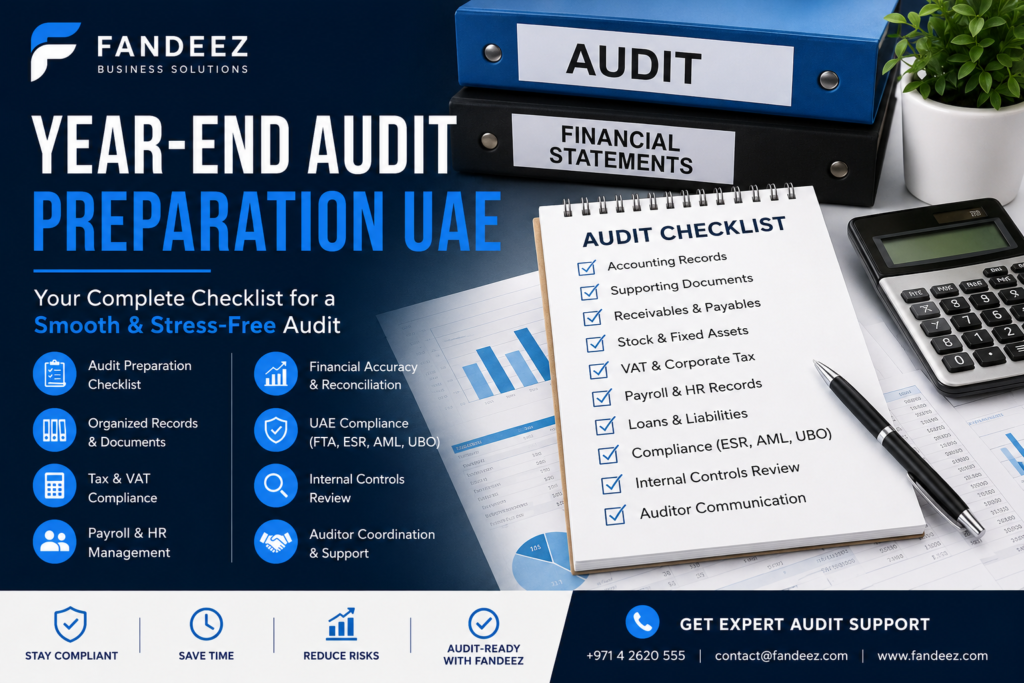
Complete Year-End Audit Preparation Checklist UAE
Use this Year-End Audit Checklist UAE to ensure your finances are in perfect order before the auditor arrives. The key to a stress-free audit is to maintain these records throughout the year, rather than scrambling at the last minute.
1. Update and Reconcile Accounting Records Ensure all transactions up to the year-end date are accurately recorded in your accounting system. This is the foundation of your entire audit. If your books are messy, your audit will be lengthy and expensive.
2. Perform Bank Reconciliations Reconcile all your bank accounts for the entire financial year. Investigate and resolve any outstanding items or discrepancies. Unreconciled bank accounts are one of the most common causes of audit delays.
3. Accounts Receivable Review Review your aged debtor list. Identify any old or doubtful debts. You may need to calculate a provision for expected credit losses (ECL).
4. Accounts Payable Review Review your list of suppliers and creditors. Ensure all outstanding liabilities are recorded and support by purchase orders and invoices.
5. Inventory/Stock Count If your business holds stock, perform a physical inventory count. Ensure the quantities on your balance sheet match the physical count and are valued correctly (cost or net realisable value, whichever is lower).
6. Fixed Asset Register Maintain a detailed fixed asset register (FAR). Include all additions and disposals during the year and ensure depreciation is calculated correctly.
7. Corporate Tax Records Review your corporate tax position. Identify any non-deductible expenses, review related-party transactions, and ensure all documentation is in place for transfer pricing (if applicable). Fandeez’s Corporate Tax compliance services can help you get this section right before the auditor asks.
8. VAT Records and Reconciliations Reconcile your VAT returns filed with the FTA to your accounting records. Confirm that your output VAT matches your invoices and your input VAT is supported by valid tax invoices.
9. Payroll and Employee-Related Records Compile all payroll records, including WPS reports, salary slips, and employment contracts. Recalculate your End of Service Benefits (EOSB) provision.
10. Bank Loans and Liabilities Obtain statements from banks for all loans. Confirm the outstanding balances and interest calculations.
11. Related-Party Transactions Document any transactions with related parties (e.g., shareholders, directors, group companies). Auditors will scrutinize these to ensure they are at arm’s length and properly disclosed.
12. UBO, AML, and Other Applicable Compliance Records Ensure your Ultimate Beneficial Owner (UBO) declarations and Anti-Money Laundering (AML) policies and risk assessments are up to date. This is a key part of regulatory compliance.
13. Management Reports & Internal Controls Prepare draft management accounts for the year. Document your internal control procedures (e.g., segregation of duties, approvals for payments).
14. Auditor Communication Engage your auditor early. Don’t wait until December for a December year-end. This secures their availability and gives you a clear timeline.
Documents Required for a UAE Year-End Audit
To streamline the process, your auditors will provide a “Prepared by Client” (PBC) list. Common documents include:
- Legal Documents: Trade license, Memorandum & Articles of Association (MOA), VAT registration certificate, and Corporate Tax registration number.
- Financial Records: Trial balance, general ledger, and draft financial statements.
- Banking: Complete bank statements for all accounts and bank confirmation letters.
- Receivables/Payables: Aged lists of debtors and creditors.
- Payroll: Employee contracts, salary records (WPS), and EOSB calculations.
- Tax: All submitted VAT returns and corporate tax returns.
- Assets: Fixed asset register and depreciation schedule.
Common Year-End Audit Mistakes UAE Businesses Should Avoid
Unreconciled Bank Accounts: Failing to reconcile accounts regularly leaves discrepancies that are time-consuming to fix.
Missing Invoices: Losing invoices, especially for input VAT claims, can lead to penalties and denied deductions.
Incorrect VAT Records: Mismatches between filed returns and accounting records are a red flag for auditors and the FTA.
Unrecorded Liabilities: Forgetting to accrue for expenses like rent or utilities at year-end gives a misleading picture of your financial position.
Old Receivables: Not making provisions for doubtful debts can lead to misstated assets and audit adjustments.
Last-Minute Preparation: Trying to compile everything a week before the audit starts is a recipe for stress and errors. Start preparing months in advance.
How to Make the UAE Audit Process Faster and Easier
Start Early: Ideally, start your internal preparation 2-3 months before your financial year-end.
Use Accounting Software: Cloud-based software like QuickBooks or Xero, used throughout the year, makes reconciliation and document retrieval much easier. Fandeez’s accounting system setup service can help you choose and configure the right platform.
Engage Your Auditor Early: Contact your auditor well in advance to discuss timelines and any specific concerns.
Organize a “Data Room”: Use a secure cloud folder to organize all your documents in one place.
Partner with Fandeez: The most effective way to ensure a smooth audit is to work with professionals who understand the UAE landscape.
How Fandeez Helps Businesses Prepare for Year-End Audit
Fandeez Business Solutions is a trusted UAE-based accounting, tax, and audit support provider. We take the stress out of Year-End Audit Preparation UAE. Our team of expert accountants and tax consultants work alongside you and your auditor to ensure a seamless experience.
Our year-end audit support services include:
- Accounting Cleanup: We review and correct your bookkeeping to ensure it’s accurate and audit-ready.
- Audit Schedules: We prepare detailed, auditor-ready schedules for fixed assets, payables, receivables, and more.
- VAT and Corporate Tax Reconciliation: We ensure your tax records are fully reconciled with your financials, minimizing compliance risk.
- Fixed Asset and Inventory Support: We help you calculate depreciation, conduct stock counts, and value inventory correctly.
- Auditor Coordination: We act as the primary point of contact for your auditors, answering their queries and providing documentation promptly.
- Final Audit Adjustments: We help post any final audit adjustment entries to your books.
By partnering with Fandeez, you can focus on running your business while we ensure your financials are in perfect shape for the annual audit.
Frequently Asked Questions
What is year-end audit preparation in the UAE? Year-end audit preparation is the process of organizing and finalizing your company’s financial records, supporting documents, and tax filings in advance of an external audit. It ensures your books are accurate, complete, and ready for the auditor’s review, minimizing delays and potential issues.
Is an annual audit mandatory for every UAE company? No. While a statutory audit is mandatory for Free Zone companies, regulated entities, and businesses with revenue over AED 50 million, it is not a universal requirement for all Mainland LLCs. However, it is commercially essential for bank financing, investor relations, and is highly recommended for good governance.
What documents are required for a UAE audit? Auditors typically request a range of documents including, but not limited to, your trade license, Memorandum of Association, all bank statements, trial balance, general ledger, aged debtor and creditor lists, payroll records, VAT returns, fixed asset register, and key contracts.
How long does a UAE company audit take? The duration of an audit varies depending on the size and complexity of your business. However, an audit typically takes between 2 to 6 weeks to complete. The most significant factor influencing this timeline is the quality of your record-keeping and preparation.
How can I prepare my company for an annual audit? You can prepare by maintaining clean accounting records throughout the year, reconciling bank accounts monthly, storing all invoices and contracts in an organized manner, and engaging an auditor early. A professional audit support firm like Fandeez can also prepare you directly for the process.
Does Corporate Tax require audited financial statements? Yes, for some businesses. Under the UAE Corporate Tax Law, companies with revenue exceeding AED 50 million are required to submit audited financial statements with their tax return. For QFZPs, an audit is a condition for maintaining the 0% tax rate.
Do Free Zone companies need an annual audit? Yes. Virtually all UAE Free Zones mandate an annual audit as a condition for the renewal of your trade license. The audited financial statements must be submitted by the authority’s deadline, which is typically 90 days after the financial year-end.
What happens if financial records are not ready for the audit? If your records are incomplete or not ready, the audit will be delayed. This can cause significant problems, including failing to meet your license renewal deadline, incurring late submission penalties, and potentially blocking your access to government services.
Conclusion
Preparing for your year-end audit in the UAE doesn’t have to be a daunting task. By following this comprehensive Year-End Audit Checklist UAE, you can transform the process from a source of stress into a strategic advantage for your business.
The key is proactive preparation: maintaining accurate records throughout the year, reconciling your accounts regularly, and understanding your specific obligations under UAE law.
For a truly hassle-free experience, let Fandeez Business Solutions be your partner in audit preparation. Our expert team ensures your financials are compliant, accurate, and ready for any auditor’s scrutiny.