

Table of Contents
ToggleUAE Taxes 2026: Complete Guide for Business & Individuals
Introduction
If you’re running a business in the UAE, planning to invest here, or simply moving to Dubai or Abu Dhabi for work, one question comes up almost immediately: what are the taxes in the UAE, exactly?
The UAE has built its reputation as one of the world’s most tax-friendly economies. But “tax-friendly” doesn’t mean “tax-free” anymore. Since 2018, the country has introduced VAT, and since 2023, Corporate Tax — and the rules keep evolving heading into 2026.
For business owners, freelancers, startups, and foreign investors, misunderstanding the UAE tax system can lead to real financial risk. Missing a Corporate Tax registration deadline, applying the wrong VAT treatment, or misclassifying a Free Zone entity can all result in penalties from the Federal Tax Authority (FTA).
This guide breaks down every tax that applies in the UAE — who pays it, how much it costs, and how to stay compliant in 2026. Whether you’re an entrepreneur setting up a mainland company, a Free Zone business owner, or a salaried resident wondering about income tax, you’ll find clear answers below.
Quick Answer (AEO Featured Snippet)
The UAE applies a small number of taxes: 9% Corporate Tax on business profits above AED 375,000, 5% VAT on most goods and services, Excise Tax on harmful products like tobacco and sugary drinks, and Customs Duty on imports. There is no personal income tax, no salary tax, and no capital gains tax on individuals in the UAE.
UAE Tax Overview Table
Tax Type | Rate | Who Pays | Registration Requirement |
Corporate Tax | 0% up to AED 375,000; 9% above that | Companies, freelancers with licenses, and certain individuals earning business income | Mandatory for all taxable persons |
Value Added Tax (VAT) | 5% (standard); 0% on some goods/services | Businesses supplying taxable goods/services above the threshold | Mandatory above AED 375,000 turnover; voluntary above AED 187,500 |
Excise Tax | 50%–100% depending on product | Producers/importers of tobacco, energy drinks, carbonated drinks, sweetened drinks | Mandatory before dealing in excise goods |
Customs Duty | Typically 5% on CIF value | Importers of goods into the UAE | Import code registration via customs authority |
Tourism Fees / Municipality Fees | Varies by emirate (e.g., Dubai Tourism Dirham) | Hotel guests and hospitality businesses | Collected by hotels/establishments |
Domestic Minimum Top-up Tax (DMTT) | 15% | Large multinational groups (revenue ≥ EUR 750 million) | Applies from financial years starting 2025 |
Personal Income Tax | 0% | N/A — no personal income tax in the UAE | Not applicable |
Key takeaway: Most individuals in the UAE pay no direct tax at all. The tax burden mainly falls on businesses, through Corporate Tax and VAT.
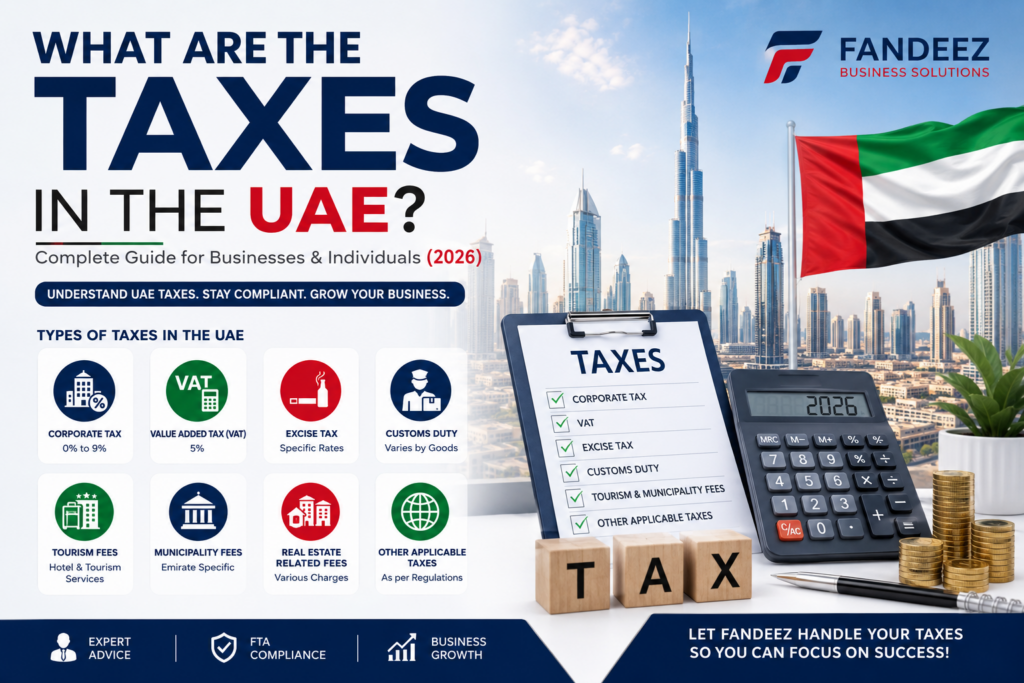
What Are the Taxes in the UAE?
The UAE tax system is built around indirect and business-level taxes rather than taxing individual income. Here’s a breakdown of every major tax currently in effect.
Corporate Tax
A federal tax on the net profit of businesses, introduced in June 2023 and now in its second full compliance cycle heading into 2026. Every taxable business needs to complete Corporate Tax Registration with the FTA, regardless of profit level.
Value Added Tax (VAT)
A 5% consumption tax applied at each stage of the supply chain, in effect since January 2018. Businesses crossing the threshold must complete VAT Registration through EmaraTax.
Excise Tax
A tax on specific goods considered harmful to health or the environment, such as tobacco, energy drinks, and sweetened beverages.
Customs Duty
A duty charged on goods imported into the UAE from outside the GCC common customs zone.
Tourism Fees
Fees charged by hotels and hospitality providers, varying by emirate — for example, Dubai’s Tourism Dirham fee, charged per room per night.
Municipality Fees
Local charges applied by individual emirates, often on utility bills or hospitality services.
Free Zone Tax Rules
Free Zone companies can qualify for a 0% Corporate Tax rate on “Qualifying Income” if they meet strict substance and activity conditions — but non-qualifying income is still taxed at 9%.
Domestic Minimum Top-up Tax (DMTT)
A 15% minimum tax targeting large multinational enterprises, aligning the UAE with the OECD’s global minimum tax framework (Pillar Two).
Key takeaway: The UAE’s tax framework is layered — Corporate Tax and VAT affect most businesses, while Excise Tax, Customs Duty, and DMTT apply to specific sectors or company sizes.
Corporate Tax in UAE
Quick answer: UAE Corporate Tax is a 9% federal tax on business profits exceeding AED 375,000 per year. Profits below that threshold are taxed at 0%. Most businesses, including mainland companies, certain Free Zone entities, and freelancers holding a business license, must register — even if they currently owe no tax.
0% Threshold
Taxable income up to AED 375,000 is taxed at 0%, a relief designed to support startups and small businesses.
9% Corporate Tax
Any taxable income above AED 375,000 is taxed at a flat 9% rate.
Who Must Register
Registration is mandatory for:
- Mainland companies
- Free Zone entities (regardless of Qualifying Free Zone Person status)
- Freelancers and sole establishments holding a commercial or professional license with revenue above the threshold
- Foreign entities with a UAE permanent establishment
Small Business Relief
Businesses with revenue of AED 3 million or less in a tax period can elect to be treated as having no taxable income, effectively paying 0% Corporate Tax. This relief is currently available for tax periods ending before 31 December 2026. Read our full breakdown of UAE Small Business Relief for eligibility details.
Exempt Persons
Government entities, government-controlled entities, extractive businesses, qualifying public benefit entities, and qualifying investment funds may be exempt, subject to conditions.
Filing Requirements
Businesses must file a Corporate Tax return within 9 months of the end of their financial year, even if no tax is due. See our detailed guide on the Corporate Tax Filing Deadline UAE (7-Month Rule) for exact timelines.
Penalties
Late registration, late filing, and inaccurate record-keeping all carry FTA penalties, which can escalate quickly for repeated non-compliance. Check the full Corporate Tax Penalty Amount UAE table, and if you’ve already missed a deadline, our guide on the Corporate Tax Penalty Waiver UAE explains how to apply for relief.
Key takeaway: Even a small business that owes zero Corporate Tax must still register and file — registration is not optional.
VAT in UAE
Quick answer: UAE VAT is a 5% tax charged on most goods and services at each stage of the supply chain. Registration is mandatory once taxable supplies exceed AED 375,000 in a 12-month period, and optional above AED 187,500.
Mandatory Registration
Required once a business’s taxable supplies and imports exceed AED 375,000 over the previous 12 months (or are expected to in the next 30 days).
Voluntary Registration
Available once taxable supplies or expenses exceed AED 187,500 — useful for startups wanting to reclaim input VAT early.
Input VAT
The VAT a business pays on its own purchases and expenses, which can generally be reclaimed if used for taxable business activities.
Output VAT
The VAT a business charges its customers on taxable sales.
Zero-Rated Supplies
Taxed at 0% but still considered taxable — examples include exports outside the GCC, certain healthcare, and international transport.
Exempt Supplies
Not subject to VAT at all — examples include certain financial services, bare land, and local passenger transport.
VAT Filing
Most businesses file VAT returns quarterly, though larger businesses may be required to file monthly. Returns and payments are due within 28 days of the tax period’s end. For the latest rule changes, see our guide on UAE VAT Amendments 2026, covering the reverse charge mechanism and the 5-year refund rule.
Key takeaway: Zero-rated and exempt supplies are often confused — zero-rated supplies still allow input VAT recovery, while exempt supplies generally do not.
Excise Tax
Excise Tax applies to goods the UAE government wants to discourage due to health or environmental impact. Rates include:
- Tobacco products: 100%
- Energy drinks: 100%
- Carbonated drinks: 50%
- Sweetened drinks: 50%
- Electronic smoking devices and liquids: 100%
Businesses that produce, import, stockpile, or release these goods from a designated zone must register for Excise Tax before conducting these activities. Excise-liable businesses should also be aware of the e-Invoicing UAE mandate, which is reshaping how transactions are reported to the FTA.
Customs Duty
Most imports into the UAE are subject to a standard 5% customs duty on the CIF (Cost, Insurance, Freight) value of goods. Certain goods, like alcohol and tobacco, attract higher rates.
Because the UAE is part of the GCC Common Customs Union, goods moving between GCC countries that have already had duty paid are generally not re-taxed at internal borders. Free Zone companies can also benefit from customs duty suspension on goods that remain within the Free Zone or are re-exported.
Tourism & Municipality Taxes
Hospitality businesses in the UAE apply several additional charges on top of VAT:
- Tourism Dirham Fee (Dubai): A per-room, per-night charge ranging based on hotel classification.
- Municipality Fee: Often around 7% on hotel services in some emirates.
- Service Charge: Commonly 10%, applied by hotels and restaurants.
- City Tax / Destination Fees: Vary by emirate, such as Abu Dhabi’s tourism fees.
These charges are collected by the hospitality provider and are separate from the 5% VAT applied to the overall bill.
Do Individuals Pay Tax in the UAE?
Quick answer: No. The UAE does not levy personal income tax, salary tax, wealth tax, or inheritance tax on individuals. Residents and expatriates keep 100% of their salary income, regardless of how much they earn.
No Personal Income Tax
Salaries, wages, and employment income are not taxed at the federal level.
No Salary Tax
There is no payroll tax deducted from employee wages in the UAE.
No Wealth Tax
Personal assets, property, and savings are not subject to an annual wealth tax.
No Inheritance Tax
Assets passed on after death are not taxed by the UAE government, though Sharia-based succession rules may apply depending on individual circumstances.
Capital Gains Considerations
Individuals generally don’t pay capital gains tax on personal investments. However, if an individual conducts business activity (such as regular property trading or holding a business license) and their revenue exceeds the Corporate Tax threshold, that income could fall under Corporate Tax rules.
Key takeaway: The absence of personal income tax applies to individuals, not businesses — anyone operating under a trade license is treated differently.
UAE Tax Registration Process
Quick answer: Corporate Tax and VAT registration in the UAE are both completed through the FTA’s EmaraTax portal, requiring a trade license, Emirates ID, passport copies, and financial details. Corporate Tax registration is mandatory for nearly all businesses, while VAT registration depends on revenue thresholds.
Corporate Tax Registration
- Create or log in to an EmaraTax account
- Add the business entity and select “Corporate Tax” registration
- Submit trade license, Memorandum of Association, and owner/shareholder details
- Receive a Corporate Tax Registration Number (TRN)
VAT Registration
- Log in to EmaraTax
- Select “VAT” registration and confirm eligibility (mandatory or voluntary)
- Submit turnover declarations, bank details, and trade license
- Receive a VAT TRN upon approval
Required Documents
- Valid trade license
- Emirates ID and passport copies of owners/managers
- Memorandum of Association (MOA)
- Financial statements or projected revenue
- Bank account details
FTA Portal
All registrations, filings, and payments are processed through EmaraTax, the FTA’s official digital platform.
Key takeaway: Businesses should register for Corporate Tax as soon as they receive their trade license — waiting until profits appear is a common and costly mistake.
Tax Compliance Tips
- Register for Corporate Tax immediately after incorporation, even if you expect zero tax liability
- Keep digital, audit-ready financial records for at least 7 years
- Reconcile VAT input and output figures every quarter before filing
- Track the Small Business Relief threshold (AED 3 million) closely if revenue is growing
- Confirm Free Zone “Qualifying Income” status annually, as conditions can change
- Set calendar reminders for the 9-month Corporate Tax filing deadline
- Use accounting software or a professional accountant rather than manual spreadsheets
- Review FTA circulars regularly, as UAE tax rules continue to evolve
- Avoid the errors covered in our guide on common bookkeeping mistakes UAE businesses make
Common Tax Mistakes
- Not registering for Corporate Tax because a business assumes zero profit means no obligation
- Missing VAT registration thresholds by not tracking rolling 12-month turnover
- Confusing zero-rated and exempt supplies, leading to incorrect input VAT claims
- Poor bookkeeping, making it impossible to substantiate deductions during an audit
- Assuming all Free Zone income is automatically tax-free, without meeting substance requirements
- Filing VAT returns late, resulting in avoidable fines
- Ignoring related-party transaction documentation, which can trigger Transfer Pricing UAE scrutiny
- Mixing personal and business expenses, which complicates both VAT and Corporate Tax calculations
Why Choose Fandeez Business Solutions?
Navigating UAE Corporate Tax, VAT, and compliance requirements can be time-consuming and risky without expert guidance. Fandeez Business Solutions offers end-to-end support so you can focus on running your business:
- Accounting & Bookkeeping — accurate, audit-ready financial records
- VAT Registration — fast, correctly structured EmaraTax registration
- Corporate Tax Registration — handled from documentation to TRN issuance
- VAT Filing — timely, accurate quarterly or monthly returns
- Corporate Tax Filing — full return preparation and submission
- Audit Support — preparation and representation during FTA reviews
- Tax Planning — legitimate strategies to optimize your tax position
- Business Advisory — guidance on structuring, Free Zone qualification, and growth
With deep, up-to-date knowledge of FTA regulations, Fandeez helps businesses across the UAE stay compliant while avoiding unnecessary penalties.
Frequently Asked Questions
- What are the taxes in the UAE? The UAE applies Corporate Tax (9% above AED 375,000), VAT (5%), Excise Tax on specific goods, Customs Duty on imports, and various tourism/municipality fees. There is no personal income tax.
- Is there income tax in the UAE? No. The UAE does not charge personal income tax on salaries or wages for residents or expatriates.
- What is the Corporate Tax rate in the UAE for 2026? The rate remains 0% on profits up to AED 375,000 and 9% on profits above that threshold, unless a business falls under the 15% Domestic Minimum Top-up Tax as a large multinational.
- Do Free Zone companies pay tax in the UAE? Free Zone companies can qualify for 0% tax on Qualifying Income if they meet substance and activity requirements, but non-qualifying income is taxed at 9%, and all Free Zone entities must still register.
- What is the VAT rate in the UAE? The standard VAT rate is 5%, with some goods and services zero-rated or exempt.
- Who needs to register for VAT in the UAE? Businesses with taxable supplies exceeding AED 375,000 in the past 12 months must register; those above AED 187,500 may register voluntarily.
- What happens if I don’t register for Corporate Tax on time? Late registration triggers an administrative penalty from the FTA, and continued non-compliance can lead to further fines and enforcement action.
- Does the UAE tax freelancers? Yes, if a freelancer holds a business or professional license and their income exceeds the Corporate Tax threshold, they must register and may owe Corporate Tax.
- Is there capital gains tax in the UAE? Individuals generally don’t pay capital gains tax on personal investments, but gains connected to a licensed business activity can fall under Corporate Tax.
- What is Small Business Relief in the UAE? It allows businesses with revenue of AED 3 million or less to elect to be treated as having no taxable income, available for tax periods ending before 31 December 2026.
- How often do I need to file VAT returns? Most businesses file quarterly, though some are required to file monthly depending on FTA classification.
- What is the Domestic Minimum Top-up Tax? A 15% minimum tax applying to large multinational groups with global revenue of EUR 750 million or more, effective for financial years starting on or after 1 January 2025.
Conclusion
Understanding what taxes apply in the UAE — and to whom — is essential for staying compliant and avoiding costly penalties in 2026. While individuals continue to enjoy a tax-free income environment, businesses must navigate Corporate Tax, VAT, and sector-specific taxes with care and accuracy.
Whether you’re registering a new company, unsure about your VAT obligations, or need help filing your Corporate Tax return correctly, Fandeez Business Solutions is here to help. Contact Fandeez Business Solutions today for expert guidance on UAE tax, VAT, accounting, and compliance — and keep your business fully compliant, penalty-free, and ready to grow.