

Table of Contents
ToggleComplete Guide to the Reverse Charge Mechanism in UAE (2026)
Introduction
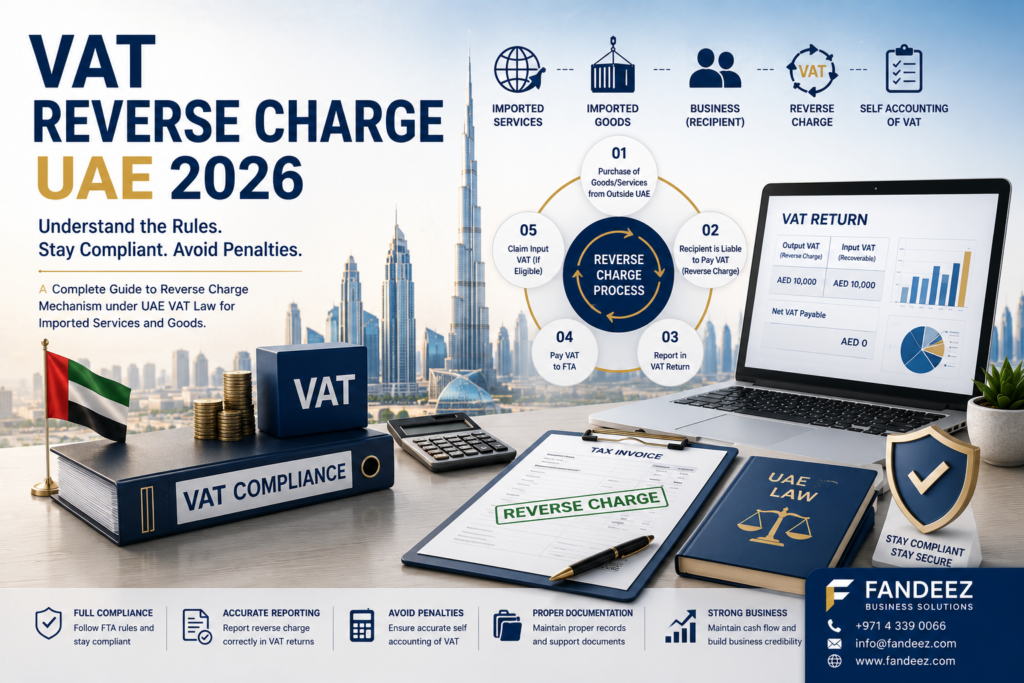
VAT Reverse Charge UAE is a rule that shifts the responsibility for accounting for VAT from the seller to the buyer. Instead of the supplier charging VAT on the invoice, the UAE business receiving the goods or services calculates the VAT itself and reports it directly to the Federal Tax Authority (FTA). The mechanism exists mainly to handle cross-border transactions, where a foreign supplier has no UAE VAT registration and cannot legally charge UAE VAT — as well as a growing list of specific domestic supplies the government has flagged as high-risk for tax evasion.
This affects far more businesses than most owners realize. Importers, exporters, mainland companies, and Free Zone entities can trigger reverse charge obligations without noticing — a foreign software subscription or consulting invoice is often enough. Since amendments to the VAT Law took effect on 1 January 2026, documentation and reporting rules have changed too. Getting this wrong leads to underpaid VAT, denied input tax recovery, and FTA penalties. This guide from Fandeez Business Solutions explains exactly how VAT Reverse Charge UAE works in 2026, who it applies to, and how to report it correctly.
What is VAT Reverse Charge UAE?
Quick Answer: VAT Reverse Charge UAE is a mechanism under Article 48 of the UAE VAT Law where the buyer, rather than the seller, accounts for VAT on a transaction. The buyer self-declares the VAT due and, where eligible, recovers it as input tax in the same return — usually resulting in a net-zero cash impact for fully taxable businesses.
The mechanism is set out in the UAE’s Federal Decree-Law No. 8 of 2017 on Value Added Tax, with the Cabinet and Ministry of Finance issuing Executive Regulations that define which supplies fall under it. Amendments through Federal Decree-Law No. 16 of 2025, effective 1 January 2026, updated how the mechanism operates, including removing a long-standing self-invoicing requirement.
A foreign supplier with no UAE presence generally cannot register for UAE VAT or issue a UAE-compliant tax invoice. Without reverse charge, VAT on these transactions would go uncollected. By shifting the reporting obligation to the UAE-based recipient, the FTA ensures VAT is captured on imported goods and services, and on specific domestic supplies the Cabinet has flagged for extra oversight.
How the Reverse Charge Mechanism Works in the UAE
Quick Answer: Under reverse charge, the buyer calculates VAT on the value of the supply, reports it as output VAT in their VAT return, and — if the purchase relates to taxable business activity — simultaneously claims the same amount as input VAT, creating a net-zero effect for most fully taxable businesses.
Here’s the self-accounting process in practice:
- A UAE business receives goods or services from a foreign supplier, or from a domestic supplier under a designated reverse charge category.
- The supplier’s invoice does not include UAE VAT.
- The UAE business calculates VAT (standard rate of 5%, unless zero-rated or exempt) on the value of the supply.
- This amount is declared as output VAT in the relevant box of the VAT return.
- If the purchase was made for taxable business purposes, the same amount is claimed as input VAT in the same return.
- The net cash effect is typically zero — but the transaction must still be correctly reported, even though no additional VAT is physically paid.
A key change took effect on 1 January 2026: businesses are no longer required to issue a self-invoice. Previously, the recipient had to generate a tax invoice to itself as evidence of the reverse charge. Now, the FTA accepts standard supporting documentation — supplier invoices, contracts, purchase orders, and import records — provided it clearly shows the transaction value, date, and nature of supply.
Reverse Charge Self-Accounting Steps
Step | Action | Responsible Party |
1 | Receive invoice without UAE VAT | Foreign or domestic RCM supplier |
2 | Calculate VAT on supply value | UAE recipient business |
3 | Declare output VAT in VAT return | UAE recipient business |
4 | Claim matching input VAT (if eligible) | UAE recipient business |
5 | Retain supporting documents | UAE recipient business |
6 | Review and process return | Federal Tax Authority |
Practical Example: A Dubai-based marketing agency pays AED 20,000 to a US-based software provider for an annual subscription used in its business. No UAE VAT appears on the invoice. The agency must calculate 5% VAT (AED 1,000) under reverse charge, declare it as output VAT, and — since the subscription is used for taxable business purposes — claim the same AED 1,000 as input VAT in the same return.
When Does the Reverse Charge Mechanism Apply?
Quick Answer: Reverse charge applies mainly to imported goods and services from foreign suppliers, plus a specific, expanding list of domestic B2B supplies the UAE government has designated — including precious metals and stones, certain hydrocarbons, electronic devices, and, from January 2026, scrap metal.
- Imported Services – Any service bought from a supplier outside the UAE for business use, such as consulting, software, digital marketing, or licensing fees, generally falls under reverse charge.
- Imported Goods – Goods brought into the UAE from outside the country for business purposes are treated as a reverse-charge supply the importer makes to itself.
- Cross-Border Transactions – Purchases from suppliers in other GCC states or outside the GCC where the supplier has no UAE VAT registration are typically subject to RCM.
- Designated Goods (Domestic Reverse Charge) – The UAE Cabinet has extended domestic reverse charge to specific high-risk categories over time, including precious metals and precious stones (with the scope widened in February 2025), certain hydrocarbons and energy products, electronic devices (since October 2023), and ferrous and non-ferrous scrap metal (from 14 January 2026).
- B2B Transactions – Reverse charge generally applies between VAT-registered businesses; supplies to non-registered consumers work differently and are usually not subject to RCM in the same way.
Example: A Sharjah-based jewellery trading company buys gold bullion from another UAE-registered supplier for resale. Under the designated domestic reverse charge rules for precious metals, the supplier does not charge VAT — the buyer accounts for it instead, provided the buyer intends to resell or further process the metal.
Who Must Apply VAT Reverse Charge UAE?
Quick Answer: VAT-registered businesses in the UAE — mainland companies, most Free Zone entities, and importers — must apply reverse charge whenever they receive qualifying imported or domestically designated supplies from a supplier who has not charged UAE VAT.
- VAT-Registered Businesses – Any taxable person with an active TRN receiving a qualifying supply must self-account for VAT.
- Mainland Companies – Standard commercial entities importing goods or services routinely encounter reverse charge obligations.
- Free Zone Companies – Generally subject to the same reverse charge rules as mainland companies, though treatment can vary for entities in Designated Zones — this needs case-by-case review.
- Importers – Businesses recorded as the importer of record are responsible for declaring and paying VAT on imported goods.
- Foreign Suppliers – Non-resident suppliers without UAE VAT registration do not charge UAE VAT; the obligation passes to the UAE recipient instead.
How to Report Reverse Charge in a UAE VAT Return
Quick Answer: Reverse charge transactions are reported within the standard VAT Return (Form VAT 201) — not a separate form — with the VAT declared as output tax in the imports/reverse charge section and, where eligible, claimed back as input tax in the same return.
- VAT Return Boxes – Imports of goods are typically reported in the imports section of the VAT 201 return, while other reverse-charge supplies appear in the relevant output VAT boxes.
- Output VAT – The VAT calculated on the reverse-charge supply must be declared as output tax, even though the supplier never charged it.
- Input VAT – Where the purchase relates to taxable supplies, the equivalent amount can usually be claimed as input tax in the same period.
- Accounting Treatment – Ledgers should reflect both the output VAT liability and the corresponding input VAT claim.
- Record Keeping – Since self-invoicing is no longer required from 2026, supplier invoices, contracts, and import documentation now carry the full evidentiary weight.
Documents Required
Quick Answer: Businesses applying reverse charge should retain supplier invoices, customs and import documentation, and internal accounting records that clearly show the transaction value, date, and nature of supply — since self-invoicing is no longer mandatory from 2026.
Use this checklist:
- Supplier’s original invoice (even without UAE VAT shown)
- Customs declarations and shipping documents for imported goods
- Contracts or purchase agreements supporting the transaction
- Proof of payment to the foreign or domestic supplier
- Internal accounting entries showing output and input VAT postings
- Filed VAT returns (Form VAT 201) reflecting the reverse-charge amounts
- Correspondence or purchase orders where a formal invoice is unavailable
Expert Tip: If a supplier invoice doesn’t include all required details, keep alternative documentation — emails, purchase orders, or bank records — that clearly evidence the transaction value and nature of supply. Fandeez’s Accounting & Bookkeeping team can help set up a reverse-charge documentation trail that satisfies FTA expectations.
Common Reverse Charge Mistakes
- Forgetting to apply reverse charge on imported services, not just goods
- Failing to declare output VAT because no invoice shows a VAT amount
- Claiming input VAT without first declaring the matching output VAT
- Missing the extended domestic reverse charge categories, like precious metals or scrap metal
- Continuing to self-invoice unnecessarily after the 2026 rule change, creating confusion in records
- Poor documentation once self-invoicing was removed, leaving no audit trail
- Applying reverse charge on B2C transactions where it does not apply
- Misreporting reverse charge in the wrong VAT return box
- Overlooking reverse charge on exempt or partially exempt purchases, which blocks full input VAT recovery
- Assuming reverse charge always nets to zero, even when the purchase relates to exempt supplies
- Inconsistent treatment across Free Zone entities without checking Designated Zone rules
If any of these sound familiar, Fandeez’s FTA Compliance Support service can review past returns and correct reporting errors before they trigger an audit.
Best Practices for VAT Compliance
- Maintain Proper Bookkeeping – Record every reverse-charge transaction with matching output and input VAT entries, even when the net effect is zero.
- Reconcile VAT Regularly – Cross-check import records and foreign supplier invoices against VAT returns each period.
- Strengthen Internal Controls – Train procurement and finance teams to flag purchases from foreign or domestic RCM-designated suppliers.
- Keep Documentation Audit-Ready – Supporting documents are now the primary evidence the FTA will review, since self-invoicing is no longer required.
- Undertake Periodic Compliance Reviews – A VAT health check can catch missed reverse-charge transactions early. Fandeez’s VAT Advisory team offers this as part of ongoing support.
Reverse Charge vs Normal VAT
Aspect | Reverse Charge VAT | Normal VAT |
Who charges VAT | Supplier does not charge VAT | Supplier charges VAT on the invoice |
Who pays VAT | Buyer self-accounts and pays | Supplier collects and remits VAT |
Accounting treatment | Buyer records both output and input VAT | Supplier records output VAT; buyer records input VAT only |
Typical scenario | Imported services/goods, designated domestic supplies | Standard domestic B2B or B2C sales |
Reporting requirement | Declared in VAT return by the buyer | Declared in VAT return by the supplier |
Net cash impact | Usually zero for fully taxable businesses | VAT collected from customer, then remitted |
How Fandeez Business Solutions Can Help
Reverse charge is one of the most commonly misapplied areas of UAE VAT — not because the concept is complicated, but because it’s easy to miss a transaction entirely. Fandeez Business Solutions supports businesses across every part of VAT compliance:
- VAT Registration – Ensuring your business is correctly registered to apply reverse charge rules.
- VAT Return Filing – Accurate VAT 201 submissions that correctly capture reverse-charge transactions.
- VAT Advisory – Practical guidance on which of your imports and domestic purchases fall under reverse charge.
- Accounting & Bookkeeping – Clean records that stand up to FTA scrutiny, especially now that self-invoicing is optional.
- Corporate Tax Services – Coordinated VAT and corporate tax compliance under one strategy.
- Financial Reporting – Clear visibility into your reverse-charge exposure across import and domestic transactions.
- Tax Planning – Structuring purchasing decisions with reverse-charge implications in mind.
- FTA Compliance Support – Support during FTA queries or audits related to reverse-charge treatment.
If you’re not confident every reverse-charge transaction in your business is being reported correctly, contact Fandeez Business Solutions today for a VAT review.
Frequently Asked Questions
- What is VAT Reverse Charge UAE? A rule under Article 48 of the UAE VAT Law where the buyer, not the seller, accounts for and reports VAT on a transaction — typically imported goods and services.
- Who should apply the Reverse Charge Mechanism? Any VAT-registered UAE business receiving qualifying imported or domestically designated supplies.
- Does Reverse Charge apply to imported services? Yes — software, consulting, and digital marketing bought from a foreign supplier for UAE business use generally fall under reverse charge.
- Does it apply to imported goods? Yes. Goods imported into the UAE for business purposes are treated as a reverse-charge supply the importer makes to itself.
- How is Reverse Charge reported? Within the standard VAT Return (Form VAT 201), with output VAT declared and matching input VAT claimed where eligible.
- Is VAT still payable under reverse charge? VAT must still be declared, though for fully taxable businesses output and input VAT often offset to a net-zero cash impact.
- What records should businesses maintain? Supplier invoices, import/customs documents, contracts, and accounting entries showing both output and input VAT treatment.
- What happens if Reverse Charge is reported incorrectly? Businesses risk underpaid VAT, denied input tax recovery, and FTA penalties.
- Do businesses still need to issue a self-invoice? No. From 1 January 2026, self-invoicing was removed; supplier invoices and supporting documentation are used instead.
- Does Reverse Charge apply to Free Zone companies? Generally yes, though Designated Zone rules for specific goods may affect treatment and should be reviewed case by case.
- Which domestic supplies are subject to Reverse Charge? Precious metals and stones, certain hydrocarbons, electronic devices, and, from January 2026, scrap metal, among other Cabinet-designated categories.
- Can input VAT always be recovered under reverse charge? No. If the purchase relates to exempt supplies, recovery may be restricted, making the reverse-charge VAT a real cost.
- How can businesses stay compliant with Reverse Charge rules? Train procurement and finance teams to flag foreign and domestic RCM purchases, maintain documentation, and reconcile VAT returns regularly.
- Should companies seek professional VAT advice on Reverse Charge? Yes — given how easily these transactions are missed or misreported, professional review is strongly recommended.
- Where can businesses find official guidance on Reverse Charge? The Federal Tax Authority’s official website (tax.gov.ae) and published Executive Regulations and Cabinet Decisions.
Conclusion
VAT Reverse Charge UAE touches nearly every business that imports goods, buys services from overseas, or trades in specific domestically designated categories like precious metals or scrap metal. With self-invoicing removed from 1 January 2026, the burden has shifted further onto good record-keeping and accurate VAT return reporting.
Getting reverse charge right means training your team to spot qualifying transactions, keeping solid documentation, and reconciling your VAT returns every period. Fandeez Business Solutions helps UAE businesses manage VAT Registration, VAT Returns, VAT Advisory, Accounting, Bookkeeping, and Corporate Tax compliance under one roof. Contact our team today to make sure your reverse-charge transactions are fully compliant.