

Table of Contents
ToggleComplete Process, Requirements, Documents & Deadlines
VAT Deregistration in UAE is the formal process of cancelling a business’s VAT registration and deactivating its Tax Registration Number (TRN) with the Federal Tax Authority (FTA). Businesses need to go through this process when taxable supplies drop below the relevant threshold, when a business stops making taxable supplies altogether, or when a VAT-registered entity simply no longer meets the conditions that required registration in the first place.
Getting this process right matters. Deregistering late, applying with an incorrect effective date, or leaving VAT returns unfiled can result in administrative penalties—even after the business has genuinely stopped trading. And deregistering incorrectly can leave gaps that surface later, during a review of outstanding filings or an FTA query.
This guide walks through when deregistration applies, how the EmaraTax process works, what’s required, and what happens once the TRN is cancelled. Where professional support is useful, Fandeez Business Solutions can help businesses through each step.
What Is VAT Deregistration in UAE?
VAT deregistration is a tax-registration process, not a business closure process. It cancels a company’s VAT registration status and TRN with the FTA, meaning the business is no longer required to charge VAT on its supplies, file VAT returns, or maintain a registered VAT account going forward.
This is an important distinction to make clearly: VAT deregistration is not the same as cancelling a trade licence or liquidating a company. A business can deregister for VAT while its trade licence remains active—for example, if its taxable turnover has simply dropped below the registration threshold. Equally, a business that is closing down entirely will usually need to handle VAT deregistration as one part of a broader closure process, alongside trade licence cancellation and any other regulatory steps, rather than treating VAT deregistration alone as sufficient to wind up the company.
When Is VAT Deregistration Required in the UAE?
Whether deregistration is required—or simply available—depends on how the business’s taxable supplies compare to the UAE VAT thresholds.
- Mandatory VAT registration threshold: AED 375,000 in taxable supplies and imports over a rolling 12-month period.
- Voluntary VAT registration threshold: AED 187,500 in taxable supplies and imports (or expenses) over a rolling 12-month period.
Mandatory deregistration generally applies where:
- The business stops making taxable supplies altogether, or
- Taxable supplies over the previous 12 months, and the anticipated supplies over the next 30 days, fall below the mandatory registration threshold of AED 375,000
Voluntary deregistration may be available where:
- The business was voluntarily registered and at least 12 months have passed since that registration, and
- Taxable supplies fall below the voluntary registration threshold of AED 187,500
The key difference is straightforward: mandatory deregistration is a legal obligation once the relevant conditions are met, while voluntary deregistration is an option a business may choose to exercise if it’s eligible, but isn’t required to.
Who Can Apply for VAT Deregistration?
A VAT deregistration application can generally be submitted by:
- The taxable person themselves, through their EmaraTax account, or
- An authorised signatory acting on the business’s behalf, or
- A registered tax agent appointed by the business
Before applying, the business should confirm it genuinely meets either the mandatory or voluntary deregistration conditions—applying without meeting the eligibility criteria can result in the application being rejected or delayed pending clarification.
Mandatory vs Voluntary VAT Deregistration
| Aspect | Mandatory Deregistration | Voluntary Deregistration |
|---|---|---|
| Eligibility | Business ceases taxable supplies, or turnover falls below AED 375,000 | Turnover falls below AED 187,500, and at least 12 months have passed since voluntary registration |
| Turnover condition | Below AED 375,000 mandatory threshold, or no taxable supplies | Below AED 187,500 voluntary threshold |
| Compulsory? | Yes — legally required within the applicable deadline | No — the business may choose to apply |
| Key consideration | Missing the deadline triggers a late deregistration penalty | Deregistering removes the ability to reclaim input VAT going forward, so timing should reflect the business’s actual plans |
Documents Required for VAT Deregistration in UAE
The exact documents requested can vary depending on the reason for deregistration and the FTA’s review of the specific application. Businesses should generally be prepared to provide:
- Trade licence copy (and any licence cancellation certificate, if the business has closed)
- Copy of Emirates ID and passport of the authorised signatory
- Financial records supporting the turnover decline or cessation of taxable supplies
- Details or evidence of the last taxable transaction, where relevant
- Bank statements or other financial statements supporting the reason for deregistration
- Board resolution or similar authorisation, where applicable to the entity type
- Any FTA correspondence or prior clarification requests relevant to the application
Additional documents may be requested depending on the business’s circumstances or if the FTA needs further clarification—businesses shouldn’t assume a fixed, universal checklist applies to every case.
VAT Deregistration Process in UAE
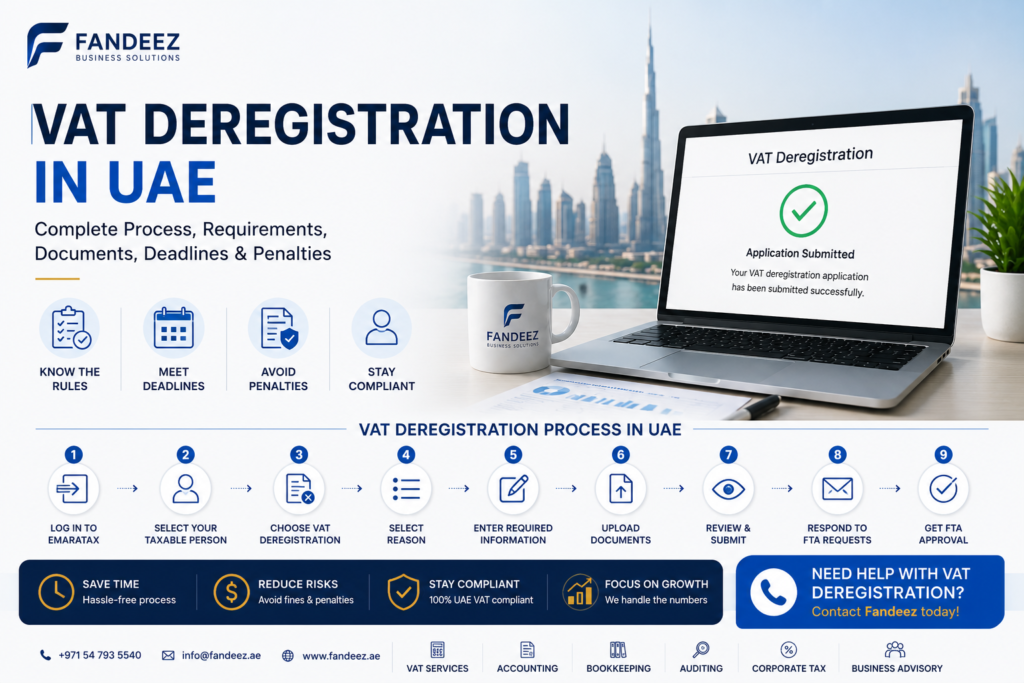
The current VAT deregistration process is completed through the FTA’s EmaraTax portal. While the exact interface may be updated by the FTA from time to time, the general steps are:
- Log in to EmaraTax using the business’s registered credentials.
- Select the relevant VAT taxable person or account the deregistration application relates to.
- Choose the VAT deregistration option within the account’s VAT services.
- Select the appropriate deregistration reason—for example, cessation of taxable supplies or turnover falling below the applicable threshold.
- Enter the required information, including the effective date being requested and supporting details.
- Provide financial or turnover information where the application requires evidence of the relevant threshold condition.
- Upload supporting documents as prompted by the portal.
- Review and submit the application for FTA processing.
- Monitor the application status on EmaraTax and respond promptly to any FTA requests for clarification or additional documents.
Once the FTA reviews the application, it may approve the deregistration, request further information, or issue a pre-approval subject to the business filing its final VAT return and settling any outstanding liabilities before deregistration is finalised.
VAT Deregistration Deadline in UAE
Where deregistration is mandatory, the business is generally required to submit its deregistration application within 20 business days of becoming eligible—that is, from the date the business either stops making taxable supplies or its turnover falls below the mandatory threshold.
Missing this deadline matters. The FTA can treat a late application as a compliance failure and apply an administrative penalty, even if the underlying reason for deregistering (reduced turnover or ceased trading) is genuine and undisputed. Businesses that anticipate becoming eligible for deregistration should track the relevant dates closely rather than waiting until the deadline is close.
VAT Deregistration Penalties in UAE
Several potential consequences apply if deregistration isn’t handled correctly or on time:
- Late deregistration penalty: where a mandatory deregistration application is submitted after the 20-business-day deadline, the FTA can apply a penalty of AED 1,000 for the first month of delay, plus AED 1,000 for each additional month, up to a maximum of AED 10,000. This penalty is separate from any other outstanding VAT liability.
- Outstanding VAT liabilities: any VAT still owed must be settled as part of, or before, the deregistration process is finalised.
- Late VAT return filing: if returns remain unfiled at the time of deregistration, standard late-filing penalties can apply in addition to the deregistration penalty.
- Other compliance consequences: unresolved errors in previous returns, or incomplete documentation, can delay approval of the deregistration application itself.
Penalty amounts and structures are set under UAE Cabinet Decisions governing administrative penalties, which have been updated in 2026. Because these frameworks can be revised, businesses should confirm the current applicable amounts before relying on any specific figure, and should treat penalty exposure as a strong reason to apply within the required timeframe rather than delaying.
What Happens After VAT Deregistration?
Deregistration isn’t the final step—several obligations follow:
- Final VAT return: the business must generally file a final VAT return covering the period up to the effective deregistration date, including any deemed supply adjustments where applicable (such as on remaining business assets).
- Payment of outstanding VAT: any VAT due, including amounts arising from the final return, must be settled.
- Input VAT adjustments: where applicable, the business may need to account for adjustments relating to previously reclaimed input VAT on assets still held at deregistration.
- Record keeping: VAT records must still be retained for the legally required period after deregistration, even though the business is no longer VAT-registered.
- Effective deregistration date: the FTA determines the effective date, which may differ from the date the business requested, and this date determines the cut-off for VAT obligations.
- TRN status: once deregistration is finalised, the TRN becomes inactive, and the business should stop issuing tax invoices or charging VAT from that date.
- Continuing obligations: the business remains responsible for any historical VAT compliance issues, FTA correspondence, or audits relating to periods when it was registered, even after the TRN is cancelled.
Common VAT Deregistration Mistakes
Businesses commonly run into avoidable issues during this process:
- Applying for deregistration when the eligibility conditions aren’t actually met
- Missing the 20-business-day mandatory deregistration deadline
- Requesting or accepting an incorrect effective date without checking its implications
- Submitting the application with incomplete or inaccurate VAT returns still outstanding
- Leaving outstanding VAT liabilities unresolved
- Providing inaccurate turnover figures to support the application
- Missing required supporting documents, delaying approval
- Ignoring or delaying responses to FTA clarification requests
- Assuming VAT deregistration automatically closes the company or cancels the trade licence
VAT Deregistration and VAT Return Filing
VAT returns and deregistration are closely linked, and businesses should not treat them as separate, unconnected tasks. All VAT returns due up to the point of deregistration—including the final return covering the period ending on the effective deregistration date—must be filed, and any VAT due must be settled. Outstanding returns or unpaid VAT can delay or block the deregistration application from being finalised, so reconciling filing history before applying is a practical first step, not an afterthought.
VAT Deregistration vs Business Closure in UAE
These are related but distinct processes, and confusing them can leave gaps in a business’s compliance obligations.
| Process | What It Covers | What It Does Not Cover |
|---|---|---|
| VAT Deregistration | Cancels VAT registration and TRN with the FTA | Does not cancel the trade licence or dissolve the legal entity |
| Trade Licence Cancellation | Cancels the business’s commercial licence with the relevant licensing authority | Does not automatically cancel VAT or Corporate Tax registration |
| Company Liquidation / Business Closure | Formally winds up and dissolves the legal entity | Requires VAT deregistration, Corporate Tax deregistration, and licence cancellation as separate supporting steps |
A business that is closing down completely typically needs to address all three—VAT deregistration, Corporate Tax deregistration where applicable, and trade licence cancellation—as coordinated but distinct steps in the overall closure process.
How Fandeez Can Help With VAT Deregistration in UAE
Fandeez Business Solutions supports UAE businesses through the VAT deregistration process from start to finish, helping avoid the timing and documentation issues that commonly cause delays or penalties.
Our support includes:
- Eligibility assessment, confirming whether mandatory or voluntary deregistration genuinely applies to your situation
- EmaraTax application support, guiding the submission through the current portal process
- Document preparation, making sure supporting evidence is complete and consistent
- VAT return review, checking that filing history is accurate and up to date before applying
- Outstanding VAT compliance, helping resolve any unpaid liabilities or unfiled returns that could delay approval
- FTA communication, responding to clarification requests promptly and accurately
- Post-deregistration compliance guidance, covering final return obligations and ongoing record-keeping requirements
If your VAT deregistration is part of a broader business wind-down, our business advisory team can also help coordinate the process alongside trade licence cancellation and other closure steps. And where deregistration decisions intersect with your wider VAT services or accounting needs, we can support the full picture rather than treating deregistration in isolation.
Frequently Asked Questions About VAT Deregistration in UAE
What is VAT deregistration in UAE? It’s the formal process of cancelling a business’s VAT registration and Tax Registration Number (TRN) with the FTA, after which the business is no longer required to charge VAT or file VAT returns.
When should a business deregister for VAT? When taxable supplies fall below the mandatory threshold, when the business stops making taxable supplies entirely, or—if eligible for voluntary deregistration—when the business chooses to do so after meeting the relevant conditions.
What is the VAT deregistration threshold in UAE? Mandatory deregistration is generally linked to taxable supplies falling below AED 375,000 over a rolling 12-month period; voluntary deregistration is linked to the AED 187,500 threshold, subject to the 12-month minimum registration period.
How do I deregister for VAT through EmaraTax? By logging into EmaraTax, selecting the relevant VAT account, choosing the deregistration option, providing the required information and supporting documents, and submitting the application for FTA review.
What documents are required for VAT deregistration? Commonly requested documents include the trade licence, authorised signatory identification, financial records supporting the reason for deregistration, and any relevant FTA correspondence—exact requirements can vary by case.
Is there a penalty for late VAT deregistration? Yes. Where mandatory deregistration isn’t applied for within the required 20-business-day period, the FTA can apply a penalty starting at AED 1,000 for the first month of delay, increasing monthly up to a cap of AED 10,000.
How long does VAT deregistration take? Processing times vary depending on the completeness of the application and whether the FTA requests further clarification, so businesses should apply promptly and respond quickly to any follow-up requests.
Can I deregister for VAT if my business is still operating? Yes, if the business genuinely meets the deregistration conditions—for example, if taxable turnover has fallen below the relevant threshold—even while trading activity continues.
Does VAT deregistration cancel my trade licence? No. VAT deregistration only affects VAT registration status with the FTA; the trade licence remains active unless cancelled separately through the relevant licensing authority.
Do I need to file a final VAT return after deregistration? Yes. A final VAT return covering the period up to the effective deregistration date is generally required, and any outstanding VAT must be settled as part of the process.
Conclusion
VAT Deregistration in UAE is a formal, deadline-driven process that requires careful attention to eligibility, documentation, and outstanding VAT obligations—not simply a box to tick once a business slows down or stops trading. Getting the effective date, final return, and supporting records right protects the business from unnecessary penalties and keeps its compliance history clean going forward.
Whether you’re approaching the mandatory deregistration deadline, considering voluntary deregistration, or managing VAT as part of a broader business closure, working through the process carefully—or with experienced support—makes a meaningful difference.