

Table of Contents
ToggleUAE Small Business Relief Extended to 2029
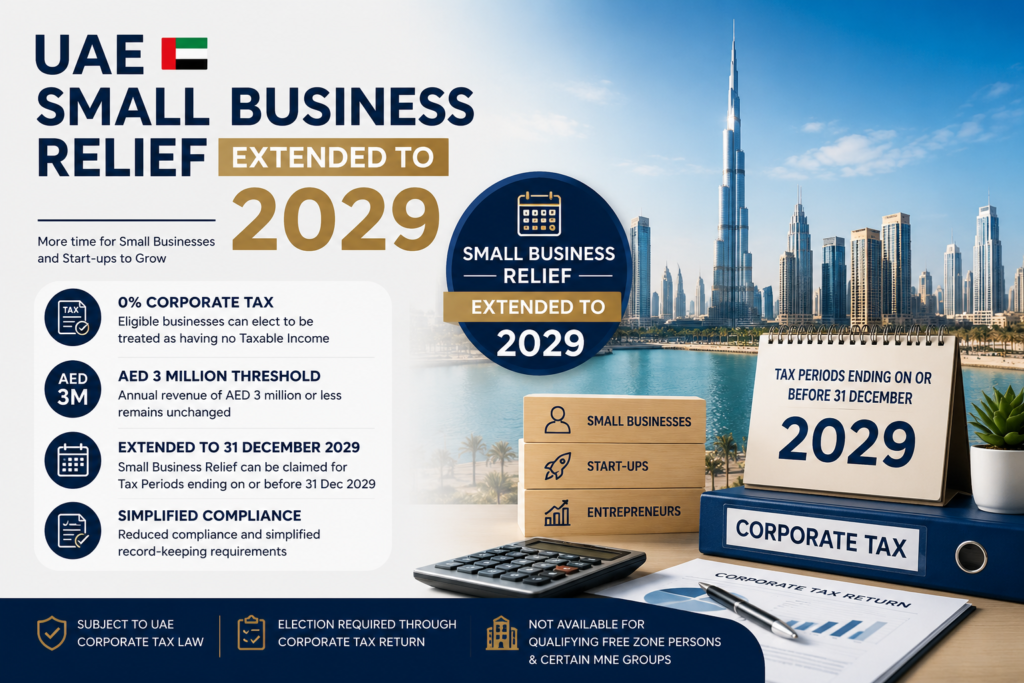
On 7 August 2026, the UAE Ministry of Finance announced that Small Business Relief — one of the most important compliance measures under the UAE Corporate Tax Law — has been extended for another three years. Under Ministerial Decision No. 131 of 2026, eligible businesses can now claim UAE Small Business Relief for tax periods ending on or before 31 December 2029, instead of the previous cut-off of 31 December 2026.
This is welcome news for small businesses, freelancers, entrepreneurs and start-ups across Dubai, Abu Dhabi, Sharjah, Ajman and the wider UAE, many of whom rely on Small Business Relief to reduce their Corporate Tax burden and simplify their compliance obligations.
However, the extension does not change who qualifies, and it does not make the relief automatic. In this guide, we break down what UAE Small Business Relief is, what has changed, who can (and cannot) claim it, and how eligible businesses can formally elect for it through their Corporate Tax return.
What Is UAE Small Business Relief?
UAE Small Business Relief is a Corporate Tax relief under Article 21 of Federal Decree-Law No. 47 of 2022, allowing eligible Resident Persons with Revenue below a set threshold to elect to be treated as having no Taxable Income for a Tax Period.
In simple terms, if a business meets all the conditions and successfully elects for Small Business Relief, it does not need to calculate Taxable Income or pay Corporate Tax on its profits for that Tax Period. It also benefits from simplified compliance requirements, which can significantly reduce the administrative burden on small businesses and start-ups. If you’re still getting to grips with the basics, our Corporate Tax services page breaks down how the UAE Corporate Tax regime applies to different business types.
Small Business Relief was introduced to support the UAE’s smallest taxpayers as the Corporate Tax regime came into effect for tax periods beginning on or after 1 June 2023, recognising that very small businesses often lack the resources for complex tax accounting.
It is important to understand that Small Business Relief is a relief, not an exemption. The underlying obligations under the UAE Corporate Tax Law — including registration, filing, and record-keeping — remain fully in place.
What Changed in UAE Small Business Relief 2026?
Ministerial Decision No. 131 of 2026 extends the period during which Small Business Relief can be claimed to tax periods ending on or before 31 December 2029, three years beyond the original 31 December 2026 sunset date.
The decision amends Ministerial Decision No. 73 of 2023, which originally introduced Small Business Relief and set its initial application window.
What Changed
- The Small Business Relief window has been extended from tax periods ending on or before 31 December 2026 to tax periods ending on or before 31 December 2029.
- Businesses now have three additional years of potential eligibility, provided they continue to meet the conditions in each relevant Tax Period.
- Free Zone Persons who elect for Small Business Relief have more time before any related restriction on Qualifying Free Zone Person (QFZP) status affects them, reducing the risk of a “relief gap” between the two regimes.
What Stayed the Same
- The AED 3 million annual Revenue threshold remains unchanged.
- The relief still applies to Tax Periods commencing on or after 1 June 2023.
- All other eligibility conditions, exclusions, and the election requirement remain exactly as they were under Ministerial Decision No. 73 of 2023.
- Small Business Relief is still not available to Qualifying Free Zone Persons or excluded members of a Multinational Enterprise (MNE) Group.
In short: the deadline moved, the rules did not.
What Is the AED 3 Million Small Business Relief Threshold?
The AED 3 million Small Business Relief threshold refers to the maximum annual Revenue an eligible business can earn in a Tax Period — and in previous relevant Tax Periods — while still qualifying for the relief.
To elect for Small Business Relief, a Taxable Person’s Revenue must not exceed AED 3 million in:
- The current relevant Tax Period, and
- Each previous Tax Period falling within the relief’s application window (Tax Periods beginning on or after 1 June 2023).
Example
A small marketing consultancy in Dubai reports:
| Tax Period | Revenue |
|---|---|
| 2023 | AED 1.8 million |
| 2024 | AED 2.4 million |
| 2025 | AED 2.9 million |
Since Revenue stayed below AED 3 million in every relevant Tax Period, the business may potentially elect for Small Business Relief for 2025, subject to meeting the other eligibility conditions.
Why Previous Tax Periods Matter
A common misunderstanding is that only the current year’s Revenue matters. In reality, the FTA’s guidance is clear that revenue from previous relevant Tax Periods is also considered. This means a business that exceeded AED 3 million in an earlier period may lose eligibility for Small Business Relief in a later period, even if current-year Revenue has since dropped below the threshold. This is a key reason businesses should track Revenue carefully across every Tax Period, not just the most recent one.
Who Is Eligible for Small Business Relief UAE?
To be eligible for Small Business Relief, a business generally needs to meet the following conditions:
- Resident Person status — The applicant must be a UAE Resident Person for Corporate Tax purposes.
- Natural or juridical persons — Both individuals (such as freelancers and sole establishment owners) and juridical persons (such as LLCs) may potentially qualify, provided all conditions are met.
- Revenue threshold — Revenue must not exceed AED 3 million in the relevant Tax Period and all applicable previous Tax Periods.
- Relevant Tax Periods — The Tax Period must fall within the window now extended to 31 December 2029.
- Corporate Tax registration — The business must be registered for Corporate Tax with the Federal Tax Authority (FTA). If you haven’t registered yet, our Corporate Tax registration support can help you avoid late-registration penalties.
- Election through the Corporate Tax return — Eligible businesses must actively elect for Small Business Relief when filing their Corporate Tax return; it is not applied by default.
Because eligibility depends on multiple interacting factors — Revenue history, entity type, and exclusions — it is advisable to review each Tax Period individually rather than assuming continued eligibility.
Who Cannot Claim Small Business Relief?
Certain categories of businesses are specifically excluded from Small Business Relief, regardless of their Revenue level.
Qualifying Free Zone Persons (QFZPs)
A Qualifying Free Zone Person cannot elect for Small Business Relief. QFZPs already benefit from a separate Corporate Tax regime — the 0% rate on Qualifying Income under the Free Zone framework — and Small Business Relief is designed for Resident Persons outside that regime. A Free Zone company that has not elected, or does not qualify, for QFZP status may still be assessed against the standard Small Business Relief conditions.
Members of Multinational Enterprise (MNE) Groups
Businesses that form part of a Multinational Enterprise Group meeting the applicable consolidated group Revenue condition are also excluded from Small Business Relief. This exclusion is intended to keep the relief targeted at genuinely small, independent businesses rather than smaller UAE entities belonging to large international corporate structures.
If your business operates within a Free Zone or is part of a wider international group, it is worth having your specific structure reviewed before assuming Small Business Relief applies.
Is Small Business Relief Automatic?
No. Small Business Relief is never automatic — it must be actively elected through the Corporate Tax return for each relevant Tax Period.
This is one of the most misunderstood aspects of the relief. Meeting the Revenue threshold alone does not mean tax is automatically reduced to zero. There are four separate steps involved, and businesses often confuse them:
- Being eligible — Meeting the Revenue threshold and other conditions.
- Registering for Corporate Tax — A mandatory obligation for almost all UAE businesses, regardless of Small Business Relief eligibility.
- Filing a Corporate Tax return — Required for every Tax Period, even if Small Business Relief is ultimately claimed.
- Electing for Small Business Relief — A specific choice made within the Corporate Tax return itself.
A business can be eligible and still fail to benefit from the relief simply by not making the election correctly, or by missing the filing deadline. This is why professional guidance during the return preparation stage matters.
How to Apply for Small Business Relief Through EmaraTax
Here is a practical step-by-step approach for reviewing and claiming Small Business Relief:
- Check Revenue eligibility — Confirm total Revenue for the relevant Tax Period does not exceed AED 3 million.
- Review previous Tax Periods — Verify Revenue in all earlier relevant Tax Periods also stayed within the threshold.
- Confirm the business is not excluded — Rule out Qualifying Free Zone Person status and MNE Group membership.
- Maintain appropriate financial records — Even with simplified compliance, accurate bookkeeping is still required to support Revenue figures. Our UAE accounting and bookkeeping services can help you keep records audit-ready.
- Complete the Corporate Tax return — File through the FTA’s EmaraTax portal within the applicable deadline. Our Corporate Tax return filing support covers this step end-to-end.
- Elect for Small Business Relief — Actively select the Small Business Relief option within the Corporate Tax return; this step is not optional or automatic.
- Retain supporting documentation — Keep Revenue records, invoices, and financial statements in case of an FTA review.
Businesses unfamiliar with EmaraTax, or unsure whether their Revenue calculation is correct, often benefit from working with a qualified UAE tax consultancy to avoid errors in the return.
What Happens If Revenue Exceeds AED 3 Million?
If a business’s Revenue exceeds AED 3 million in the relevant Tax Period, it becomes ineligible for Small Business Relief for that period and must calculate and pay Corporate Tax under the standard rules.
This means Taxable Income above AED 375,000 becomes subject to Corporate Tax at the standard rate, and full compliance requirements — including detailed Taxable Income computation — apply for that Tax Period.
Example
A boutique interior design studio in Sharjah generates:
- 2024 Revenue: AED 2.6 million (eligible)
- 2025 Revenue: AED 3.2 million (exceeds threshold)
For the 2025 Tax Period, the studio would no longer be able to elect for Small Business Relief, even though it qualified the previous year. It would need to calculate Taxable Income and comply with the standard Corporate Tax filing requirements for that period.
Because Revenue can fluctuate, especially for growing businesses, it is wise to monitor Revenue throughout the Tax Period rather than only at year-end, so there are no surprises when it is time to file.
Small Business Relief UAE 2029: What Does the Extension Mean for Start-Ups?
The extension to 2029 offers several practical advantages for UAE start-ups, freelancers and entrepreneurs:
- More planning time — Businesses now have visibility on Small Business Relief availability for the next several years, rather than facing an imminent 2026 cut-off.
- Reduced Corporate Tax burden for eligible businesses — Qualifying businesses may continue to avoid Taxable Income calculations for years to come.
- Lower administrative pressure — Simplified compliance reduces the accounting workload for very small operations.
- Better cash-flow planning — Predictability around tax treatment supports more accurate financial forecasting.
- More certainty for entrepreneurs — Founders can factor Small Business Relief into medium-term business plans with greater confidence.
- Additional time for businesses to grow — Start-ups have a longer runway to scale before potentially outgrowing the AED 3 million threshold.
It is worth stressing that this extension does not mean every business under AED 3 million automatically pays zero Corporate Tax. Eligibility still depends on meeting every condition, and the election must still be made correctly each year. Our tax planning and consulting services can help growing start-ups map out their Corporate Tax position well before Revenue approaches the threshold.
UAE Corporate Tax 0% Small Business Relief — Is It Really 0% Tax?
Where Small Business Relief is validly elected, the eligible business is treated as having no Taxable Income for that Tax Period — but this is not the same as a blanket 0% tax status or an exemption from compliance.
The “0%” outcome only applies where:
- The business meets every eligibility condition, and
- The election is correctly made in the Corporate Tax return for that specific Tax Period.
Even where Small Business Relief results in no Taxable Income, the business must still:
- Remain registered for Corporate Tax.
- File a Corporate Tax return for the relevant Tax Period.
- Maintain financial records sufficient to support the Revenue figures reported.
- Reassess eligibility for every subsequent Tax Period, since Small Business Relief is elected period by period, not once and forever.
Small Business Relief reduces the tax and compliance burden — it does not remove the underlying legal relationship between the business and the Federal Tax Authority.
Small Business Relief Eligibility UAE — Quick Checklist
Use this checklist as a starting point to assess potential eligibility:
- Is the business a UAE Resident Person for Corporate Tax purposes?
- Is the business registered for Corporate Tax with the FTA?
- Did Revenue stay at or below AED 3 million in the current relevant Tax Period?
- Did Revenue stay at or below AED 3 million in all previous relevant Tax Periods?
- Is the Tax Period within the extended window (ending on or before 31 December 2029)?
- Is the business not a Qualifying Free Zone Person?
- Is the business not part of an excluded Multinational Enterprise Group?
- Are financial records available to support the Revenue figures reported?
- Will the election for Small Business Relief be made within the Corporate Tax return?
If you answered “yes” to all of the above, your business may potentially qualify — but final confirmation should always be based on a detailed review of your specific facts against current FTA and Ministry of Finance guidance.
Frequently Asked Questions
1. What is UAE Small Business Relief? UAE Small Business Relief is a Corporate Tax relief under Article 21 of the UAE Corporate Tax Law that allows eligible Resident Persons with Revenue under AED 3 million to elect to be treated as having no Taxable Income for a Tax Period.
2. Has Small Business Relief been extended to 2029? Yes. Ministerial Decision No. 131 of 2026, announced on 7 August 2026, extends Small Business Relief to tax periods ending on or before 31 December 2029.
3. What is the AED 3 million threshold for Small Business Relief? It is the maximum annual Revenue a business can earn — in the current and all previous relevant Tax Periods — while remaining eligible for Small Business Relief.
4. Who can claim Small Business Relief in the UAE? Eligible UAE Resident Persons, including qualifying natural persons and juridical persons, whose Revenue stays within the AED 3 million threshold and who meet all other conditions.
5. Is Small Business Relief automatic? No. It must be actively elected through the Corporate Tax return for each relevant Tax Period.
6. Can a Free Zone company claim Small Business Relief? A Qualifying Free Zone Person cannot elect for Small Business Relief, as it falls under a separate Free Zone Corporate Tax regime.
7. Do freelancers qualify for Small Business Relief? Freelancers operating as natural persons conducting Business may potentially qualify if their Revenue and other conditions meet the eligibility criteria.
8. What happens if revenue exceeds AED 3 million? The business becomes ineligible for Small Business Relief for that Tax Period and must calculate Taxable Income and comply with standard Corporate Tax rules.
9. Do businesses still need to file a Corporate Tax return? Yes. Corporate Tax registration and return filing remain mandatory, whether or not Small Business Relief is elected.
10. How do I elect for Small Business Relief through EmaraTax? Eligible businesses select the Small Business Relief election option while completing their Corporate Tax return on the EmaraTax portal.
11. Can Small Business Relief be claimed in 2029? Yes, provided the Tax Period ends on or before 31 December 2029 and all eligibility conditions are met at that time.
12. Does Small Business Relief mean the business does not need Corporate Tax registration? No. Corporate Tax registration is required regardless of Small Business Relief eligibility.
Small Business Relief at a Glance
| Factor | Small Business Relief |
|---|---|
| Revenue threshold | AED 3 million |
| Extension | Tax periods ending on or before 31 December 2029 |
| Eligible persons | Eligible UAE Resident Persons |
| Election required | Yes |
| Corporate Tax registration | Required |
| Corporate Tax return | Required |
| QFZP eligibility | Not eligible |
| MNE exclusion | Applies where relevant |
| Relief status | Subject to applicable UAE Corporate Tax rules |
Final Thoughts
The extension of UAE Small Business Relief to 2029 gives small businesses, freelancers, entrepreneurs and start-ups across Dubai, Abu Dhabi, Sharjah, Ajman and the wider UAE valuable extra time to benefit from simplified Corporate Tax compliance. But the fundamentals have not changed: the AED 3 million threshold remains fixed, exclusions for Qualifying Free Zone Persons and MNE Group members still apply, and the relief must be actively elected — not assumed — with every Corporate Tax return.
Because eligibility depends on Revenue history, entity structure, and correct application through EmaraTax, it’s worth having your position reviewed by professionals who track UAE Corporate Tax legislation closely.
Fandeez, a trusted UAE tax and accounting consultancy, supports businesses through every stage of this process — from Corporate Tax registration and return filing, to a full Small Business Relief eligibility review, ongoing UAE accounting and bookkeeping, and broader tax planning and Corporate Tax advisory. Growing businesses juggling multiple compliance areas may also benefit from our Business Advisory Service. If you’re unsure whether your business qualifies for Small Business Relief through 2029, our team can help you review your Revenue history, confirm eligibility, and make sure the election is filed correctly and on time.