

Table of Contents
ToggleUAE Holding Company: Your Complete Guide to Setup, Benefits, and Tax
The United Arab Emirates has become one of the world’s most attractive destinations for holding companies, drawing interest from family offices, multinational corporations, and international investors. A UAE Holding Company offers a powerful combination of strategic location, flexible regulations, and a competitive tax environment, making it an ideal structure for managing investments, owning subsidiaries, and planning for succession.
However, setting up a holding company in the UAE requires careful planning. From choosing the right jurisdiction to navigating the complexities of the Corporate Tax regime, every decision has significant long-term implications.
Fandeez Business Solutions is a trusted UAE-based corporate structuring, accounting, and tax consultancy that guides investors and business groups through every step of the holding company setup process. We ensure your structure is compliant, tax-efficient, and aligned with your strategic goals. This guide provides a comprehensive overview of the UAE Holding Company — from structure and benefits to costs and tax considerations.
What Is a UAE Holding Company?
A holding company is a legal entity created for the purpose of owning shares in other companies, holding assets (like intellectual property or real estate), or managing investments. It typically does not engage in direct trading, manufacturing, or service provision. Instead, it serves as the central point of control for a group’s assets and subsidiaries.
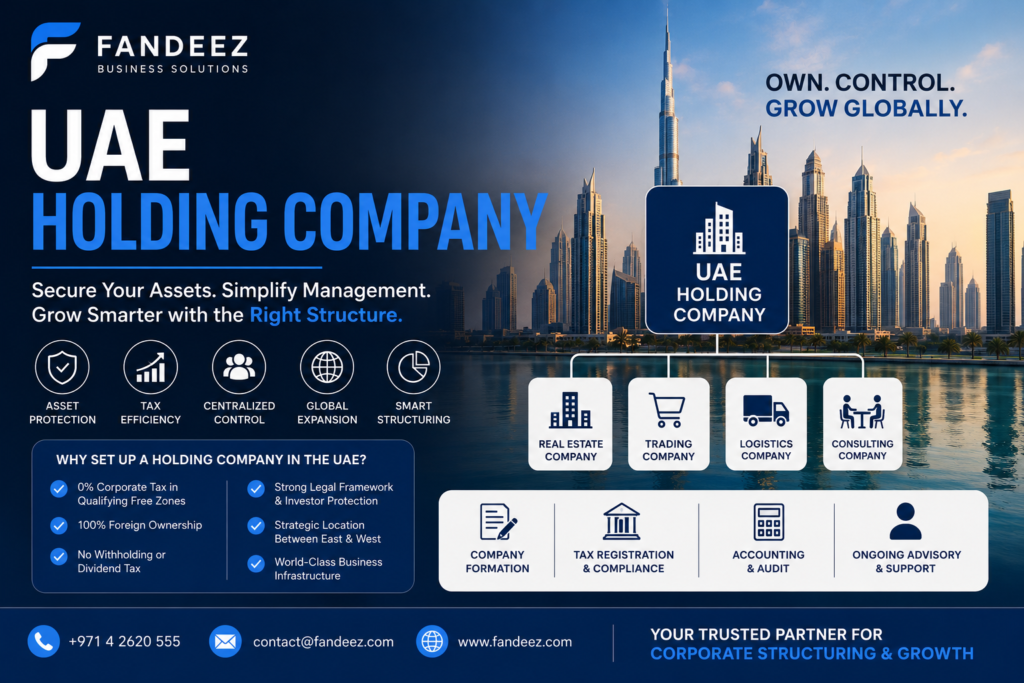
How it works: A holding company sits at the top of a corporate group structure. It owns the shares of subsidiary companies, which are the entities that carry out day-to-day operational business activities.
Practical example: If you own a trading company, a logistics company, and a consulting firm, you could establish a UAE Holding Company to own all three. This centralizes ownership, simplifies group management, and allows for more efficient profit repatriation and succession planning.
Why Set Up a Holding Company in the UAE?
The UAE offers several compelling advantages for establishing a holding company:
- 100% Foreign Ownership — Foreign investors can fully own a holding company in most free zones, financial free zones (ADGM, DIFC), and, following recent reforms, on the mainland for many activities.
- Asset Protection — A holding company creates a legal separation between the parent entity and the operating subsidiaries. If one subsidiary faces a liability, the assets of the holding company and other subsidiaries are generally shielded.
- Centralized Control — It provides a single point for managing and controlling a diverse group of companies, simplifying administrative, legal, and financial management.
- Succession Planning — Holding companies facilitate the efficient transfer of ownership to the next generation or new partners.
- Potential Tax Efficiency — The UAE’s corporate tax regime offers exemptions on dividends and capital gains from qualifying subsidiaries, making it a tax-efficient vehicle for holding investments.
Types of Holding Company Structures in the UAE
The right structure depends on your specific assets, investors, banking needs, and tax position.
Mainland Holding Company
Registered with the Department of Economy and Tourism (DET) in the relevant emirate, a mainland holding company can own shares in other mainland entities and free zone companies. It provides full access to the UAE market and may be suitable for groups with significant local operations. Since the 2020 reforms, 100% foreign ownership is permitted in most activities.
Free Zone Holding Company
Established in one of the UAE’s many free zones (e.g., DMCC, JAFZA, RAKEZ), this structure offers 100% foreign ownership and the potential for 0% corporate tax on qualifying income. Free zones are ideal for international asset management and holding subsidiaries outside the UAE.
Financial Free Zones (ADGM & DIFC)
These are world-class financial centres with common law legal systems based on English law. They are particularly attractive for investment holding structures, family wealth consolidation, and private equity platforms requiring a robust and familiar legal framework. They offer 0% tax on qualifying income but come with higher setup and annual costs.
Offshore Company (e.g., RAK ICC)
RAK ICC is a leading offshore jurisdiction offering International Business Companies (IBCs). These entities are ideal for holding assets (like shares in foreign companies or IP), international business structuring, and asset protection without requiring physical presence in the UAE. They are cost-effective, with no mandatory office space and no corporate tax on qualifying income.
What Can a UAE Holding Company Own?
A UAE Holding Company can typically own a wide range of assets and interests, depending on its permitted activities, including:
- Shares in subsidiaries — Both domestic (UAE Mainland, Free Zone, or Offshore) and foreign companies
- Investments — Equity and debt investments across various asset classes
- Intellectual property (IP) — Patents, trademarks, copyrights, and other IP rights
- Real estate interests — Direct or indirect ownership of property in certain jurisdictions
- Loans or investments in group companies — Where legally permitted and compliant with transfer pricing rules
Restriction: A holding company’s license does not permit it to engage in direct trading, manufacturing, or services. If it were to conduct these activities, it would need a separate operating license, and its corporate tax treatment would change.
UAE Holding Company vs Operating Company
| Feature | Holding Company | Operating Company |
|---|---|---|
| Main Purpose | Own and control assets or subsidiaries | Conduct business operations |
| Trading Activity | Usually not the primary purpose | Yes, where licensed |
| Employees | Minimal (management and admin staff) | Usually required for operations |
| Revenue Source | Dividends, capital gains, investment income | Sales, service revenue |
| Risk Exposure | Low (liability generally limited to its shareholding) | High (faces direct operational and commercial risks) |
How to Set Up a UAE Holding Company
- Define the purpose — Determine what the holding company will own or control: shares in subsidiaries, real estate, IP, or other investments.
- Choose the jurisdiction — This is the most critical decision. Consider whether a Mainland, Free Zone (like DMCC or RAKEZ), Financial Free Zone (ADGM or DIFC), or Offshore (RAK ICC) structure best aligns with your goals.
- Select the legal structure — For a free zone holding company, common structures are an FZE (Free Zone Establishment, single shareholder) or FZ-LLC (Free Zone Limited Liability Company, multiple shareholders). In ADGM/DIFC, you might use an SPV (Special Purpose Vehicle) or a Prescribed Company.
- Select the business activity — Choose an activity that accurately reflects the company’s purpose, such as “Holding Company” or “Investment Holding.”
- Reserve the company name — Submit a name that complies with UAE naming regulations and includes the word “Holding.”
- Prepare required documents — Typically passport copies, proof of address for shareholders, shareholding structure, and a Memorandum of Association (MOA) or Articles of Association (AOA).
- Submit the application — Apply through the relevant authority (e.g., DET for Mainland, the Free Zone authority, or RAK ICC).
- Obtain the license and incorporation documents — After approval and payment, you’ll receive your trade license and incorporation certificates.
- Open a corporate bank account — Banks require the trade license, MOA, and shareholder details for due diligence.
- Complete tax and compliance requirements — Register for Corporate Tax (and VAT if applicable), comply with Economic Substance Regulations (ESR), and file UBO declarations.
UAE Holding Company Corporate Tax
The UAE’s Corporate Tax (CT) regime, effective from 1 June 2023, has specific implications for holding companies. A UAE Holding Company is a taxable person and must register for CT and file annual returns, even if all its income is exempt. Working with a corporate tax consultant in Dubai can help ensure registration, filing, and structuring decisions are handled correctly from day one.
The Participation Exemption
The most significant provision for holding companies is the participation exemption, which can exempt dividends and capital gains on the sale of shares in qualifying subsidiaries from UAE Corporate Tax.
Conditions for the exemption:
- Ownership — The holding company must own at least 5% of the subsidiary’s shares, or have an acquisition cost of AED 4 million or more.
- Holding period — The interest must have been held for a continuous period of at least 12 months.
- Subject-to-tax — The subsidiary must be subject to a corporate tax rate of at least 9% in its jurisdiction. However, Ministerial Decision No. 116 of 2023 provides relief for subsidiaries in jurisdictions with a headline rate below 9%, provided the subsidiary’s income does not primarily arise from passive sources.
Note: Dividends from UAE-resident subsidiaries are exempt without any conditions, provided they are not part of a tax avoidance arrangement.
Free Zone Holding Companies
Holding companies in qualifying free zones may benefit from the 0% Corporate Tax rate on qualifying income if they meet specific conditions, including substance requirements and limited transactions with mainland UAE.
Tax Benefits of a UAE Holding Company
- Participation exemption — The primary tax benefit, exempting dividends and capital gains from qualifying subsidiaries
- No withholding tax — The UAE does not levy withholding tax on outbound payments such as dividends, interest, or royalties
- Double tax treaties — The UAE has an extensive network of over 130 double taxation treaties, preventing double taxation on international income
Costs of Setting Up a UAE Holding Company
Costs vary dramatically based on jurisdiction and structure. Here is an indicative breakdown based on available data:
| Jurisdiction | Incorporation & Annual License | Office/Flexi-Desk | First-Year Total (Approx.) |
|---|---|---|---|
| RAK ICC (Offshore) | ~AED 7,200 | Not required | ~AED 7,200+ |
| RAKEZ (Free Zone) | From ~AED 5,499/yr | From ~AED 4,000/yr | ~AED 9,500+ |
| DMCC (Free Zone) | ~AED 20,000+ | Included in packages | ~AED 35,000+ |
| DIFC (Prescribed Co.) | ~USD 1,100 (License) | Required (physical) | ~AED 10,000+ |
| DIFC (Standard LLC) | ~USD 20,000 (License) | Required (physical) | ~AED 75,000+ |
Common Mistakes to Avoid
- Choosing the wrong jurisdiction — Selecting a free zone or structure based on cost alone, without considering banking needs, substance requirements, or the nature of the assets being held.
- Poor economic substance — Failing to maintain adequate substance (office, management presence, decision-making) can jeopardize tax exemptions and Qualifying Free Zone Person status.
- Ignoring compliance obligations — Missing Corporate Tax registration deadlines, UBO filings, or audit requirements can result in penalties.
- Mixing holding and operating activities — Conducting trading or operational activities under a holding license can trigger licensing issues and change tax treatment.
- Overlooking the participation exemption conditions — Assuming dividends or capital gains are automatically exempt without verifying ownership thresholds, holding periods, and subject-to-tax requirements.
UAE Holding Company Example
Consider an entrepreneur who owns three separate businesses: a trading company in JAFZA, a consulting firm in DMCC, and a logistics company on the mainland. Rather than holding each individually, they establish a UAE Holding Company in RAK ICC to own all three subsidiaries.
This structure allows the entrepreneur to:
- Consolidate ownership and simplify succession planning for their family
- Ring-fence liabilities so that a legal claim against one subsidiary does not threaten the others or the group’s overall assets
- Centralize the flow of dividends from each subsidiary into a single entity, benefiting from the participation exemption where conditions are met
- Streamline future transactions, such as selling one subsidiary, without disrupting the others
How Fandeez Helps With UAE Holding Company Setup
Fandeez Business Solutions is a long-term partner for investors and business groups looking to establish a UAE Holding Company. Our team provides end-to-end support, including:
- Holding company setup guidance — From concept to license issuance
- Jurisdiction selection — Expert advice on whether a Mainland, Free Zone, or Offshore (RAK ICC) structure is right for you
- Corporate structuring — Helping you design the optimal holding structure for your group
- Documentation support — Preparing and reviewing all necessary corporate documents
- Corporate tax registration — Ensuring your holding company is compliant with UAE Corporate Tax law
- Accounting and bookkeeping — Providing ongoing financial management and reporting
- Audit support — Assisting with statutory audit requirements
- UBO compliance — Managing Ultimate Beneficial Owner declarations
- Ongoing tax and compliance services — Keeping your structure compliant and tax-efficient over the long term
Fandeez simplifies the complexity, so you can focus on your investment strategy and business growth.
Frequently Asked Questions
What is a UAE holding company? A UAE holding company is a legal entity that owns shares in other companies, holds assets like intellectual property or real estate, or manages investments. It does not directly engage in trading or operational activities.
How does a holding company work in the UAE? It works as a parent company at the top of a group structure. It owns and controls subsidiary companies, centralizing ownership, management, and financial reporting while potentially benefiting from tax-efficient treatment of dividends and capital gains.
Why should I set up a holding company in the UAE? The UAE offers 100% foreign ownership, asset protection through legal separation of liabilities, centralized management control, potential tax efficiency through the participation exemption, and a strategic global location for international investments.
Can foreigners own a UAE holding company? Yes. Foreign investors can fully own a holding company in most Free Zones, Financial Free Zones (ADGM, DIFC), and in many mainland activities following recent reforms.
What can a UAE holding company own? It can own shares in subsidiaries, investments, intellectual property, and certain real estate interests. It cannot engage in direct trading, manufacturing, or operational services without a separate license.
Is a UAE holding company subject to Corporate Tax? Yes. A holding company is a taxable person and must register for Corporate Tax and file annual returns, even if all its income is exempt under the participation exemption.
Are dividends received by a UAE holding company taxable? Dividends from UAE-resident subsidiaries are exempt without conditions. Dividends from foreign subsidiaries may be exempt under the participation exemption if specific ownership, holding period, and subject-to-tax conditions are met.
Are capital gains taxable for a UAE holding company? Capital gains on the sale of shares in qualifying subsidiaries are exempt from UAE Corporate Tax, provided the participation exemption conditions are satisfied.
Which UAE Free Zone is best for a holding company? The best free zone depends on your specific needs. DMCC and JAFZA are well-established, RAKEZ offers cost-effective options, while ADGM and DIFC are preferred for financial and investment structures requiring a common law legal framework.
How much does it cost to set up a UAE holding company? Costs range from approximately AED 7,200+ for an offshore RAK ICC company to AED 75,000+ for a standard DIFC LLC, depending on the jurisdiction, license type, and office requirements.
How long does UAE holding company formation take? Typical approval timelines are 3–7 business days for free zone entities and 3–5 working days for RAK ICC offshore companies. The process can be longer for mainland or ADGM/DIFC structures.
Does a UAE holding company need an office? A physical office is required for mainland and ADGM/DIFC entities. Free zones typically require a flexi-desk, while offshore RAK ICC companies do not require office space.
Does a UAE holding company need an audit? Yes. All Qualifying Free Zone Persons (QFZPs) must maintain IFRS-audited financial statements prepared by a UAE-licensed auditor. Mainland and offshore entities may also need audits depending on their size and activities.
Can a UAE holding company own shares in other companies? Yes. This is its primary purpose. It can own shares in both UAE and foreign operating companies, acting as a central parent entity for the group.
Conclusion
Establishing a UAE Holding Company is a strategic move for investors and business groups seeking asset protection, centralized control, and tax efficiency in one of the world’s most dynamic business hubs. However, success requires a clear understanding of the different jurisdiction options, the corporate tax framework, and the strict compliance obligations.
From the participation exemption to substance requirements, getting the structure right from the start is crucial.
Contact Fandeez Business Solutions today for a consultation. Our expert team will guide you through every step of the holding company setup, ensuring your structure is compliant, tax-optimized, and positioned for long-term success.