

Table of Contents
ToggleHow to Open a Bank Account in UAE: Requirements, Documents & Process
Quick Answer: How Do I Open a Bank Account in UAE?
To open a bank account in UAE, you generally need to choose a bank and account type, gather your identification and eligibility documents (passport, Emirates ID and visa for residents, or additional compliance documents for non-residents), complete the bank’s application form, and attend an in-person verification appointment where required. Business bank accounts additionally require trade license, incorporation, and ownership documents. Exact requirements, minimum balances, and processing times vary by bank, applicant profile, and business activity — this guide walks through what to expect at each stage.
Opening a bank account is one of the first practical steps for anyone living, working, or running a business in the UAE. Whether you’re a new resident setting up a salary account, a foreign investor exploring your options, or a founder opening a corporate account for a newly formed company, the process in 2026 follows a fairly consistent structure — even though specific requirements differ from bank to bank.
1. Who Can Open a Bank Account in UAE?
UAE banks generally serve three broad categories of applicants:
- UAE residents — individuals holding a valid UAE residence visa and Emirates ID, who generally have the widest access to account types, including current accounts, multi-currency accounts, and credit facilities
- Foreign nationals and non-residents — individuals without UAE residency who may still be able to open certain accounts, typically savings accounts with more limited features and stricter compliance checks
- Companies and businesses — mainland and Free Zone entities registered in the UAE, which can apply for business or corporate accounts to manage company finances
Each category faces a different set of documentation and eligibility requirements, which are covered in detail below.
2. Types of Bank Accounts in UAE
| Account Type | Typical Use | Key Features |
|---|---|---|
| Personal current account | Salary, day-to-day spending | Cheque book, debit card, online/mobile banking |
| Personal savings account | Saving and earning interest | Limited transaction features, may have minimum balance |
| Business/corporate current account | Company operations, supplier and client payments | Linked to trade license, supports WPS salary payments |
| Multi-currency account | International transactions | Holds and transacts in multiple currencies |
| Non-resident savings account | Non-residents without a UAE visa | Debit card, limited or no cheque book, higher minimum balance |
Some UAE banks and digital-first providers also offer app-based business and personal accounts with faster onboarding, though the underlying documentation requirements are broadly similar.
3. Can Foreigners Open a Bank Account in UAE?
Yes. Foreigners can open a bank account in the UAE, though the process and account options differ depending on whether they hold UAE residency.
Foreign nationals with a valid UAE residence visa and Emirates ID are generally treated the same as any other resident and can access the full range of personal banking products — current accounts, savings accounts, multi-currency accounts, and credit facilities — subject to each bank’s standard eligibility criteria.
Foreign nationals without UAE residency (visitors, overseas investors, or those banking remotely) fall into the non-resident category discussed next, where account options are more limited.
4. Can Non-Residents Open a UAE Bank Account?
Yes, but with more restrictions. Non-residents — meaning individuals without a UAE residence visa — can generally open savings or deposit-type accounts at a limited number of UAE banks, though full-featured current accounts with cheque books are typically reserved for residents.
Key points for non-resident applicants:
- Only a subset of UAE banks accept non-resident applications
- Minimum opening deposits and ongoing minimum balances are typically higher than for resident accounts
- Physical presence in the UAE is usually required at some stage of the process, even where initial steps can be started online
- Additional documentation — such as proof of income, source-of-funds evidence, and reference letters — is commonly requested
- Account features (debit cards, online banking, multi-currency support) may be more limited than resident accounts
Because requirements and minimum balances vary significantly by bank, non-resident applicants should confirm current terms directly with their chosen bank before starting the process.
5. UAE Bank Account Requirements
While specific requirements differ by bank, customer profile, and account type, most UAE banks assess applicants against a common set of criteria:
- Identity verification — valid passport, and Emirates ID or residence visa for residents
- Proof of address — a recent utility bill, tenancy contract, or bank statement
- Source of funds / source of income — evidence such as salary certificates, employment letters, or business income documentation
- Compliance and KYC checks — banks conduct Know Your Customer checks in line with UAE anti-money-laundering regulations
- Minimum deposit or minimum balance — varies significantly between banks and account types
Banks retain discretion over whether to approve an application, even where all requested documents are submitted, so meeting the baseline requirements does not guarantee approval.
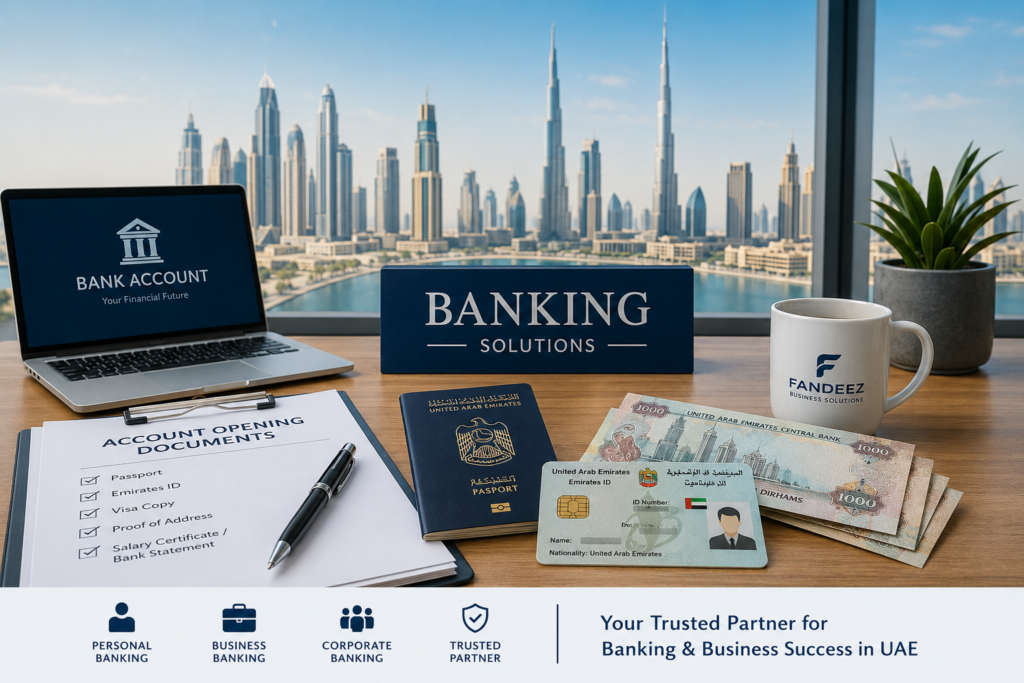
6. Documents Required to Open a Bank Account in UAE
The table below summarizes commonly requested documents by applicant category. Always confirm the exact list with your chosen bank, since requirements vary.
| Requirement | UAE Residents | Foreigners (Non-Resident) | Companies/Businesses |
|---|---|---|---|
| Valid passport | ✔ | ✔ | ✔ (for shareholders/signatories) |
| Emirates ID | ✔ | ✘ | ✔ (for resident signatories) |
| UAE residence visa | ✔ | ✘ | ✔ (where applicable) |
| Proof of address | ✔ (UAE) | ✔ (home country) | ✔ (registered office / Ejari) |
| Proof of income/source of funds | Often required | Required | Required (business activity evidence) |
| Trade license | ✘ | ✘ | ✔ |
| Certificate of incorporation / MOA | ✘ | ✘ | ✔ |
| Board resolution naming signatories | ✘ | ✘ | ✔ |
| Higher minimum balance | Sometimes | Usually | Varies by bank and activity |
7. How to Open a Bank Account in UAE: Step-by-Step Process
- Choose the right bank and account type based on your residency status, needs, and the bank’s fee and balance requirements.
- Gather the required documents — passport, Emirates ID and visa (for residents), proof of address, and income or source-of-funds evidence.
- Complete the application — many banks allow you to begin online or through a mobile app, though some steps may require an in-branch visit.
- Attend in-person verification, where required, particularly for non-residents or where the bank requests biometric or face-to-face identity checks.
- Submit to KYC and compliance review — the bank will verify your documents and assess your source of funds against its internal compliance policies.
- Fund the account to meet any minimum opening deposit required by the bank and account type.
- Receive account activation — once approved, you’ll typically receive account details, a debit card (where applicable), and access to online or mobile banking.
Processing time varies depending on the bank, applicant profile, and completeness of documentation — this is addressed further in Section 10.
8. How to Open a Business or Corporate Bank Account in UAE
Both mainland and Free Zone companies can open corporate bank accounts in the UAE. Approval is not determined solely by jurisdiction — banks also review the business activity, ownership structure, expected transaction patterns, and supporting documentation.
The general process for a business account follows a similar shape to personal accounts, with additional company-specific steps:
- Select a bank that suits your business size, activity, and banking needs — considering minimum balance requirements, trade finance availability, and the bank’s familiarity with your Free Zone or business sector.
- Prepare your company documentation file, including trade license, incorporation documents, and shareholder details.
- Identify authorized signatories and prepare a board resolution naming them.
- Submit the application, either online through the bank’s business banking portal or via a relationship manager.
- Attend interviews or verification meetings, which many banks require for company signatories and major shareholders.
- Respond to compliance queries regarding business activity, expected transaction volumes, and source of funds.
- Fund and activate the account once approved.
A UAE corporate bank account is also generally necessary for practical compliance reasons — Corporate Tax and VAT payments are typically made from a registered UAE business account linked to the company’s Tax Registration Number, and mainland and most Free Zone employers are required to pay staff through a Wages Protection System-compliant account.
9. Documents Required for a UAE Corporate Bank Account
Commonly requested documents for a UAE business or corporate account include:
- Valid trade license
- Certificate of incorporation and Memorandum/Articles of Association
- Shareholder register and passport copies for shareholders (particularly those holding significant ownership stakes)
- Emirates ID and visa copies for resident signatories
- Board resolution authorizing the account opening and naming signatories
- Proof of registered office — a tenancy contract (Ejari) or Free Zone office/flexi-desk agreement
- Business plan or activity summary describing operations, main clients, and suppliers
- Corporate Tax Registration Number, where applicable
Document requirements vary by bank, company type (mainland or Free Zone), ownership structure, and business activity, so businesses should confirm the specific checklist with their chosen bank before applying.
10. How Long Does UAE Bank Account Opening Take?
Processing times vary considerably depending on the bank, applicant type, and completeness of documentation:
- Personal resident accounts can sometimes be opened within a single day at digital-first banks, or within a few business days at traditional banks
- Non-resident personal accounts often take longer due to additional compliance checks, commonly ranging from several days to a couple of weeks
- Corporate/business accounts typically take longer still, often several weeks, given the additional company-level due diligence involved
Applications with complete, consistent, and well-organized documentation generally move faster than those requiring back-and-forth clarification.
11. UAE Bank Account Fees and Minimum Balance Requirements
Minimum balance requirements and fees vary widely across UAE banks and account types. As general context:
- Some digital-first or SME-focused accounts offer low or zero minimum balance requirements
- Standard personal and business accounts commonly require minimum balances that can range from a few thousand dirhams to significantly higher amounts, depending on the bank and account tier
- Non-resident and premium/priority banking accounts generally carry the highest minimum balance requirements
- Falling below the required minimum balance can result in monthly fees at many banks
Because fee structures and minimum balance requirements differ significantly between banks and change periodically, applicants should request current, written terms directly from their chosen bank rather than relying on generalized figures.
12. Why Do UAE Banks Delay or Reject Applications?
UAE banks apply discretionary approval processes, and applications can be delayed or declined for a range of reasons, including:
- Incomplete or inconsistent documentation — mismatches between stated business activity, invoices, and expected transaction patterns are a common red flag
- Unclear source of funds — banks generally require a clear, verifiable explanation of where funds originate
- Compliance and AML concerns — stricter anti-money-laundering and Know Your Customer requirements mean banks scrutinize beneficial ownership and business substance closely
- High-risk business activities — certain sectors face additional scrutiny or may be declined by specific banks
- Missing or expired documents — expired passports, outdated trade licenses, or documents nearing expiry can stall applications
- Insufficient evidence of genuine operations — particularly for newly formed companies with limited trading history
Approval is never guaranteed, even where all requested documents are submitted, since UAE banks retain full discretion over account opening decisions.
13. Common Mistakes to Avoid
- Submitting incomplete documentation — always confirm the bank’s full checklist before applying
- Inconsistent business activity descriptions — ensure your trade license, business plan, and actual transactions align
- Underestimating processing time — apply well before you need the account to be active
- Not comparing banks — fees, minimum balances, and account features vary significantly
- Overlooking non-resident restrictions — confirm which account types are actually available to you before applying
- Ignoring source-of-funds documentation — prepare clear, verifiable evidence in advance rather than reactively
- Assuming approval is guaranteed — banks assess each application individually and can decline at their discretion
14. Tips for Choosing the Right UAE Bank
- Compare minimum balance and fee structures across a few banks before committing
- Consider your banking needs — international transfers, multi-currency support, trade finance, or digital-first convenience
- Check the bank’s familiarity with your Free Zone or sector, since some banks are more experienced with certain business activities
- Review physical presence requirements, especially if you’re applying as a non-resident or from outside the UAE
- Ask about onboarding timelines upfront so you can plan around them
- Prepare documentation early so you’re ready to move quickly once you’ve chosen a bank
15. How Fandeez Can Help
Opening a bank account is only one part of getting your UAE finances properly set up. Fandeez Business Solutions, a UAE-based accounting, auditing, VAT, Corporate Tax, bookkeeping, and business advisory consultancy, supports individuals and businesses with the broader financial and compliance groundwork that banks look for during account opening — accurate financial documentation, business activity clarity, and ongoing accounting support.
Fandeez does not open bank accounts on a client’s behalf or guarantee approval — that decision rests entirely with the bank. What Fandeez can help with includes:
- Accounting Services and Bookkeeping Services to keep your financial records organized and bank-ready
- Business Advisory for founders preparing documentation ahead of a banking application
- VAT Services and Corporate Tax support to ensure your registrations and filings align with the business activity presented to your bank
- Auditing Services for businesses that need financial statements as part of their banking or compliance documentation
Frequently Asked Questions
1. How can I open a bank account in UAE? Choose a bank and account type, prepare your identification and eligibility documents, complete the application (often startable online), attend in-person verification if required, and fund the account once approved.
2. What documents do I need to open a bank account in UAE? Typically a valid passport, and for residents, an Emirates ID and residence visa. Proof of address and source-of-funds documentation are also commonly required. Businesses need a trade license, incorporation documents, and shareholder details in addition.
3. Can foreigners open bank accounts in UAE? Yes. Foreigners with UAE residency generally access the same account types as other residents. Foreigners without residency can typically open more limited savings-type accounts, subject to additional compliance checks.
4. Can a non-resident open a UAE bank account? Yes, at a limited number of banks, though usually only savings or deposit accounts with higher minimum balances and fewer features than resident accounts, and often requiring in-person verification.
5. How long does it take to open a UAE bank account? This varies by bank and applicant type — personal resident accounts can sometimes be opened within days, while non-resident and corporate accounts often take longer, from a couple of weeks up to several weeks.
6. How much money do I need to open a bank account in UAE? Minimum balance requirements vary significantly by bank and account type, ranging from low or zero minimums at some digital-first accounts to substantially higher amounts for non-resident or premium accounts. Confirm current figures directly with your chosen bank.
7. Can I open a business bank account in UAE? Yes. Both mainland and Free Zone companies can apply for corporate bank accounts, subject to the bank’s review of business activity, ownership, and documentation.
8. What are the requirements for a corporate bank account in UAE? Generally a trade license, incorporation documents, shareholder and signatory identification, proof of registered office, and information about the company’s business activity and expected transactions.
9. Why can a UAE bank reject a bank account application? Common reasons include incomplete or inconsistent documentation, unclear source of funds, compliance or AML concerns, high-risk business activities, or insufficient evidence of genuine business operations. Banks retain discretion over approval regardless of documentation completeness.
Get Your UAE Finances Bank-Ready
Whether you’re opening a personal account as a new resident or preparing a corporate account for a growing business, having your financial documentation in order makes the process smoother. Contact Fandeez Business Solutions for support with accounting, bookkeeping, VAT, Corporate Tax, auditing, and business advisory needs as you set up your UAE banking and financial operations.
Contact Us to speak with our advisory team.