

Table of Contents
ToggleComplete Guide to Rules, Documentation & Compliance (2026)
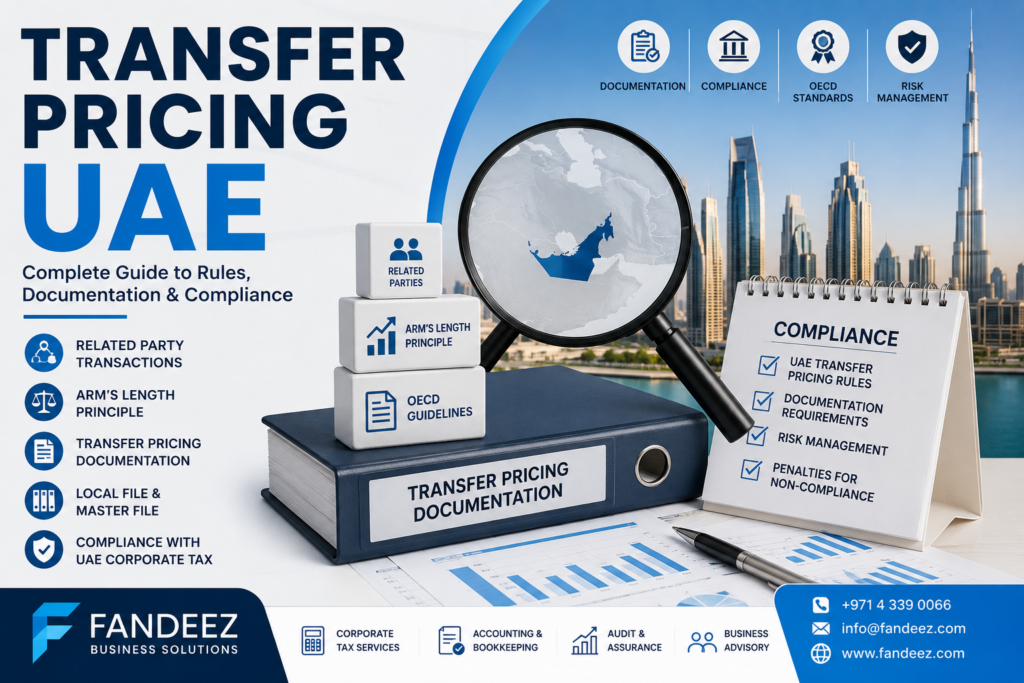
If your business deals with a related party — a parent company, a sister branch, a shareholder-owned entity, or even a connected individual — Transfer Pricing UAE rules almost certainly apply to you. Since the introduction of UAE Corporate Tax, the Federal Tax Authority (FTA) has made it clear that transactions between related parties must be priced the same way they would be between two unrelated businesses. This single requirement has changed how thousands of UAE companies structure invoices, service fees, loans, and intercompany agreements. In this guide, we break down what Transfer Pricing UAE actually means, who it applies to, how the documentation works, and how to stay fully compliant without slowing down your business.
What is Transfer Pricing UAE?
Transfer Pricing UAE refers to the rules that govern how companies price transactions with related or connected parties — for example, a UAE parent company charging a subsidiary for management services, or two group companies trading goods across emirates or borders.
The core idea is simple: related parties should not be able to shift profits from one entity to another simply by adjusting prices. Under UAE Transfer Pricing Rules, every transaction between connected parties must reflect what independent, unrelated businesses would have agreed to under similar circumstances.
The UAE introduced these rules as part of Federal Decree-Law No. 47 of 2022 on the Taxation of Corporations and Businesses, aligning the country with international standards set by the OECD. Since profits are now taxed locally under UAE Corporate Tax, the FTA needs assurance that businesses aren’t artificially moving income to lower-tax jurisdictions or Free Zones enjoying the 0% rate.
Why Transfer Pricing Matters Under UAE Corporate Tax
Before Corporate Tax existed, pricing between related UAE entities had little tax consequence. That has changed completely.
Transparency and fair taxation. The FTA wants to see that profits are reported where genuine economic activity happens — not where it’s most convenient on paper.
OECD alignment. The UAE is a member of the OECD’s Inclusive Framework on BEPS (Base Erosion and Profit Shifting). Transfer Pricing Corporate Tax UAE rules mirror OECD Transfer Pricing Guidelines almost directly, which makes the UAE regime familiar to multinational groups already compliant elsewhere.
Free Zone scrutiny. Because Qualifying Free Zone Persons can benefit from a 0% Corporate Tax rate, the FTA pays close attention to transactions between Free Zone entities and their Mainland or foreign related parties, to confirm profits aren’t being artificially routed into the zero-rated environment.
Audit readiness. Even businesses with modest related-party dealings need proper records. An FTA audit without supporting documentation can quickly turn a minor pricing decision into a costly dispute.
Who Must Comply with UAE Transfer Pricing Rules?
Transfer Pricing UAE obligations are broader than most business owners expect.
- Mainland companies transacting with related UAE or foreign entities.
- Free Zone businesses, particularly Qualifying Free Zone Persons trading with connected parties outside the zone.
- Multinational groups with UAE subsidiaries, branches, or holding structures.
- SMEs and startups that are part of a group structure, even a small one — for example, two companies owned by the same family.
- Related parties, defined broadly to include entities under common ownership or control, and close relatives of a natural person shareholder.
- Connected persons, such as owners, directors, or key shareholders who transact directly with the business (e.g., a director charging the company consultancy fees).
If any transaction happens between two parties that aren’t fully independent of each other, Transfer Pricing UAE rules are relevant — regardless of company size. If you’re unsure whether your structure falls into any of these categories, a quick review with a business advisory specialist can clarify your obligations before they become a problem.
Understanding Related Party Transactions
A related party transaction is any dealing between entities or individuals connected through ownership, control, or family relationship.
Common examples:
- A UAE holding company charging its subsidiary for shared services like HR, IT, or finance.
- Two sister companies owned by the same shareholder trading inventory at internal prices.
- A foreign parent company licensing its brand name to its UAE entity for a royalty fee.
- A company borrowing funds from its shareholder and paying (or not paying) interest.
- A director leasing personal property to their own company.
Each of these needs to reflect market-based pricing — not whatever number is administratively convenient.
Arm’s Length Principle Explained
The Arm’s Length Principle UAE is the foundation of the entire Transfer Pricing framework. It requires that pricing between related parties matches what independent parties would have agreed to in a comparable transaction, under comparable conditions.
Practical example: Suppose a UAE Free Zone company manufactures goods and sells them to its Mainland sister company at AED 50 per unit, while the same goods sell to unrelated customers at AED 90 per unit. Unless there’s a commercially justifiable reason (bulk volume, different market conditions, and so on), this AED 40 gap could be challenged by the FTA as an artificial shift of profit into the Free Zone entity.
To defend a price, businesses typically compare it against:
- Prices charged to independent customers for similar goods or services.
- Market rates published in industry data.
- Pricing used by competitors in comparable transactions.
This comparison exercise is called a benchmarking study, and it forms the backbone of Transfer Pricing Documentation UAE.
Transfer Pricing Documentation Requirements
Businesses that cross certain related-party transaction thresholds must maintain formal documentation. Even smaller businesses below the threshold are expected to keep basic records to justify their pricing if questioned.
Local File. Documents the UAE entity’s specific related-party transactions, functions performed, risks assumed, and the pricing method applied, along with supporting financial data.
Master File. Provides an overview of the wider multinational group — its structure, business lines, intangible assets, financing arrangements, and overall Transfer Pricing policies.
Disclosure Form. A summary of related-party and connected-person transactions submitted alongside the Corporate Tax return, required even for businesses that don’t meet the Local File/Master File threshold.
Supporting documents. Contracts, invoices, board resolutions, and correspondence that back up the commercial rationale for a transaction. Keeping these organized is far easier when your bookkeeping and accounting records are accurate and up to date from the start.
Benchmarking analysis. Independent market data used to prove that the pricing applied is consistent with the Arm’s Length Principle.
Local File and Master File UAE requirements generally apply where related-party transaction values exceed the thresholds set under Ministerial Decision guidance — but the Disclosure Form applies more broadly, so most businesses with related-party dealings will need to file it regardless of size.
Transfer Pricing Methods
The FTA, following OECD Transfer Pricing Guidelines, recognizes five accepted methods for establishing arm’s length pricing.
Comparable Uncontrolled Price (CUP) Method. Compares the price charged in a related-party transaction to the price charged for the same or similar goods/services between unrelated parties. Example: comparing the price a UAE trading company charges its sister company for raw materials against the price it charges an unrelated buyer for the same materials.
Cost Plus Method. Adds a reasonable profit margin on top of the costs incurred by the supplying entity. Commonly used for intercompany manufacturing or service arrangements. Example: a shared-services entity charging group companies its costs plus a 10% markup.
Resale Price Method. Starts from the resale price to an independent customer and works backward, deducting an appropriate margin. Often used for distribution arrangements. Example: a UAE distributor buying goods from its overseas parent and reselling locally.
Transactional Net Margin Method (TNMM). Compares the net profit margin earned on a related-party transaction to the margins earned by independent companies performing similar functions. This is the most widely used method in practice due to its flexibility.
Profit Split Method. Divides combined profits between related parties based on the relative value each contributes, typically used in highly integrated operations, such as joint product development.
Choosing the right method depends on the nature of the transaction, available data, and the functions and risks each party carries.
Common Transfer Pricing Mistakes
- Assuming Transfer Pricing only applies to large multinationals. Even two locally owned companies under common ownership are in scope.
- Ignoring transactions with connected individuals, such as director fees or shareholder loans.
- Not preparing a Disclosure Form, mistakenly believing it’s only required above the documentation threshold.
- Setting prices for administrative convenience rather than market-based reasoning.
- Failing to document the rationale behind a price at the time of the transaction — reconstructing evidence years later is far harder.
- Overlooking interest-free or below-market loans between related parties, which can still require Transfer Pricing justification.
- Treating Free Zone-to-Mainland pricing casually, without considering how it affects Qualifying Free Zone Person status.
- Using outdated or irrelevant benchmarking data that doesn’t reflect current UAE market conditions.
- Copying group Transfer Pricing policies from another country without adapting them to UAE-specific rules and thresholds.
- Leaving Transfer Pricing until the Corporate Tax filing deadline, rather than reviewing pricing policies throughout the year.
Penalties for Non-Compliance
Non-compliance with Transfer Pricing Compliance UAE requirements carries real financial and operational risk.
- Tax adjustments. If the FTA determines pricing wasn’t at arm’s length, it can recalculate taxable income, resulting in additional Corporate Tax owed.
- Administrative penalties. Late or incorrect filing of the Disclosure Form, Local File, or Master File can trigger fixed and escalating penalties under the Cabinet Decision penalty framework.
- Audit exposure. Weak or missing documentation makes a business a more likely candidate for a detailed FTA audit, which is time-consuming and resource-intensive. Regular internal auditing helps catch pricing gaps before the FTA does.
- Reputational risk. For groups with international shareholders, investors, or lenders, a Transfer Pricing dispute can raise governance concerns beyond the tax bill itself.
- Loss of Free Zone benefits. For Qualifying Free Zone Persons, poorly justified related-party pricing can jeopardize eligibility for the 0% Corporate Tax rate entirely.
Best Practices for Compliance
- Map all related-party and connected-person transactions at the start of each financial year, not at filing time.
- Choose and document a pricing method for each category of transaction, with a clear commercial rationale.
- Run a benchmarking study using credible, UAE-relevant market data, and refresh it periodically.
- Keep contracts and invoices consistent with the pricing policy actually applied.
- File the Disclosure Form accurately, even if your business falls below the Local File/Master File threshold.
- Review intercompany loans, service fees, and royalties annually, since market conditions and group structures change.
- Involve your tax advisor early when entering new related-party arrangements, rather than after the transaction is already in place — this pairs naturally with your existing VAT compliance reviews, since many related-party deals affect both taxes at once.
- Train finance and management teams on what qualifies as a related-party transaction, since these often go unnoticed outside the finance department.
How Fandeez Business Solutions Can Help
Transfer Pricing UAE compliance touches accounting, legal structuring, and tax strategy all at once — which is exactly where Fandeez Business Solutions specializes. Our team helps UAE businesses:
- Identify and map related-party and connected-person transactions
- Prepare Local Files, Master Files, and Disclosure Forms in line with FTA requirements
- Conduct benchmarking studies to support arm’s length pricing
- Handle Corporate Tax registration and Corporate Tax filing end-to-end
- Manage day-to-day bookkeeping and accounting so your records stay audit-ready
- Support internal and external auditing to catch issues before the FTA does
- Provide ongoing tax advisory as your group structure or transactions evolve
Whether you’re a Free Zone company managing intercompany trade, a family-owned group with multiple entities, or a multinational setting up in the UAE for the first time, Fandeez Business Solutions can build a Transfer Pricing framework that keeps you compliant and audit-ready. Get in touch with our team today to review your related-party transactions before your next Corporate Tax filing deadline.
Frequently Asked Questions
- What is Transfer Pricing in UAE Corporate Tax? It’s the set of rules requiring related-party and connected-person transactions to be priced as they would be between independent businesses, in line with the Arm’s Length Principle.
- Does Transfer Pricing apply to small businesses in the UAE? Yes. Any business with related-party or connected-person transactions must comply, regardless of size, though documentation depth depends on transaction value.
- What is the Arm’s Length Principle? It’s the requirement that pricing between related parties matches what unrelated parties would agree to under similar market conditions.
- Who is considered a related party under UAE Transfer Pricing Rules? Entities under common ownership or control, and, for individuals, close family members who hold ownership or influence over the business.
- What is a connected person in UAE Corporate Tax? A connected person is typically an owner, director, or officer of a business who transacts directly with that business, such as receiving fees or rent.
- Do Free Zone companies need to comply with Transfer Pricing rules? Yes, and often with extra scrutiny, since pricing between Free Zone and Mainland or foreign related parties can affect Qualifying Free Zone Person status.
- What is the difference between a Local File and a Master File? The Local File covers the UAE entity’s specific transactions and pricing; the Master File gives an overview of the entire multinational group’s structure and policies.
- Is the Disclosure Form mandatory for all businesses? Generally yes, for businesses with related-party or connected-person transactions, even if they fall below the Local File/Master File preparation threshold.
- What Transfer Pricing method is most commonly used in the UAE? The Transactional Net Margin Method (TNMM) is widely used due to its flexibility, though the appropriate method depends on the transaction type.
- What happens if the FTA finds non-arm’s-length pricing? The FTA can adjust taxable income, impose administrative penalties, and in Free Zone cases, potentially affect eligibility for the 0% Corporate Tax rate.
- How often should Transfer Pricing documentation be updated? At minimum annually, and whenever there’s a material change in transactions, group structure, or market conditions.
- How can a business start becoming Transfer Pricing compliant? Start by mapping all related-party and connected-person transactions, then work with a tax advisor to select pricing methods, prepare documentation, and file the required forms.
Conclusion
Transfer Pricing UAE is no longer a concept limited to global corporations — it’s a compliance requirement for any UAE business with related-party or connected-person dealings, from family-owned groups to Free Zone traders and multinational subsidiaries. Getting it right means understanding the Arm’s Length Principle, choosing the correct pricing method, and maintaining documentation that can stand up to FTA scrutiny. Getting it wrong can mean tax adjustments, penalties, and unwanted audit attention.
Fandeez Business Solutions helps UAE businesses build Transfer Pricing frameworks that are practical, well-documented, and fully aligned with FTA requirements. Contact Fandeez Business Solutions today to review your related-party transactions and get ahead of your next Corporate Tax filing.