

Table of Contents
ToggleMandatory VAT Registration in UAE
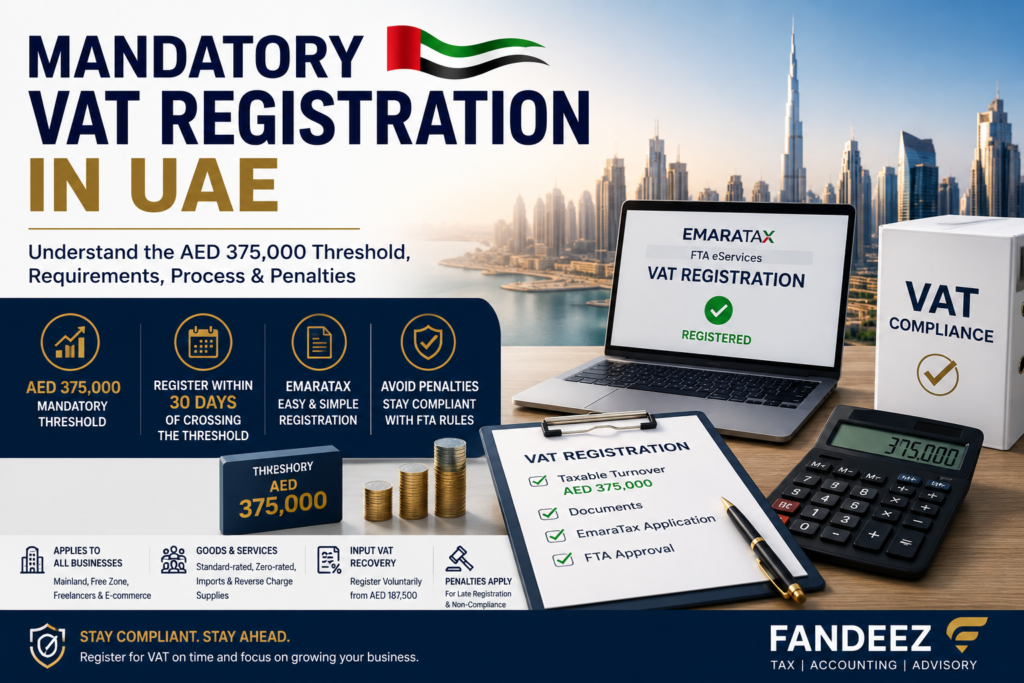
When is VAT registration mandatory in the UAE? VAT registration becomes mandatory once a business’s taxable supplies and imports exceed AED 375,000 over the previous 12 months, or when it expects to exceed that amount within the next 30 days. This is the core rule behind Mandatory VAT Registration in UAE, applying to mainland companies, Free Zone businesses, freelancers, and certain non-resident businesses alike — whether based in Dubai, Abu Dhabi, Sharjah, or Ajman.
Registering too late brings penalties and retroactive VAT liability. This guide covers the AED 375,000 threshold, mandatory vs voluntary registration, who must register, the EmaraTax process, required documents, and penalties.
What Is Mandatory VAT Registration?
VAT registration is the process of notifying the Federal Tax Authority (FTA) that your business must charge, collect, and remit VAT. Once approved, the FTA issues a Tax Registration Number (TRN), required on every tax invoice and VAT return.
Once registered, a business must:
- Charge 5% VAT on taxable supplies.
- Issue compliant tax invoices showing the TRN.
- File periodic VAT returns.
- Maintain supporting accounting records.
- Recover input VAT on eligible expenses.
Registration is mandatory once taxable turnover crosses AED 375,000. Below that, voluntary registration may still apply.
The AED 375,000 Mandatory Threshold
A UAE-resident business must register if either applies:
- Taxable supplies and imports exceeded AED 375,000 over the previous 12 months (backward-looking test), or
- The business expects to exceed AED 375,000 within the next 30 days (forward-looking test).
This is a rolling 12-month calculation — not a fixed financial year. A business checking only its annual accounts can miss the point at which it actually crossed the threshold mid-year.
Example: A Dubai design studio earns AED 310,000 in Year 1, but its rolling 12-month figure from July Year 1–June Year 2 reaches AED 385,000. It must register from that point, even though its Year 1 annual total stayed under AED 375,000.
What Counts Toward the Threshold
Counted: standard-rated supplies, zero-rated supplies, relevant imports, and applicable reverse-charge supplies. Generally excluded: exempt supplies (e.g., specific financial services), which don’t count toward the mandatory threshold.
Taxable turnover is based on supplies, not profit — a business with modest profit but high-value taxable sales can cross AED 375,000 quickly.
Mandatory vs Voluntary VAT Registration
Factor | Mandatory Registration | Voluntary Registration |
Threshold | AED 375,000 | AED 187,500 |
Registration | Compulsory when conditions are met | Optional |
Main purpose | Legal compliance | Input VAT recovery, credibility |
Deadline | Fixed — 30 days from crossing threshold | Business chooses |
Typical businesses | Established SMEs crossing the threshold | Start-ups, growing businesses |
Voluntary registration (above AED 187,500) suits start-ups wanting to recover input VAT on early costs like rent or equipment, or businesses that want to appear VAT-registered to corporate clients. It carries the same filing obligations as mandatory registration.
Who Must Register — and Free Zone Rules
Mandatory registration applies to mainland companies, Dubai and other emirate-based businesses, sole establishments, freelancers, e-commerce sellers, traders, and retailers once they cross AED 375,000. Non-resident businesses making taxable supplies in the UAE generally have no minimum threshold and may need to register from their first taxable supply.
Free Zone companies are not automatically exempt. Standard VAT rules generally apply to Free Zone businesses in the same way as mainland ones. The exception is Designated Zones, which receive specific VAT treatment on the movement of certain goods between Designated Zones under defined conditions — this does not extend broadly to services, and it does not remove a Free Zone company’s registration obligation for its other taxable activities. Businesses should confirm their specific position rather than assume Designated Zone treatment applies.
Calculating Taxable Turnover — and Documents Needed
To calculate taxable turnover: list all revenue by category (standard-rated, zero-rated, exempt), include relevant imports and reverse-charge supplies, exclude exempt income, and recalculate on a rolling 12-month basis rather than waiting for year-end.
Documents typically required for EmaraTax registration:
- Trade licence
- Passport and Emirates ID (owner and authorised signatory)
- Memorandum of Association or equivalent
- UAE business address proof
- Authorised signatory details
- Bank account information
- Turnover evidence (invoices, contracts, financials)
- Customs information, where applicable
Incomplete documentation is a common cause of delayed approvals, so accuracy the first time matters. Our VAT services in Dubai and the UAE team helps businesses classify turnover correctly before submitting.
How to Register Through EmaraTax
- Create or access an EmaraTax account.
- Select VAT registration.
- Enter business information and activities.
- Provide owner and authorised signatory details.
- Declare taxable turnover.
- Upload supporting documents.
- Review the application carefully.
- Submit to the FTA.
- Receive TRN confirmation once approved.
Clean applications are typically processed within days, though timing varies by case. Our VAT registration UAE service manages this end-to-end.
VAT Registration Penalty in UAE
Businesses that cross AED 375,000 have 30 days to apply. Missing this deadline generally results in:
- A fixed late-registration penalty, set by Cabinet Decision.
- Retroactive VAT liability — VAT the business should have charged from the date it crossed the threshold, which usually can’t be recovered from customers afterward.
- Increased FTA scrutiny of the wider tax position.
These are two separate costs — the fixed penalty and the backdated VAT — and can apply together. Because penalty amounts are periodically revised by Cabinet Decision, always confirm the current figure on tax.gov.ae or with a registered tax agent rather than relying on older sources.
Compliance After Registration
Registration is the start, not the end, of VAT obligations. Registered businesses must continue:
- Filing VAT returns (VAT 201) by the deadline, generally the 28th day after the tax period ends.
- Paying any VAT due on time.
- Issuing FTA-compliant tax invoices.
- Maintaining accounting records and retaining them for the required period.
- Correctly recovering input VAT and charging output VAT.
Note on e-invoicing: the UAE’s move toward structured e-invoicing is a separate compliance initiative from VAT registration. It changes how invoices are issued and reported but does not replace the underlying obligation to register once AED 375,000 is crossed. Treat the two as separate compliance workstreams.
What to Do After Crossing AED 375,000
- Confirm the exact date the threshold was crossed.
- Note the 30-day registration deadline.
- Gather required documents.
- Apply through EmaraTax without delay.
- Prepare invoicing and accounting systems for VAT.
- Remember VAT obligations apply from the effective registration date, not the date the TRN is issued.
Fast-growing businesses — especially in e-commerce, trading, or professional services — should review taxable turnover monthly, not annually.
Frequently Asked Questions
- What is the mandatory VAT registration threshold in UAE? AED 375,000 in taxable supplies and imports, on a rolling 12-month basis.
- What is the voluntary VAT registration threshold? AED 187,500 in taxable supplies, imports, or taxable expenses.
- Do Free Zone companies need VAT registration? Generally yes — Free Zone status doesn’t automatically exempt a business once the threshold is crossed.
- Are freelancers required to register? Yes, once taxable turnover exceeds AED 375,000.
- What documents are required? Trade licence, ID documents, MOA, address proof, bank details, and turnover evidence.
- What happens if a business registers late? A fixed penalty applies, plus VAT owed retroactively from the date the threshold was crossed.
- Does taxable turnover mean profit? No — it refers to taxable supplies and imports, not net profit.
- Do non-resident businesses have the same threshold? No — they generally have no minimum threshold and may need to register regardless of turnover.
Final Thoughts
Mandatory VAT registration in the UAE comes down to one figure — AED 375,000 — but reaching that number accurately depends on correctly classifying revenue, tracking turnover on a rolling basis, and understanding how Free Zone and non-resident rules apply.
Fandeez, a trusted UAE tax and accounting consultancy, supports businesses with VAT registration and EmaraTax applications, VAT return filing and compliance, accounting and bookkeeping, and tax consulting and advisory support. Businesses managing both VAT and Corporate Tax can also review our Corporate Tax services.
If you’re unsure whether your business has crossed — or is approaching — the AED 375,000 threshold, our team can review your turnover and manage the EmaraTax application for you.