

Table of Contents
ToggleReceiving a notice or administrative penalty from the Federal Tax Authority (FTA) can be deeply unsettling for any UAE business owner or finance professional. However, a prompt, well-structured, and fully compliant response can significantly reduce your financial exposure and protect your business reputation from lasting damage.
This guide explains exactly what an FTA notice means, why penalties are issued, and how to respond correctly and confidently under UAE tax regulations.
Understand the Type of FTA Notice You Have Received
Not all FTA notices are penalties. Before taking any action, it is essential to understand precisely what type of communication you have received. The FTA may issue:
- Clarification requests (e.g., VAT return discrepancies or missing information)
- Voluntary disclosure reminders
- Audit notifications
- Administrative penalty assessments
- Late payment or filing alerts
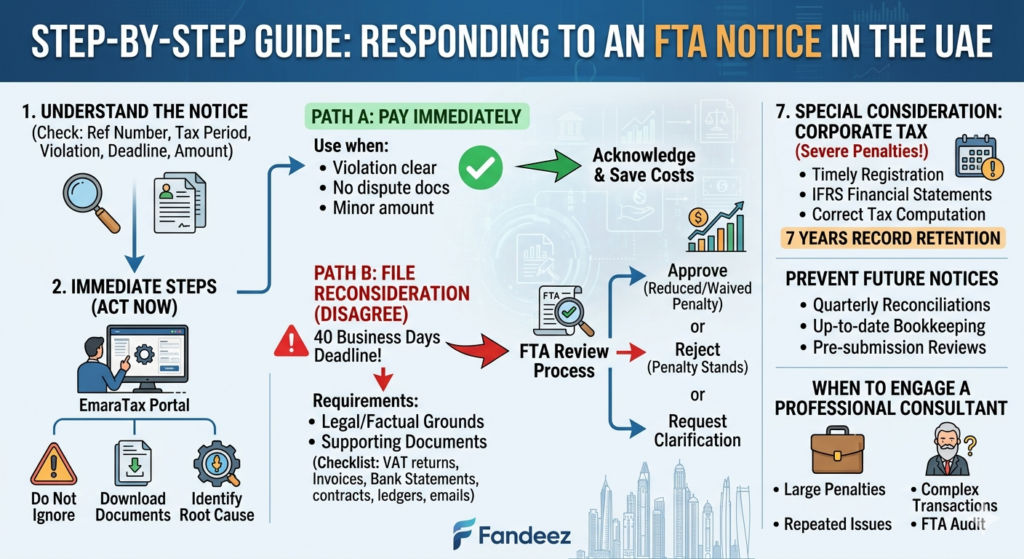
Your immediate first step is to carefully review:
- The official reference number
- The specific tax period concerned
- The exact nature of the violation or query
- The deadline for your response
- The penalty amount, if applicable
Most FTA communications are issued formally through the EmaraTax portal — your primary point of contact for all FTA correspondence.
Common Reasons for FTA Penalties in the UAE
Understanding why penalties are issued helps you address the root cause — not just the symptom. Penalties are typically imposed for:
- Late VAT return filing
- Late corporate tax registration
- Incorrect or incomplete tax return submission
- Failure to maintain proper and up-to-date accounting records
- Non-payment or late payment of due tax amounts
- Failure to issue correct and compliant tax invoices
- Errors or delays in voluntary disclosure submissions
With the introduction of corporate tax in the UAE, compliance scrutiny has increased significantly — and the FTA is actively monitoring businesses across all sectors for adherence to their obligations.
Immediate Steps to Take After Receiving an FTA Notice
Time is critical. Every FTA notice carries a strict deadline, and delayed action almost always makes the situation worse.
Step 1: Do Not Ignore It
Ignoring an FTA notice — even briefly — can rapidly escalate the issue and lead to additional compounding fines, legal proceedings, or forced account restrictions. Act immediately upon receipt.
Step 2: Log Into EmaraTax
Access your registered account on the FTA’s EmaraTax portal and review the full details of the notice. Make sure to download:
- The official notice document
- Any calculation sheets provided
- All supporting references and attachments
Step 3: Identify the Root Cause
Before crafting any response, conduct a thorough internal review. Ask yourself:
- Was this a clerical error in data entry?
- Was there a genuine misunderstanding of VAT or corporate tax rules?
- Was there a system miscalculation in your accounting software?
- Was the issue caused by a temporary cash flow delay?
Internal reconciliation is absolutely critical before you respond. Responding without fully understanding the root cause can weaken your position significantly.
When Should You Pay the Penalty Immediately?
In certain situations, paying the penalty promptly is the most practical and cost-effective course of action. Consider immediate payment when:
- The violation is clear, valid, and well-documented by the FTA
- You do not have sufficient documentation to support a credible dispute
- The penalty amount is relatively minor compared to the cost of disputing it
Early payment can stop additional accrual penalties from compounding further — and in some cases, demonstrates good faith cooperation with the FTA that may benefit you in future interactions.
How to File a Reconsideration Request If You Disagree With the Penalty
If you genuinely believe the penalty is unjustified, inaccurate, or disproportionate, you have the right to submit a formal reconsideration request to the FTA.
Critical Conditions to Meet:
- Must be filed within 40 business days from the date of notification — without exception
- Must be accompanied by comprehensive supporting documentation
- Must clearly articulate the legal and factual grounds for your disagreement
The reconsideration request is submitted directly and formally through the FTA portal.
Supporting Documents That May Strengthen Your Case:
- VAT returns for the relevant period
- Tax invoices and credit notes
- Bank statements
- Signed contracts and agreements
- Full accounting ledgers
- Relevant email communications and correspondence
Your reconsideration argument must be logically structured, professionally written, and directly reference the applicable UAE tax laws and regulations. A poorly prepared submission significantly reduces your chances of a favourable outcome.
What Happens After You File a Reconsideration Request?
Once your reconsideration request has been formally submitted, the FTA will conduct a thorough and structured review of your complete case. Based on their findings, the FTA will reach one of the following decisions:
- Approve the request — resulting in the penalty being fully waived or significantly reduced, providing immediate financial relief to your business
- Reject the request — confirming that the original penalty stands in full and must be settled without further delay
- Request additional clarification — asking for further supporting documents, explanations, or evidence before arriving at a final and binding decision
If your reconsideration request is ultimately rejected by the FTA, further formal escalation can be pursued through the Tax Disputes Resolution Committee (TDRC). However, this route involves considerably more complexity — including formal legal procedures, mandatory financial deposits, and strict procedural requirements. At this advanced stage, engaging professional legal and tax advisory support is not just recommended — it is absolutely essential to protect your position and maximise your chances of a favourable resolution.
7. Special Consideration: Corporate Tax Penalties
With corporate tax enforcement expanding rapidly and consistently, and with increasing scrutiny across the UAE, businesses of all sizes must now exercise particular care and diligence in the following critical areas:
- Timely registration with the FTA — ensuring your business is registered before all applicable deadlines, without exception
- Accurate financial statements — prepared and audited in full accordance with IFRS standards as mandated under UAE law
- Correct tax computation — based on properly and carefully determined taxable income, with no rounding errors or unsupported deductions
- Proper record retention — UAE law strictly mandates a minimum retention period of 7 years for all financial records, tax returns, invoices, and supporting documents
Penalties in corporate tax matters can be substantially more severe than standard VAT administrative fines — often running into hundreds of thousands of dirhams for serious or repeated violations. This stark reality makes proactive, year-round compliance far more cost-effective than reactive damage control after an FTA notice has already been issued. Businesses that invest in proper tax governance today protect themselves from significantly greater financial and reputational consequences tomorrow.
How to Prevent Future FTA Notices
The most powerful strategy is ensuring you never receive an FTA penalty notice in the first place. To significantly and consistently reduce your compliance risk:
- Conduct quarterly VAT reconciliations to catch discrepancies early
- Maintain clean, accurate, and fully up-to-date bookkeeping records at all times
- Implement internal tax compliance checklists for every filing period
- Perform thorough pre-submission tax reviews before submitting any return
- Actively monitor all registration and filing deadlines throughout the year
Businesses that maintain audit-ready documentation consistently throughout the year face significantly fewer regulatory complications — and are able to resolve issues far more efficiently when they do arise.
When to Engage a Professional Tax Consultant
While some FTA notices can be handled internally, professional assistance becomes strongly recommended — and often essential — when:
- The penalty amount exceeds a significant financial threshold for your business
- You are facing repeated or escalating compliance issues
- There is an active and ongoing FTA tax audit of your business
- The matter involves complex transactions, multi-period discrepancies, or cross-border elements
An experienced and qualified UAE tax advisor can professionally structure a strong, well-documented reconsideration file, represent your business credibly before the FTA, and build a robust compliance framework that protects you from future exposure.
Final Thoughts
An FTA notice is not the end of the road — but it demands immediate, structured, and professional action. Whether you choose to pay the penalty directly or file a formal reconsideration request, three factors are always critical: timing, documentation, and a thorough understanding of UAE tax regulations.
The single most cost-effective strategy available to any UAE business is proactive compliance. Businesses that invest consistently in proper tax governance, accurate bookkeeping, and regular engagement with qualified professionals dramatically reduce both their financial penalty exposure and their operational disruption