

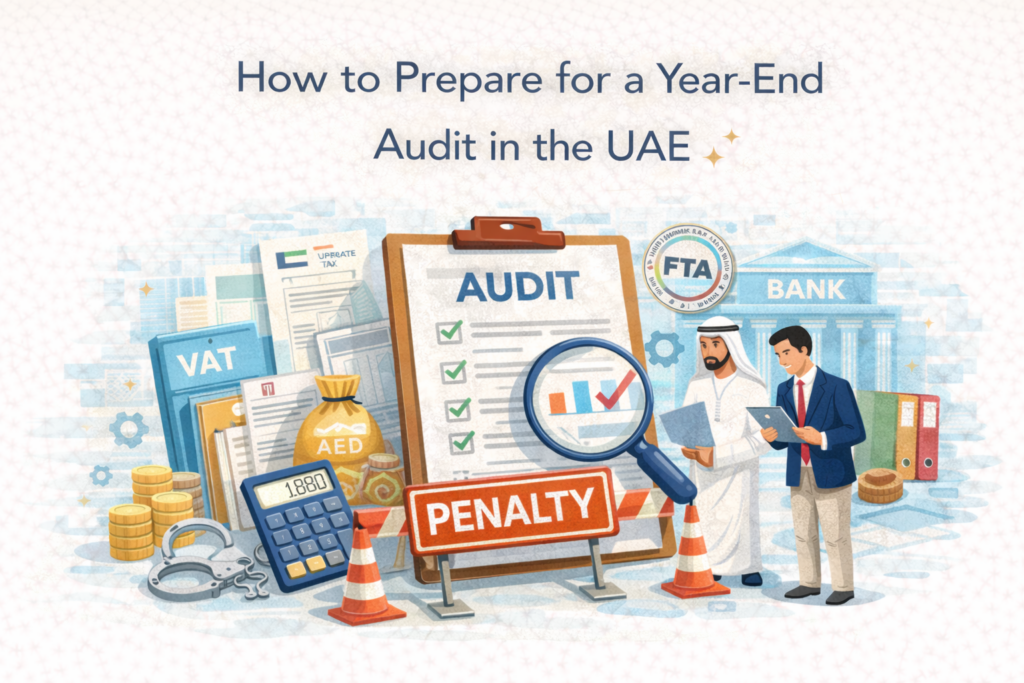
In the UAE’s regulated financial environment, year-end audits are no longer procedural formalities, they are compliance checkpoints. With Corporate Tax in force and stricter VAT enforcement, businesses must ensure their financial records can withstand scrutiny from auditors and regulators such as the Federal Tax Authority (FTA).
Proper year-end audit preparation reduces tax risk, strengthens financial credibility, and protects your business from penalties.
Whether you operate in Mainland UAE or a Free Zone, structured preparation is essential.
1️⃣ Understand Your Audit Requirement
Not every UAE business is legally required to conduct a statutory audit — but many are.
You may require an audit if:
- Your Free Zone authority mandates audited financials
- You are applying for bank facilities
- You are part of a corporate group
- Your Memorandum of Association requires it
- You need Corporate Tax compliance documentation
Confirm audit obligations early to avoid last-minute pressure.
2️⃣ Close Your Books Properly
A clean year-end close is the foundation of a smooth audit.
Key steps:
- Complete all journal entries
- Record accruals and prepayments
- Reconcile receivables and payables
- Depreciate fixed assets accurately
- Review inventory valuation
Unreconciled accounts are the most common audit delay.
Best practice: Conduct a pre-audit internal review before submitting records to auditors.
3️⃣ Perform Bank & VAT Reconciliations
Ensure:
- All bank accounts are reconciled
- Outstanding cheques are properly tracked
- VAT payable/receivable matches filed returns
- Input VAT claims are supported by valid tax invoices
Auditors will verify VAT balances against submitted returns.
Discrepancies can trigger compliance exposure.
4️⃣ Organize Supporting Documentation
Auditors typically request:
- Trade license copy
- Memorandum of Association
- VAT registration certificate (if applicable)
- Lease agreement (Ejari for Mainland)
- Bank statements
- Supplier and customer contracts
- Fixed asset register
- Payroll records
Missing documentation increases audit risk and extends timelines.
5️⃣ Review Revenue Recognition
Revenue must be recognized in accordance with accounting standards and UAE tax rules.
Red flags include:
- Unrecorded cash sales
- Revenue deferred without justification
- Incorrect cutoff at year-end
Ensure revenue aligns with invoices, contracts, and bank deposits.
6️⃣ Verify Expense Validity
Auditors will test expense claims for:
- Business purpose
- Proper approval
- Supporting invoices
- VAT compliance
Personal expenses booked under business accounts may create audit findings.
7️⃣ Assess Corporate Tax Readiness
With UAE Corporate Tax in effect:
- Confirm taxable income calculations
- Review non-deductible expenses
- Assess related-party transactions
- Prepare transfer pricing documentation if applicable
Year-end audit figures directly impact Corporate Tax reporting.
8️⃣ Prepare Management Representations
Auditors require written confirmation from management that:
- Financial statements are accurate
- All liabilities are disclosed
- No material information is concealed
Ensure directors understand their responsibilities.
9️⃣ Conduct an Internal Compliance Health Check
Before audit submission, review:
- Trade license validity
- UBO compliance
- AML policies (if applicable)
- ESR filings (if required)
An audit often reveals broader compliance gaps.
Common Mistakes That Delay UAE Audits
- Poor bookkeeping throughout the year
- Mixing personal and business expenses
- Delayed VAT reconciliations
- Lack of fixed asset tracking
- Unexplained related-party transactions
Preparation is a year-round process — not a last-week task.
Benefits of Proper Year-End Audit Preparation
✔ Faster audit completion
✔ Lower compliance risk
✔ Improved bank credibility
✔ Stronger investor confidence
✔ Better Corporate Tax positioning
In today’s UAE business environment, audited financial statements are strategic assets — not just compliance documents.
FAQs
1. When should I start preparing for a year-end audit?
Ideally 2–3 months before financial year closing.
2. Are Free Zone companies required to audit?
Many Free Zones require audited financials for license renewal.
3. Can poor audit preparation lead to tax penalties?
Yes, especially if discrepancies affect VAT or Corporate Tax reporting.
4. How long does a UAE audit take?
Typically 2–6 weeks depending on company size and record quality.
Final Thoughts
Year-end audit preparation in the UAE is not merely about satisfying auditors it is about ensuring regulatory compliance, financial transparency, and tax efficiency.
Businesses that maintain disciplined bookkeeping and structured documentation throughout the year experience smoother audits and lower regulatory risk.