

Table of Contents
ToggleFinancial KPIs Every UAE Business Owner Should Track
Running a business in the UAE has become more data-driven than ever. With VAT compliance, corporate tax, audits, and increasing banking scrutiny, business owners can no longer rely on bank balances alone to measure success.
To stay profitable, compliant, and investor-ready, UAE business owners need to track the right financial Key Performance Indicators (KPIs).
In this blog, we break down the most important financial KPIs every UAE business should monitor — why they matter, and how they support better decision-making, tax compliance, and long-term growth.
What Are Financial KPIs?
Financial KPIs are quantifiable metrics that help measure:
- Business performance
- Financial health
- Profitability
- Cash flow efficiency
- Compliance readiness
Tracking KPIs allows you to move from reactive decisions to strategic, informed control over your business.
Why Financial KPIs Matter for UAE Businesses
In the UAE’s regulatory environment, KPIs play a critical role in:
- VAT and corporate tax compliance
- Audit readiness
- Bank loan approvals
- Investor confidence
- Cash flow management
- Cost control
Without KPIs, financial issues often go unnoticed until they become serious problems.
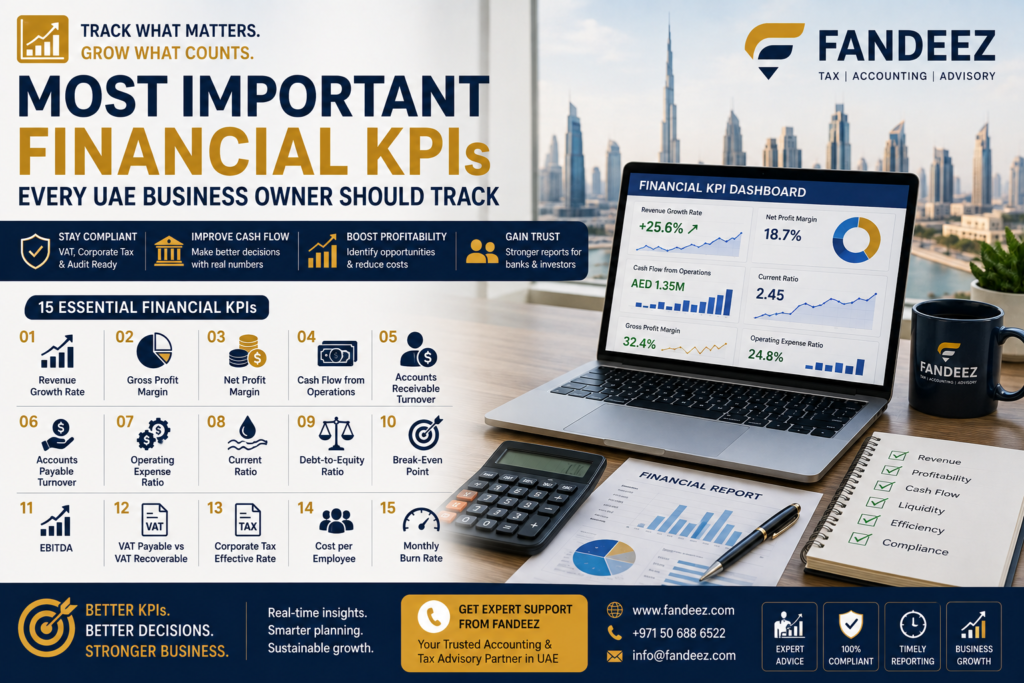
15 Key Financial KPIs to Track
1. Revenue Growth Rate
What it shows: How fast your business income is growing or declining.
Why it matters: Consistent revenue growth signals stability and scalability — a key factor for investors and banks.
Formula: (Current Period Revenue − Previous Period Revenue) ÷ Previous Period Revenue
2. Gross Profit Margin
What it shows: How much profit you retain after direct costs.
Why it matters: A declining gross margin can point to rising supplier costs, pricing issues, or operational inefficiencies.
Formula: (Gross Profit ÷ Revenue) × 100
3. Net Profit Margin
What it shows: Overall profitability after all expenses and taxes.
Why it matters: This KPI directly affects your corporate tax liability and long-term sustainability.
Formula: (Net Profit ÷ Revenue) × 100
4. Cash Flow from Operations
What it shows: Actual cash generated from core business activities.
Why it matters: Profitable businesses can still fail due to poor cash flow. Banks often prioritize cash flow over profit when evaluating loans.
5. Accounts Receivable Turnover
What it shows: How quickly customers pay you.
Why it matters: Slow collections lead to cash shortages and working capital stress.
Formula: Credit Sales ÷ Average Accounts Receivable
6. Accounts Payable Turnover
What it shows: How efficiently you pay your suppliers.
Why it matters: Balancing supplier payments helps maintain strong relationships without straining cash flow.
7. Operating Expense Ratio
What it shows: The share of revenue consumed by operating expenses.
Why it matters: A high ratio can signal inefficiencies or unnecessary costs.
Formula: Operating Expenses ÷ Revenue
8. Current Ratio
What it shows: Your ability to meet short-term liabilities.
Why it matters: Banks and auditors use this KPI to assess liquidity.
Formula: Current Assets ÷ Current Liabilities
9. Debt-to-Equity Ratio
What it shows: How much debt your business carries relative to equity.
Why it matters: High leverage increases financial risk and can reduce your chances of loan approval.
Formula: Total Liabilities ÷ Shareholder Equity
10. Break-Even Point
What it shows: The sales level required to cover all costs.
Why it matters: Understanding your break-even point supports smarter pricing, budgeting, and expansion decisions.
11. EBITDA
What it shows: Operational profitability before tax, interest, depreciation, and amortization.
Why it matters: Widely used by banks, investors, and during business valuations.
12. VAT Payable vs. VAT Recoverable
What it shows: Your overall VAT compliance position.
Why it matters: Misaligned VAT figures often trigger FTA audits and penalties.
13. Corporate Tax Effective Rate
What it shows: The actual tax paid relative to accounting profit.
Why it matters: Helps you assess how efficient your tax planning really is.
14. Cost per Employee
What it shows: Total employment cost relative to productivity.
Why it matters: Useful for workforce planning and improving operational efficiency.
15. Monthly Burn Rate (For Startups)
What it shows: How quickly cash reserves are being consumed.
Why it matters: Critical for startups managing runway and investor expectations.
How Often Should You Track Financial KPIs?
| Frequency | KPIs to Review |
|---|---|
| Daily / Weekly | Cash flow, sales, receivables |
| Monthly | Profitability, expenses, margins |
| Quarterly | Tax-related KPIs |
| Annually | Strategic KPIs for growth and valuation |
Common KPI Mistakes UAE Businesses Make
- Tracking too many KPIs at once
- Ignoring cash flow metrics
- Not reconciling KPIs with accounting records
- Relying on manual reporting prone to errors
- Focusing only on revenue while ignoring profitability
How Fandeez Helps Businesses Track the Right KPIs
At Fandeez, we help UAE businesses gain clarity and control through:
- Professional bookkeeping and accounting
- Management reports and KPI dashboards
- IFRS-compliant accounting
- VAT and corporate tax alignment
- Financial health checks and business advisory
- Audit-ready reporting
We turn numbers into actionable insights. Explore our full range of accounting and tax services to see how we can support your business.
Conclusion
Financial KPIs are no longer optional in today’s UAE business environment. Tracking the right metrics helps you stay compliant, profitable, and prepared for growth. If you don’t measure it, you can’t manage it.
Want clear financial KPIs for your business?
Let Fandeez help you track, interpret, and act on the numbers that matter. Check out our pricing plans or get in touch with our team to get started.
🌐 Visit: www.fandeez.com 📞 Talk to our accounting experts today