

Table of Contents
ToggleIf you run a business in the UAE, you have likely heard two terms floating around boardrooms and billing software: VAT and Excise Tax. While they are both indirect taxes collected by the Federal Tax Authority (FTA), treating them as the same thing is a costly mistake.
I have spoken to dozens of SME owners in Dubai and Abu Dhabi who assume that because they file VAT, they understand Excise Tax. They don’t. And that misunderstanding often leads to steep penalties.
In this guide, we will break down Excise Tax vs VAT in the UAE in plain English. You will learn exactly how they differ, which products they apply to, and how to keep your books clean. By the end, you will have a clear roadmap for UAE tax system compliance—without the headache.
What is VAT in the UAE?
Let us start with the more common one. VAT in the UAE stands for Value Added Tax. It was introduced on January 1, 2018, as part of a broader GCC agreement to diversify government revenue away from oil.
So, what is VAT in the UAE in simple terms? It is a consumption tax levied at each stage of the supply chain—from importation to manufacturing to the final sale to the customer. Unlike a sales tax, which is only charged at the point of sale to the end user, VAT is collected by every business in the chain. However, businesses can recover the VAT they pay on their own expenses (input tax) by offsetting it against the VAT they charge their customers (output tax).
The standard rate is 5%. There is also a zero rate (0%) for specific supplies like exports, international transport, and certain education and healthcare services. Some supplies are exempt altogether, such as residential property rentals (bare) and local passenger transport.
For most businesses, VAT is a pass-through mechanism. You collect it, hold it, and remit the difference to the FTA. But if you get the paperwork wrong, you pay the price.
Benefits of VAT in the UAE
Why did the UAE introduce VAT? Beyond revenue, there are practical benefits for the economy and compliant businesses:
- Diversified Government Revenue: Reduces reliance on oil, funding public services like roads, hospitals, and schools.
- Recoverable by Businesses: Registered businesses can claim back VAT on most business-related expenses, effectively making it a tax only on the final consumer.
- Low Rate: At 5%, the UAE has one of the lowest VAT rates globally, keeping the business environment competitive.
- Transparency: VAT invoices create a clear paper trail, which actually helps businesses track their own spending better.
What is Excise Tax in the UAE?
Now, let us talk about the heavier hitter. Excise tax in the UAE is a selective indirect tax imposed on specific goods that are considered harmful to human health or the environment. The government’s goal is not just revenue—it is public health.
Excise tax in the UAE was introduced in October 2017, a few months before VAT. It is often called a “sin tax” because it targets products like tobacco, energy drinks, and carbonated beverages. More recently, sweetened drinks and vape devices have been added to the list.
Unlike VAT, excise tax is charged only once—at the point of importation or production. You cannot pass it along in the same way as VAT. It is a cost that businesses absorb or pass on to consumers through higher shelf prices, but they cannot reclaim it.
The rates are significantly higher than VAT:
- 100% on tobacco and tobacco products
- 100% on energy drinks
- 50% on carbonated beverages
- 50% on sweetened beverages (added in 2019)
- 100% on electronic smoking devices and liquids (added in 2019)
If you import or manufacture these goods, you need an excise tax registration. And the penalties for non-compliance are brutal.
Benefits of Excise Tax in the UAE
You might wonder, “Why would I celebrate a tax?” For the UAE government and society, the benefits are clear:
- Public Health Improvement: Higher prices discourage consumption of tobacco, sugary drinks, and energy drinks.
- Reduced Healthcare Costs: Less consumption means fewer lifestyle diseases over the long term.
- Environmental Protection: Discourages single-use sugary and carbonated packaging.
- Specific Revenue Channel: Funds are often directed toward health services and awareness campaigns.
For a business owner, the benefit is indirect—a healthier workforce and a more sustainable market. But from a compliance perspective, ignoring it is not an option.
Key Differences Between Excise Tax and VAT in the UAE
This is the core of our discussion. Understanding the difference between excise tax and VAT in the UAE will save you from filing errors. While both are federal taxes managed by the FTA, they operate under completely different logics.
Here are the seven most important distinctions:
- Tax Base (What it applies to)
- VAT: Applies to most goods and services unless specifically zero-rated or exempt.
- Excise Tax: Applies only to a short, specific list of “sin goods”.
- Tax Rate
- VAT: Standard 5%, with 0% for certain supplies.
- Excise Tax: Much higher—50% or 100%.
- Point of Charge
- VAT: Charged at every stage of the supply chain (manufacturer → wholesaler → retailer → consumer).
- Excise Tax: Charged only once, at the point of importation or release from a designated zone.
- Recoverability
- VAT: Businesses can recover input VAT (the VAT they paid on purchases).
- Excise Tax: Generally NOT recoverable. It is a cost to the business.
- Registration Threshold
- VAT: Mandatory if annual supplies exceed AED 375,000. Voluntary if between AED 187,500 and AED 375,000.
- Excise Tax: No threshold. If you deal with excise goods, you MUST register immediately.
- Filing Frequency
- VAT: Usually quarterly; some large businesses file monthly.
- Excise Tax: Monthly filing is standard.
- Refund Mechanism
- VAT: Tourists can claim refunds via the system. Businesses file regular returns.
- Excise Tax: No refunds for businesses or tourists.
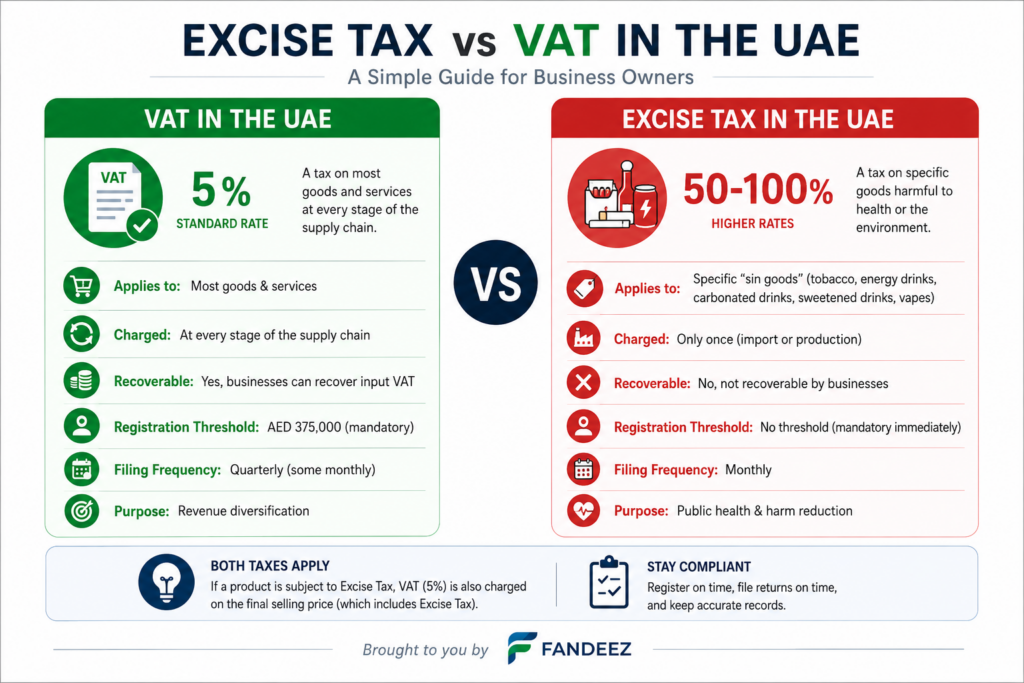
Detailed Comparison Table: Excise Tax vs VAT in the UAE
For a quick reference, here is how VAT vs excise tax stack up side by side:
Feature | VAT in the UAE | Excise Tax in the UAE |
Introduction Date | January 1, 2018 | October 1, 2017 |
Tax Rate | 5% (standard), 0% (zero-rated) | 50% or 100% |
Applicable Products | General goods & services | Tobacco, energy drinks, carbonated drinks, sweetened drinks, vapes |
Charge Point | Multiple stages (value-added chain) | Single stage (import or production) |
Recoverable by Business? | Yes (input tax recovery) | No |
Registration Threshold | AED 375,000 (mandatory) | No threshold (mandatory immediately) |
Filing Frequency | Quarterly (or monthly) | Monthly |
Primary Purpose | Revenue diversification | Public health & harm reduction |
Products Covered Under VAT in the UAE
To understand the UAE tax system, you need to know which goods attract which tax. Most people assume everything is at 5%. That is not true.
Products covered under VAT in the UAE at the standard 5% rate include the following:
- Electronics (phones, laptops, TVs)
- General food items (restaurant meals, packaged snacks)
- Clothing and footwear
- Furniture and home appliances
- Petrol and diesel (yes, fuel has VAT)
- Construction materials
- Professional services (legal, consulting, marketing)
Zero-rated (0%) products include:
- Exported goods
- International air and sea transport
- First sale of residential property (within 3 years of completion)
- Certain educational services and supplies
- Preventative healthcare services
Exempt products (no VAT and no recovery):
- Residential property rent (bare, not serviced)
- Local passenger transport (buses, taxis, metro)
- Life insurance and reinsurance
- Financial services (certain types)
Notice that exempt means you cannot charge VAT, but you also cannot recover VAT on your related expenses.
Products Covered Under Excise Tax in the UAE
This list is much shorter, but the compliance burden is heavier.
Products covered under excise tax in the UAE currently include the following:
- Tobacco and tobacco products (100% tax) – cigarettes, shisha, cigars, and pipe tobacco.
- Energy drinks (100% tax) – any drink marketed to boost energy containing stimulants like caffeine, taurine, or ginseng.
- Carbonated beverages (50% tax) – sodas, sparkling water with added sugar or sweeteners.
- Sweetened beverages (50% tax) – any drink with added sugar or artificial sweeteners, including juices, flavoured milk, and non-carbonated sweet drinks.
- Electronic smoking devices (100% tax) – vapes, e-cigarettes, and the liquids used in them.
Important nuance: Plain sparkling water with no added sugar or sweetener is not subject to excise tax. Also, medical drinks and milk substitutes for infants are excluded.
If you run a grocery store, a cafe, or a trading company, do not assume you are safe just because you do not sell cigarettes. Sweetened drinks catch many businesses off guard.
How VAT and Excise Tax Work Together in the UAE
Here is where it gets tricky. On certain products, both taxes apply. They are not mutually exclusive.
If you import a can of an energy drink, you will pay Excise Tax (100%) at the time of import. Then, when you sell that same can to a customer, you will charge VAT (5%) on the final selling price—which already includes the Excise Tax.
In other words, you pay tax on tax. The Excise Tax becomes part of the cost base, and then VAT is applied on top of that total.
For businesses, this means you need two separate accounting lines. You cannot roll them into one. And you definitely cannot ignore Excise Tax just because you already filed VAT.
Example Calculation of VAT and Excise Tax
Let us walk through a real example. Suppose you are a UAE distributor importing 1,000 cans of an energy drink.
- Cost per can from supplier: AED 2.00
- Excise Tax (100%): AED 2.00 per can
- Cost after Excise Tax: AED 4.00 per can
Now, you sell that can to a retailer for AED 5.00 per can.
- VAT (5% on AED 5.00): AED 0.25
- Final invoice to retailer: AED 5.25 per can
You must remit:
- Excise Tax: AED 2.00 per can (total AED 2,000) to the FTA on your monthly Excise return.
- VAT: AED 0.25 per can (total AED 250), but you can recover VAT you paid on import (if any) on your quarterly VAT return.
If you incorrectly charge VAT at 5% on the original AED 2.00 cost (ignoring Excise Tax), you underpay VAT. The FTA will catch this in an audit.
Why Understanding Excise Tax vs VAT in the UAE Matters for Your Business
You might think, “I do not sell tobacco or energy drinks, so I am fine.” But the lines blur. A small cafe selling a sweetened bottled latte? That falls under Excise Tax if it contains added sugar. A grocery store selling imported cola? Excise Tax.
The difference between excise tax and VAT in the UAE matters for three reasons:
- Penalties are severe. Late registration for excise tax carries fines up to AED 20,000. Filing incorrect returns adds more.
- Cash flow impact. Excise tax is due monthly and is not recoverable. You need cash on hand.
- Pricing strategy. If you do not factor 50% or 100% excise tax into your landed cost, you will sell at a loss.
I have seen a trading company in Sharjah face AED 150,000 in penalties simply because they misclassified sweetened flavoured water as regular water. Do not let that be you.
Common Compliance Mistakes Businesses Make
Even experienced finance managers slip up. Here are the most frequent errors:
- Using VAT return fields for Excise Tax. They are separate returns in the FTA portal.
- Forgetting to register for Excise Tax. If you import any excise goods even once, you must register. No threshold.
- Incorrect product classification. What you call “health drink” might be an “energy drink” under FTA rules.
- Missing monthly filing deadlines. Excise returns are due by the 15th of the following month.
- Not maintaining separate stock records. FTA auditors expect to see physical segregation of excise goods from non-excise goods in your warehouse.
- Assuming tourism refunds apply to Excise Tax. They do not.
VAT Compliance UAE Requirements
To stay on the right side of the FTA, every business needs a solid VAT compliance UAE framework. Here is what that looks like:
- Register if your taxable supplies exceed AED 375,000 (or voluntarily between AED 187,500 and AED 375,000).
- Issue tax invoices for every taxable supply (AED 10,000+ requires detailed invoice).
- Maintain records for 5 years (some records for 15 years under related laws).
- File VAT returns on time—usually quarterly. The deadline is the 28th of the month following the tax period.
- Pay any due VAT by the same deadline.
- Claim input VAT only on qualifying business expenses with proper invoices.
Failure to file on time incurs a late filing penalty of AED 1,000 for the first time and AED 2,000 for repeat offenses within 24 months. Late payment penalties are 2% on unpaid tax immediately, plus 4% after 7 days, plus 1% daily after 30 days.
Excise Tax Compliance UAE Requirements
Excise tax compliance The UAE is stricter and leaves less room for error:
- Mandatory registration before any import, production, or release of excise goods. No threshold.
- Monthly returns filed by the 15th of the following month.
- Payment due by the same date (15th of the next month).
- Marking scheme for certain tobacco and vape products (digital tax stamps).
- Physical stock records with clear segregation.
- Designated zone rules – goods moving between designated zones have specific suspension rules.
The penalties are higher: AED 20,000 for failing to register, AED 5,000 for failing to appoint a tax agent, and potential imprisonment for severe evasion.
Tips to Stay Compliant in the UAE Tax System
Here is my practical advice based on helping dozens of businesses pass FTA audits:
Separate your ledgers. Use different general ledger codes for VAT and Excise Tax. Do not mix them.
Train your procurement team. They need to ask suppliers: “Does this product contain added sugar or stimulants?”
Review your product portfolio every quarter. FTA updates excise product lists occasionally.
Schedule monthly Excise Tax reviews. Do not wait for quarterly VAT filing.
Use FTA-approved accounting software that supports both tax types.
Keep digital copies of all import documents. Customs declarations show excise paid.
Appoint a tax agent if you handle excise goods. The FTA recommends it.
And the best tip? Work with experts who live and breathe UAE tax every day.
Conclusion
Navigating the UAE tax system does not have to feel like walking through a minefield. But ignoring the real differences between Excise Tax vs VAT in the UAE is a risk no business should take.
To summarise: VAT is broad, low-rate (5%), recoverable, and applies across most goods and services. Excise Tax is narrow, high-rate (50–100%), non-recoverable, and targets specific harm-reduction goods like tobacco, energy drinks, and sweetened carbonated beverages. They are filed on different schedules, registered separately, and enforced with different penalties.
Whether you are a startup selling bottled juices or a distributor handling tobacco products, getting this right protects your cash flow, your reputation, and your bottom line.
Let Fandeez Handle Your VAT and Excise Tax Compliance
You did not start your business to become a tax accountant. That is where Fandeez comes in.
As a trusted UAE business advisory and tax consultancy, Fandeez helps businesses like yours navigate VAT compliance UAE and Excise tax compliance UAE with confidence. From registration and filing to audit defense and product classification, our experts ensure you never miss a deadline or overpay a dirham.