

Table of Contents
ToggleIs there actually a country without taxes where you can legally keep more of what you earn?
The honest answer is yes. And there are more of them than most people realise.
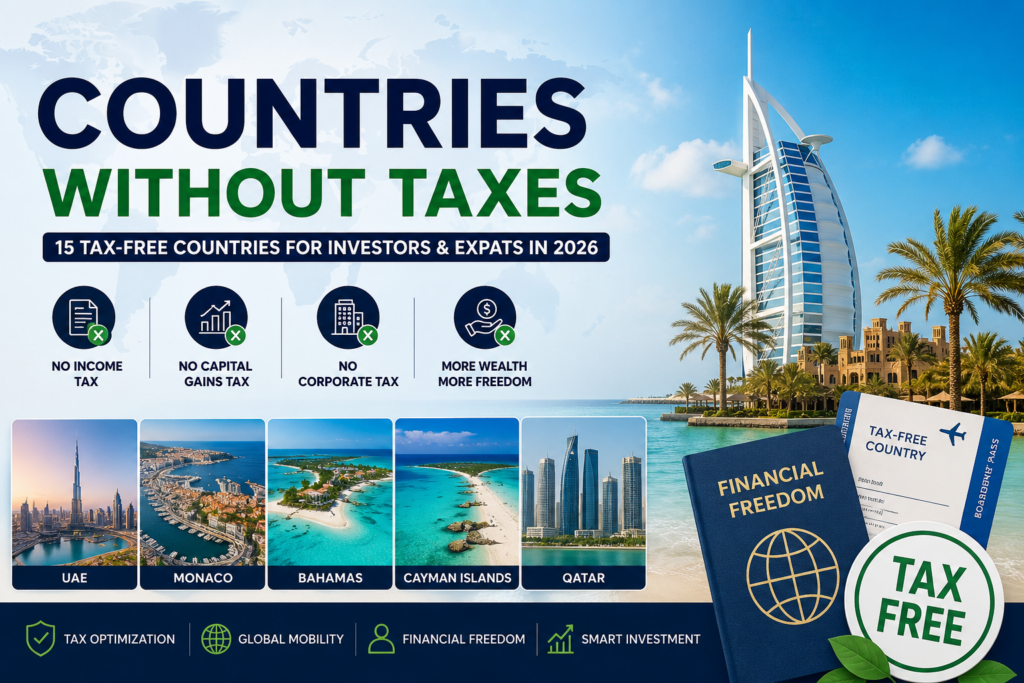
Countries without taxes have become some of the most sought-after destinations in the world. Business owners, digital nomads, retirees, and global investors all share the same goal: keep more of what they earn, legally and securely.
This guide covers the top 15 tax-free countries in 2026, explains how they fund public services without taxing income, and makes the case for why the UAE, and Dubai in particular, remains the world’s most practical tax-friendly destination.
What Are Countries Without Taxes?
A country without taxes imposes little or no direct taxation on individuals or businesses. In practical terms, this usually means no personal income tax, no capital gains tax, no inheritance tax, and sometimes no corporate tax either.
No country runs entirely without revenue, though. Even the most tax-free jurisdictions collect money through other means — oil and gas revenues, tourism levies, import duties, VAT, and property fees all fund public services. What makes a country tax-free is the absence of direct taxes on income and wealth, not the absence of government income altogether.
For entrepreneurs and investors, this distinction matters enormously. Establishing tax residency in a zero-tax country can mean retaining 100% of your salary or investment returns, compared with handing over 40% or more under a high-tax regime.
Quick Comparison: Tax-Free Countries at a Glance
|
Country |
Personal Income Tax |
Capital Gains Tax |
Corporate Tax |
|
UAE |
0% |
0% |
9% (above AED 375,000) |
|
Monaco |
0% |
0% |
Only for international revenue >25% |
|
Bahamas |
0% |
0% |
0% |
|
Bermuda |
0% |
0% |
0% |
|
Cayman Islands |
0% |
0% |
0% |
|
Qatar |
0% |
0% |
10% (foreign-owned) |
|
Bahrain |
0% |
0% |
Oil companies only |
|
Kuwait |
0% |
0% |
15% (foreign-owned) |
|
Saudi Arabia |
0% |
0% |
20% (foreign-owned) + Zakat |
|
Brunei |
0% |
0% |
18.5% |
|
Vanuatu |
0% |
0% |
0% |
|
Turks and Caicos |
0% |
0% |
0% |
|
Saint Kitts and Nevis |
0% |
0% |
33% (resident companies) |
|
Antigua and Barbuda |
0% |
0% |
25% |
|
British Virgin Islands |
0% |
0% |
0% |
Top 15 Countries Without Taxes in 2026
- United Arab Emirates. The UAE is the most accessible and well-developed tax-free destination in the world. There is no personal income tax, no capital gains tax, and no inheritance tax. A 9% corporate tax was introduced in 2023, but businesses earning up to AED 375,000 in annual profit pay 0%, and qualifying Free Zone companies continue to benefit from 0% on qualifying income. A 5% VAT applies on most goods and services — see Fandeez’s complete guide to VAT in the UAE for details. Residency is genuinely accessible through investor visas, freelancer visas, the 10-year Golden Visa, and retirement visas.
- Monaco. Monaco has levied no personal income tax since 1869. It remains the benchmark for ultra-high-net-worth individuals wanting a European lifestyle without a European tax bill. Corporate tax applies only to companies earning more than 25% of revenue outside Monaco. The main limitation is cost — property and living expenses are extremely high.
- Bahamas. No income tax, no capital gains tax, no corporate tax, and no inheritance tax. Public services are funded through VAT, import duties, and tourism revenues. Residency by property investment is straightforward, making it popular with retirees and entrepreneurs.
- Bermuda. No income tax, no capital gains tax, no corporate tax, and no withholding tax. Particularly popular with global insurance and reinsurance companies. Residency is harder to obtain than in many other destinations.
- Cayman Islands. No direct taxes whatsoever — no income tax, no corporate tax, no capital gains tax, no payroll tax. A leading global financial centre for hedge funds and offshore corporate structures, though individual residency is not straightforward.
- Qatar. No personal income tax. The country funds public services almost entirely through oil and gas revenues. A 10% corporate tax applies to foreign-owned businesses, though Qatari and GCC-owned entities are generally exempt.
- Bahrain. No personal income tax, no capital gains tax, no withholding tax. Corporate tax applies only to oil companies. One of the most open economies in the GCC, increasingly popular with fintech and financial services businesses.
- Kuwait. No personal income tax, funded primarily by oil revenues. A 15% corporate tax applies to foreign-owned companies, though Kuwaiti and GCC partners are generally exempt.
- Saudi Arabia. No personal income tax for residents. A 20% corporate tax applies to foreign-owned entities, alongside Zakat at 2.5% on Saudi and GCC shareholders. Vision 2030 has opened the Kingdom up significantly, though tax residency remains more complex than in the UAE.
- Brunei. No personal income tax for decades, funded by oil and gas revenues. Corporate tax applies at 18.5%. Not a major destination for international entrepreneurs, but notable for its zero personal income tax position.
- Vanuatu. No income tax, no capital gains tax, no inheritance tax. Best known for its citizenship by investment programme, one of the fastest in the world at around 30 days.
- Turks and Caicos Islands. No income tax, no capital gains tax, no corporate tax. Operates under English common law, with residency available through property investment.
- Saint Kitts and Nevis. No income tax, no capital gains tax, no inheritance tax. Runs one of the world’s most reputable citizenship by investment programmes.
- Antigua and Barbuda. No personal income tax, no capital gains tax, no inheritance tax. Offers a citizenship by investment programme for qualifying investors.
- British Virgin Islands. No income tax, no capital gains tax, no inheritance tax, no sales tax. One of the world’s most widely used jurisdictions for corporate structures and holding companies, though residency options are limited.
Why Does Dubai Have No Tax?
This is one of the most frequently asked questions on the topic, and the answer lies directly in the UAE’s economic history.
Dubai, and the UAE more broadly, was built on oil revenues. For decades, hydrocarbon wealth meant the government had no need to tax residents or businesses to fund public services. Over time, the UAE deliberately used its tax-free status as a tool for economic diversification, attracting foreign capital, international businesses, and skilled professionals who would not relocate if they faced a heavy income tax bill.
Today, the UAE has diversified well beyond oil. The economy runs on trade, tourism, real estate, financial services, and technology. Government revenue comes from VAT at 5%, corporate tax at 9% on profits above AED 375,000, trade and licensing fees, and tourism levies.
Personal income tax, however, remains absent. That is a policy choice, not an accident. A doctor, engineer, or consultant living in Dubai keeps every dirham of their earnings — for someone earning AED 50,000 a month, that is tens of thousands of pounds saved annually compared with the UK or much of Europe.
For the full picture on business taxation, see Fandeez’s guide to income tax in UAE for companies. According to the UAE Ministry of Finance, the Corporate Tax regime was designed to consolidate the UAE’s position as a leading global hub for business while remaining one of the most competitive systems in the world.
Zero Capital Gains Tax Countries
For investors in equities, real estate, or cryptocurrency, capital gains tax can be the single largest liability in a high-tax jurisdiction. The UAE, Bahamas, Cayman Islands, Bermuda, Monaco, Vanuatu, Turks and Caicos, Saint Kitts and Nevis, Antigua and Barbuda, and the British Virgin Islands all impose zero capital gains tax.
The UAE stands apart from this group. It combines zero capital gains tax with a world-class financial centre, straightforward residency pathways, strong banking infrastructure, and a stable legal environment — advantages that small island jurisdictions rarely match.
Tax-Free Country vs Low-Tax Country
A tax-free country eliminates personal income tax entirely. A low-tax country still charges income tax, but at significantly lower rates than major economies. Georgia charges a flat 20%, Andorra caps personal tax at 10%, and Cyprus applies a flat 12.5% corporate tax with substantial exemptions. For most investors and entrepreneurs, a genuinely tax-free country with accessible residency, such as the UAE, remains the stronger option.
Benefits and Risks of Tax-Free Jurisdictions
The most obvious benefit of a tax-free country is financial: keeping more of what you earn. Many of these destinations, particularly the UAE, also offer strong infrastructure, straightforward business registration, and internationally minded communities.
But tax-free living is not without complications. Your home country’s rules may still follow you — many high-tax countries have exit tax rules or requirements to keep paying tax on worldwide income for a period after leaving. Residency requirements are also real: most jurisdictions require genuine physical presence, typically 183 days a year, and a visa alone is rarely sufficient. Banking and infrastructure vary too, with smaller island jurisdictions often offering more limited options than the UAE, Bahamas, or Cayman Islands.
This is exactly why professional tax advisory matters before making any move. Getting the structure right from the outset is far less costly than correcting it later.
How to Become a Tax Resident in a Tax-Free Country
Becoming a tax resident is not simply a matter of arriving and staying. Most jurisdictions require a minimum physical presence, usually 183 days a year, a qualifying basis for residency such as employment or investment, and formal registration with the local authority.
In the UAE, obtaining a residency visa through employment, business ownership, or property investment is the first step. After meeting the 180-day presence requirement, individuals can apply for a Tax Residency Certificate, often needed to claim treaty benefits or prove non-residency elsewhere.
Why the UAE Remains the Most Attractive Tax-Friendly Destination
Among all the countries without taxes in this guide, the UAE is the only jurisdiction that combines zero personal income tax, a clear corporate tax framework, over 40 free zones with qualifying 0% corporate tax, zero capital gains tax, world-class infrastructure, and multiple accessible residency pathways.
For entrepreneurs, the UAE’s Free Zone network is unmatched anywhere in the world — read Fandeez’s full breakdown of UAE Free Zone tax benefits. For those considering the move, Fandeez has also published a practical guide to the real cost of starting a business in Dubai in 2026.
How Fandeez Helps Businesses and Investors in the UAE
Relocating to or setting up in a tax-free country is only the first step. Getting the structure right is what determines whether you actually benefit from the advantages you moved for.
Fandeez Business Solutions supports entrepreneurs and investors with bookkeeping and accounting services that keep your books FTA-compliant, corporate tax consultants who handle registration and return filing, end-to-end VAT registration and return filing, and full business setup support covering company formation, free zone selection, and visa applications.
Frequently Asked Questions
What countries don’t have taxes? Countries with no personal income tax include the UAE, Monaco, Bahamas, Bermuda, Cayman Islands, Qatar, Bahrain, Kuwait, Brunei, Vanuatu, Turks and Caicos, Saint Kitts and Nevis, Antigua and Barbuda, and the British Virgin Islands.
Is there a country without taxes on everything? No country eliminates every form of taxation. The Cayman Islands and Bermuda come closest, with no income, corporate, or capital gains tax, though fees and duties still apply.
Which country is completely tax free? The Cayman Islands is often cited as the closest, though import duties and fees still apply. For a practical, liveable destination, the UAE remains the stronger choice.
Why does Dubai have no income tax? Dubai’s economy was built on oil revenues, removing the need to tax residents. Today, zero personal income tax is a deliberate policy to attract foreign investment and skilled professionals.
Does Dubai have any taxes at all? Yes. VAT at 5%, corporate tax at 9% above AED 375,000, and excise tax on select goods. There is no personal income tax, capital gains tax, or inheritance tax.
What are the best zero capital gains tax countries? The UAE, Cayman Islands, Bermuda, Bahamas, Monaco, Vanuatu, Saint Kitts and Nevis, and Turks and Caicos. The UAE is the most practical for active investors due to its infrastructure and ecosystem.
Can foreigners live in tax-free countries? Yes. The UAE is the most accessible, offering investor, freelancer, Golden, and retirement visas. Saint Kitts and Nevis, Vanuatu, and Antigua and Barbuda offer citizenship by investment.
Which GCC countries have no income tax? All six GCC states — UAE, Saudi Arabia, Qatar, Bahrain, Kuwait, and Oman — currently impose no personal income tax, though Oman is set to introduce one from 2028.
Are tax-free countries safe and stable for businesses? Many are. The UAE, Cayman Islands, Bermuda, and Bahamas have stable governments and strong legal frameworks. Smaller island jurisdictions vary and should be assessed carefully.
How can I move to a tax-free country? The process depends on the destination. For the UAE, a business licence, employment contract, or qualifying investment typically secures a residency visa. Working with experienced UAE business setup specialists from the start avoids costly mistakes.
Conclusion
Countries without taxes are no longer an option reserved only for the ultra-wealthy. With the right advice and structure, entrepreneurs and investors can legally reduce their tax burden by relocating to or incorporating in a zero-tax jurisdiction.
Among all the options available in 2026, the UAE stands in a class of its own — no personal income tax, zero capital gains tax, accessible residency, and world-class infrastructure combine to make it the most complete tax-friendly destination on this list.
If you are ready to explore what the UAE can offer for business setup, corporate tax planning, VAT compliance, or accounting and bookkeeping support, Fandeez Business Solutions is here to guide you through every step. Visit https://fandeez.com for a free consultation.