

Table of Contents
ToggleWhat Are Corporate Tax Deductions in UAE?
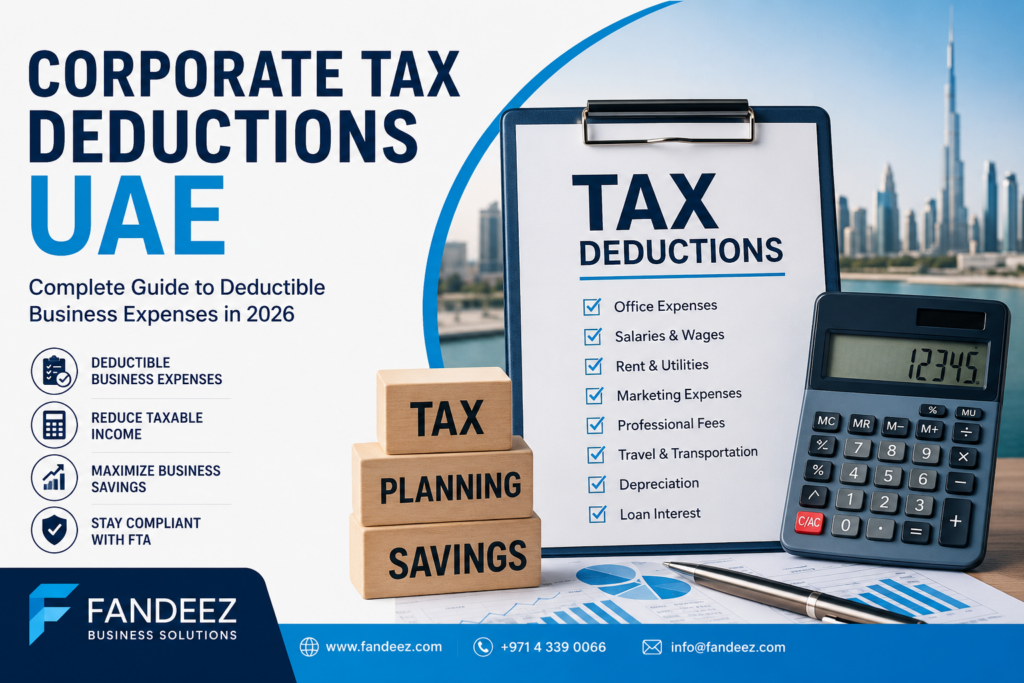
Corporate Tax Deductions UAE are the business expenses that UAE Corporate Tax law allows you to subtract from your revenue before working out how much tax you owe. Getting them right is one of the most direct ways a business can legally control its tax bill.
Under Federal Decree-Law No. 47 of 2022, the UAE taxes taxable income — not total revenue. Taxable income is your revenue minus your allowable business expenses, so the more correctly you claim, the less Corporate Tax you pay.
Think of it this way: if your business earns AED 1,000,000 in revenue but spends AED 600,000 on legitimate business expenses, your taxable income is AED 400,000 — and you only pay 9% on the amount above AED 375,000. Understanding UAE Corporate Tax Deductions isn’t just a compliance exercise; it’s a direct lever on your tax liability.
How Corporate Tax Deductions Work in UAE
Here’s a simple breakdown of how deductions reduce tax liability:
| Line Item | Amount (AED) |
|---|---|
| Total Revenue | 1,500,000 |
| Less: Allowable Business Expenses | (900,000) |
| Net Profit (Taxable Income) | 600,000 |
| Less: 0% Threshold | (375,000) |
| Taxable Amount | 225,000 |
| Corporate Tax at 9% | 20,250 |
Without claiming deductions correctly, a business with AED 1,500,000 revenue and AED 900,000 in real expenses could end up calculating tax on the full AED 1,500,000 — resulting in a significantly higher, incorrect tax bill.
Practical example. A Dubai-based marketing consultancy earns AED 800,000 a year. It pays AED 120,000 in staff salaries, AED 60,000 in office rent, AED 40,000 in software subscriptions, and AED 30,000 in marketing expenses — AED 250,000 in total deductible expenses. That brings taxable income down to AED 550,000, with tax owed at 9% of AED 175,000 (the amount above AED 375,000) = AED 15,750.
Allowable Business Expenses Under UAE Corporate Tax
Office Rent. Rent paid for space used exclusively for business — your main office, warehouses, retail units, or free zone flexi-desks — is fully deductible. Keep your tenancy contract and Ejari registration as supporting evidence. Example: a mainland LLC paying AED 80,000 a year for a Dubai office can deduct the full amount.
Employee Salaries and Wages. Salaries, wages, bonuses, allowances, and end-of-service gratuity paid to genuine employees performing real roles are deductible, provided they’re reasonable and commercially justified. Payments to owner-managers or related parties must be at arm’s length — inflated shareholder salaries used to reduce taxable profit invite FTA scrutiny.
Utilities. Water, electricity, gas, and other utility bills for business premises are deductible — keep monthly bills clearly linked to your business address.
Marketing and Advertising. Digital advertising (Google Ads, Meta Ads), print, outdoor, trade shows, PR, and branding costs directly related to your business are fully deductible. Example: a retail business spending AED 50,000 on Google Ads can deduct the full amount.
Professional Fees. Legal fees, consulting fees, and other professional service costs incurred for business purposes — contract advice, HR consulting, management consulting, regulatory advisory — are deductible.
Accounting and Bookkeeping. Fees paid to accountants and bookkeepers for financial statement preparation and tax compliance are deductible, which makes working with a professional firm a tax-efficient decision in its own right. Learn more about Bookkeeping and Accounting services at Fandeez.
Audit Fees. External audit fees paid to licensed auditors are deductible. Businesses above AED 50 million revenue are required to have audited financial statements, but audit fees remain deductible below that threshold too. See Auditing Services at Fandeez.
Business Insurance. Premiums for professional indemnity, public liability, property, and employer liability insurance are deductible when incurred for business purposes.
Office Supplies. Stationery, printing, office furniture below the capitalization threshold, and everyday consumables are deductible.
Software Subscriptions. Accounting software, CRM systems, project management tools, cloud storage, and cybersecurity subscriptions are deductible. Example: a business paying AED 15,000 a year for accounting software can deduct the full amount.
Internet and Telephone. Business internet, telephone, and mobile costs are deductible. If a personal phone is used partly for business, only the business-use portion qualifies — document the split.
Travel Expenses. Flights, hotels, and ground transportation incurred wholly for business purposes are deductible, with receipts and evidence of business purpose kept for each trip. Personal travel components are not deductible — if a business trip is extended for leisure, only the business portion qualifies.
Vehicle Expenses. Vehicles used exclusively for business — delivery vehicles, sales team cars — can have running costs (fuel, insurance, maintenance) deducted. Personal-use vehicles are not deductible, and mixed-use vehicles require apportionment.
Bank Charges. Bank fees, transaction charges, and wire transfer costs incurred in the normal course of business are deductible.
Loan Interest. Interest on business loans and financing is deductible, subject to the General Interest Deduction Limitation Rule. For businesses above AED 12 million revenue, net interest expense is capped at 30% of EBITDA; below that threshold, interest is generally fully deductible.
Training Costs. Employee training, professional development, certifications, and workshops relevant to the business are deductible.
Business Licenses and Regulatory Fees. Annual trade license renewals, free zone license fees, and other regulatory fees paid to government authorities are deductible.
Depreciation. Capital assets — equipment, machinery, computers, furniture above the capitalization threshold — can’t be deducted in full in the year of purchase. Instead, they’re depreciated over their useful life, with the annual depreciation charge deductible. UAE Corporate Tax follows IFRS-based depreciation methods, so keep your depreciation schedule properly maintained.
Repairs and Maintenance. Routine repairs and maintenance for business assets and premises are deductible. Capital improvements that significantly extend an asset’s life or value must be capitalized and depreciated instead of expensed immediately.
Non-Deductible Expenses in UAE
Not every business expense qualifies. The main non-deductible categories are:
- Personal expenses — anything benefiting the owner personally rather than the business (groceries, family holidays, personal clothing)
- Fines and penalties — administrative penalties, FTA fines, and legal penalties are explicitly non-deductible
- Illegal payments — bribes, kickbacks, or any payment violating UAE law
- Excess entertainment expenses — only 50% of client meals, events, and gifts are deductible; the other 50% is disallowed
- Donations to non-qualifying entities — only donations to recognized Qualifying Public Benefit Entities are deductible
- Capital expenditure — the full cost of capital assets can’t be deducted in the purchase year, only annual depreciation
- Non-business costs — any expense without a clear, demonstrable business purpose
- Related-party payments above arm’s length — payments to shareholders or connected companies exceeding what an independent third party would charge
Conditions for Claiming Corporate Tax Deductions
Quick checklist — every expense must be:
- Wholly and exclusively incurred for business purposes
- Actually paid or accrued during the Tax Period
- Supported by valid invoices or receipts
- Recorded in your accounting books
- Supported by bank payment evidence
- Not specifically excluded by UAE Corporate Tax law
- Priced at arm’s length, for related-party transactions
The FTA can request supporting documentation during an audit. If a claimed deduction can’t be evidenced, it may be disallowed — potentially resulting in additional tax and penalties.
Documents Required for Every Deduction
Maintain these records for every deduction claimed:
- Tax invoices from suppliers (VAT invoices where applicable)
- Bank statements showing payment
- Contracts and agreements (rent, employment, professional services)
- Payroll records and WPS (Wages Protection System) statements
- Depreciation schedule for fixed assets
- Entertainment expense log with business purpose noted
- Travel expense reports with business purpose
- Vehicle usage log (for mixed-use vehicles)
- Loan agreements for interest deductions
- Training invoices and attendance records
Keep all records for a minimum of 7 years — the FTA’s audit window.
Common Mistakes Businesses Make with Tax Deductions
- Mixing personal and business expenses — running personal costs through the company account and claiming them as deductions.
- Missing the 50% entertainment rule — claiming 100% of client entertainment costs instead of the allowable 50%.
- No supporting documentation — claiming deductions without invoices, receipts, or bank evidence.
- Deducting capital assets in full — expensing computers, machinery, or furniture in one year instead of depreciating them.
- Ignoring the interest deduction cap — businesses above AED 12 million revenue deducting net interest beyond 30% of EBITDA.
- Related-party payments not at arm’s length — inflated shareholder-director salaries with no commercial justification.
- Deducting fines and penalties — incorrectly running FTA penalties or traffic fines through the company.
- Poor depreciation records — no proper fixed asset register or depreciation schedule.
- Claiming non-business travel — deducting personal holidays with no business purpose.
- Not separating VAT from expense amounts — for VAT-registered businesses, reclaimable input VAT shouldn’t be included in the deduction amount.
Tax Planning Tips to Maximize Your Deductions
- Plan large purchases before year-end. Timing equipment or software purchases before your Tax Period end date brings the depreciation deduction forward.
- Document entertainment expenses immediately. Note the business purpose and attendees right after every client meeting — reconstructing this months later is far harder.
- Use proper accounting software. Cloud tools like Xero or QuickBooks automatically categorize expenses, making every deduction easier to identify and substantiate.
- Review related-party transactions annually. Confirm all payments to connected parties are properly documented and commercially justifiable before your Tax Period closes.
- Work with a Corporate Tax consultant. The most reliable way to maximize deductions without compliance risk is working with advisors who stay current with FTA updates. Fandeez Business Solutions reviews client accounts specifically to identify missed deductions and ensure every allowable expense is correctly claimed.
Example Corporate Tax Deduction Calculation
| Line Item | Amount (AED) |
|---|---|
| Total Revenue | 2,000,000 |
| Office Rent | (120,000) |
| Staff Salaries | (450,000) |
| Marketing and Advertising | (80,000) |
| Professional and Accounting Fees | (40,000) |
| Software Subscriptions | (25,000) |
| Travel Expenses | (30,000) |
| Utilities and Internet | (18,000) |
| Depreciation | (35,000) |
| Bank Charges and Loan Interest | (22,000) |
| Entertainment (50% allowable) | (15,000) |
| Total Allowable Deductions | (835,000) |
| Taxable Income | 1,165,000 |
| Less: 0% Threshold | (375,000) |
| Amount Subject to 9% Tax | 790,000 |
| Corporate Tax Payable | 71,100 |
Without properly claiming deductions, this same business might incorrectly calculate tax on the full AED 2,000,000 — resulting in a much higher tax bill than it actually owes.
Benefits of Claiming Corporate Tax Deductions
- Lower taxable income — every AED 100,000 of correctly claimed deductions saves AED 9,000 in Corporate Tax.
- Better cash flow — a reduced tax liability leaves more cash in the business for reinvestment and growth.
- Full FTA compliance — correctly claiming only allowable deductions, with proper documentation, keeps the business safe from penalties.
- Better financial visibility — the process of identifying and documenting deductions pushes businesses toward cleaner, more accurate accounts year-round.
- Stronger financial planning — understanding deductible expenses makes tax liability far easier to forecast.
How Fandeez Business Solutions Can Help
Getting Corporate Tax Deductions UAE right takes more than basic bookkeeping — it requires a clear understanding of UAE Corporate Tax law, IFRS-based accounting, and FTA compliance requirements. Our ACCA-certified team at Fandeez Business Solutions provides:
- Corporate Tax Registration and Filing — registering your business with the FTA and preparing your tax computation to ensure every allowable deduction is correctly applied
- Tax Planning — reviewing your business expenses and structure to legally minimize your tax liability
- Accounting and Bookkeeping — maintaining accurate financial records year-round so your deductions are always substantiated
- Auditing Services — compliance reviews that identify deduction opportunities and flag exposures before they become FTA issues
- VAT Registration and Filing — aligning your VAT and Corporate Tax positions to avoid double-counting issues
- FTA Compliance Reviews — assessing your full tax position and flagging risks proactively
View our transparent pricing, or book a free consultation today and let our team ensure your business claims every deduction it’s entitled to — accurately, compliantly, and efficiently.
Frequently Asked Questions
1. What are Corporate Tax Deductions UAE? Corporate Tax Deductions UAE are allowable business expenses that reduce your taxable income before calculating UAE Corporate Tax — rent, salaries, marketing costs, professional fees, depreciation, and more — provided they’re wholly for business purposes and properly documented.
2. Are employee salaries deductible under UAE Corporate Tax? Yes. Salaries, wages, bonuses, and end-of-service gratuity paid to genuine employees are fully deductible if reasonable and commercially justified. Excessive related-party salaries may be challenged by the FTA.
3. Is office rent deductible for UAE Corporate Tax? Yes. Office rent paid for business premises is fully deductible — keep your tenancy contract and payment receipts as supporting documentation.
4. Can I deduct marketing and advertising expenses in UAE? Yes. All marketing and advertising expenses directly related to your business — digital ads, print, outdoor, trade shows — are fully deductible under UAE Corporate Tax.
5. Are vehicle expenses deductible in UAE? Vehicles used exclusively for business can have full running costs deducted. Mixed-use vehicles require apportionment, and personal vehicles are not deductible.
6. What expenses cannot be deducted under UAE Corporate Tax? Non-deductible expenses include personal costs, fines and penalties, bribes, donations to non-qualifying entities, and the 50% disallowed portion of entertainment costs.
7. How can I legally reduce my taxable income in UAE? By correctly identifying and documenting all allowable business expenses, timing capital purchases strategically, and working with a qualified Corporate Tax consultant to ensure full compliance and maximum legitimate deductions.
8. What documents do I need to support my tax deductions? Tax invoices, bank statements, contracts, payroll records, depreciation schedules, travel expense reports, and entertainment logs — all kept for a minimum of 7 years.
9. Is depreciation deductible under UAE Corporate Tax? Yes. Annual depreciation on capital assets, calculated under IFRS, is deductible — the full cost of an asset can’t be expensed in the year of purchase.
10. Should I hire a Corporate Tax consultant in UAE? Yes — especially for your first few years of Corporate Tax compliance. Deduction rules are nuanced, related-party rules require careful attention, and documentation standards are strict.
11. Is loan interest deductible under UAE Corporate Tax? Yes, subject to conditions. Most businesses can deduct loan interest fully; businesses above AED 12 million revenue are subject to the General Interest Deduction Limitation Rule, capping net interest at 30% of EBITDA.
12. Are donations deductible in the UAE? Only donations to recognized Qualifying Public Benefit Entities are deductible. Donations to unrecognized organizations are not.
Conclusion
Understanding Corporate Tax Deductions UAE is one of the most impactful things a UAE business owner can do to manage tax liability legally and efficiently. Every allowable expense correctly claimed reduces taxable income — and directly reduces what’s owed to the FTA. The rules are clear: expenses must be wholly for business, properly documented, and not specifically excluded by law. Get this right, and a business pays only what it genuinely owes.
Contact Fandeez Business Solutions today for expert Corporate Tax advice, bookkeeping, accounting, and FTA compliance support. Our ACCA-certified team ensures your business claims every deduction it’s entitled to — accurately, completely, and on time.