

Table of Contents
ToggleCommon Bookkeeping Mistakes UAE Businesses Make And How to Avoid Them
Running a business in the UAE comes with real opportunity — and real responsibility. Since VAT was introduced in 2018 and UAE Corporate Tax in 2023, the Federal Tax Authority (FTA) expects every business, from a one-person consultancy to a large mainland group, to keep clean, accurate financial records. Yet bookkeeping mistakes UAE businesses make every day remain one of the biggest hidden risks to profitability, tax compliance, and long-term growth.
Many business owners treat bookkeeping as simple data entry. In reality, it is the foundation your VAT returns, Corporate Tax filings, financial statements, and business decisions are all built on. A small bookkeeping error today can become a tax penalty, a failed audit, or a cash flow crisis tomorrow. In this guide, Fandeez Business Solutions breaks down the most common bookkeeping errors UAE companies make, how they affect VAT and Corporate Tax, and how to fix them.
Why Accurate Bookkeeping Matters in the UAE
Accurate bookkeeping is not optional in the UAE — it’s a legal requirement. Businesses must maintain proper accounting records and financial statements that can be produced to the FTA on request. Good bookkeeping helps you file accurate VAT returns, calculate Corporate Tax correctly, track real profit and loss, maintain a clear audit trail for FTA audits, and make confident decisions about hiring, spending, and expansion. Poor bookkeeping does the opposite — it hides problems until they become expensive.
What Is Bookkeeping?
Bookkeeping is the process of recording, organizing, and maintaining a business’s financial transactions — sales, purchases, expenses, payments, and receipts — in an accurate and consistent way. It includes recording invoices, managing accounts payable and receivable, bank reconciliation, maintaining the general ledger and trial balance, and preparing data for financial statements. Bookkeeping is different from accounting: bookkeeping records the data, accounting interprets it — but one cannot be accurate without the other.
Why Businesses Make Bookkeeping Mistakes
Most UAE bookkeeping mistakes aren’t caused by dishonesty — they happen because of time pressure, limited accounting knowledge, or outdated systems. Common causes include owners doing their own books without training, relying on spreadsheets instead of proper software, not understanding UAE VAT and Corporate Tax requirements, rapid growth outpacing internal processes, and treating bookkeeping as a year-end task instead of an ongoing one.
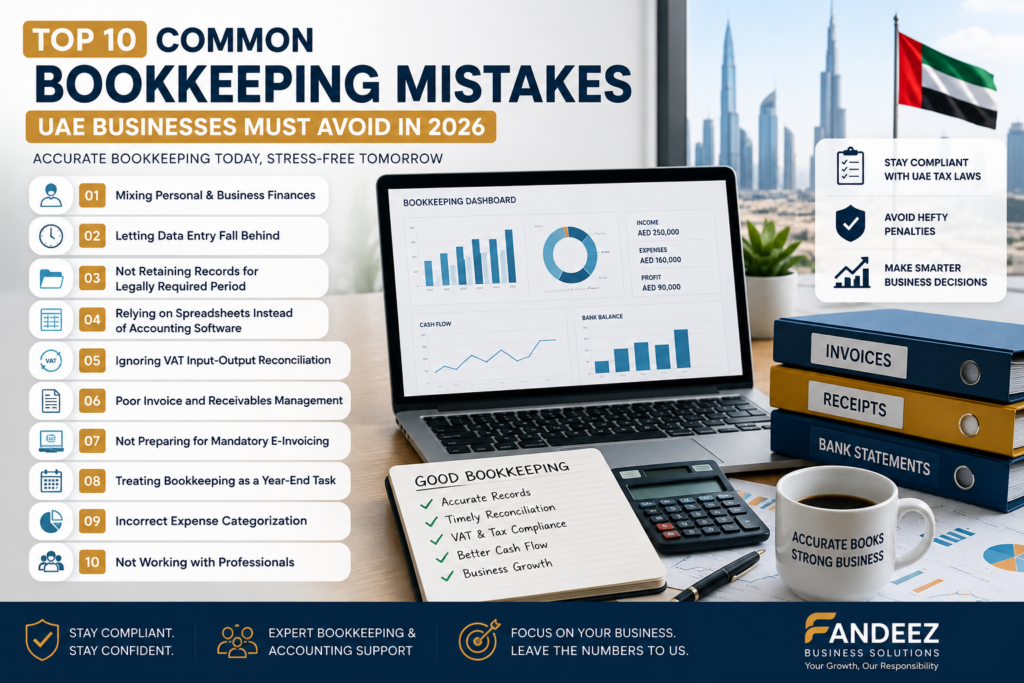
Top 10 Common Bookkeeping Mistakes UAE Businesses Make
- Mixing Personal and Business Finances Many startups use one bank account for everything. This distorts profit and loss, and personal expenses claimed as business deductions can be disallowed under Corporate Tax, while input VAT wrongly reclaimed on personal purchases gets reversed in an audit. Fix: open a dedicated business bank account for every transaction.
- Poor Record Keeping and Missing Invoices Invoices get lost or never collected from suppliers. Without a valid tax invoice, input VAT cannot be reclaimed and expenses may not be deductible for Corporate Tax. UAE law requires records to be retained for at least five years. Fix: digitize every invoice immediately using cloud accounting software.
- Delayed or Inconsistent Data Entry Bookkeeping left until month-end or year-end means missed transactions, reconciliation errors, and no real-time view of cash flow — increasing the risk of errors in VAT returns and Corporate Tax filings. Fix: record transactions weekly, not monthly.
- Incorrect VAT Treatment of Transactions Confusion between standard-rated, zero-rated, and exempt supplies leads to overcharging or undercharging VAT, customer disputes, and FTA penalties. Fix: classify every product or service correctly under UAE VAT law and maintain a VAT treatment matrix.
- Not Reconciling Bank Statements Regularly Skipping bank reconciliation lets errors, duplicate payments, or fraud go unnoticed, overstating cash and misstating taxable income. Mismatches between bank records and invoiced VAT can also trigger FTA queries. Fix: reconcile accounts weekly or monthly using software like Zoho Books, QuickBooks, or Xero.
- Misclassifying Business Expenses Without a clear chart of accounts, capital equipment gets recorded as an operating expense, distorting the Profit & Loss and Balance Sheet and affecting allowable Corporate Tax deductions. Fix: set up a proper chart of accounts and review classification quarterly.
- Ignoring Corporate Tax and VAT Deadlines No compliance calendar means missed Corporate Tax registration or VAT filing deadlines, resulting in automatic FTA penalties. Fix: maintain a compliance calendar and assign one person as the compliance owner.
- Not Maintaining a Proper Audit Trail Transactions recorded without supporting documentation make it hard to explain entries during an FTA audit, and the FTA can disallow VAT claims lacking a traceable trail. Fix: link every entry to a source document and use software with built-in audit logs.
- Relying on Manual Spreadsheets Instead of Accounting Software Spreadsheet formula errors are a leading cause of incorrect VAT returns and misstated taxable income. Fix: move to cloud accounting software built for UAE VAT and Corporate Tax compliance.
- Not Reviewing Financial Statements Regularly When financial statements are only prepared for tax filing, shrinking margins go unnoticed until it’s too late to correct course. Fix: review Profit & Loss and Balance Sheet monthly with your accountant.
Quick Reference Table
Bookkeeping Mistake | Business Risk | Solution |
Mixing personal and business finances | Disallowed deductions | Separate business bank account |
Missing invoices | Lost input VAT recovery | Digitize records |
Delayed data entry | Poor cash flow visibility | Weekly bookkeeping routine |
Incorrect VAT treatment | FTA penalties | VAT treatment matrix |
No bank reconciliation | Undetected errors/fraud | Monthly reconciliation |
Misclassified expenses | Wrong taxable profit | Proper chart of accounts |
Missed deadlines | Automatic FTA fines | Compliance calendar |
Weak audit trail | Failed FTA audits | Source-document-linked entries |
Manual spreadsheets | Calculation errors | Cloud accounting software |
No financial review | Missed business risks | Monthly financial review |
How Poor Bookkeeping Affects Your Business
Corporate Tax: Inaccurate records lead to incorrect taxable income calculations and disallowed deductions under Corporate Tax, increasing the risk of FTA reassessments and penalties.
VAT: Errors in input and output VAT reporting under VAT result in underpaid or overpaid VAT, both of which invite FTA scrutiny.
Cash Flow: Without accurate, up-to-date records, businesses can’t forecast cash flow, leading to liquidity problems even when profitable on paper.
Business Growth: Investors, banks, and partners rely on clean financial statements — poor bookkeeping undermines fundraising and expansion plans.
FTA Audits: A weak audit trail and disorganized records make audits longer, more stressful, and more likely to result in penalties.
Decision Making: Owners can’t make sound pricing, hiring, or investment decisions without trustworthy financial data.
Bookkeeping Best Practices for UAE Businesses
Maintain a dedicated business bank account, use FTA-compliant cloud accounting software, record transactions weekly, reconcile bank accounts regularly, keep a chart of accounts aligned with Corporate Tax categories, retain invoices for at least five years, build a compliance calendar, review financial statements monthly, and set up strong internal controls. For most SMEs, working with professional bookkeeping and accounting services is the most reliable way to stay consistent.
Bookkeeping Compliance Checklist
- Separate business and personal bank accounts
- All invoices recorded and filed
- Bank reconciliation completed monthly
- Correct VAT treatment applied to every transaction
- VAT returns filed on time and accurately
- Corporate Tax records maintained and up to date
- Chart of accounts reviewed and accurate
- Records retained for the legally required period
- Financial statements reviewed monthly
- Cloud accounting software in use
- Compliance calendar tracking all FTA deadlines
Why Choose Fandeez Business Solutions
Bookkeeping mistakes are easy to make and expensive to fix. Fandeez supports UAE businesses across bookkeeping and accounting, Corporate Tax registration and filing, VAT registration and returns, auditing services, and business advisory — helping startups, SMEs, Free Zone and mainland companies stay audit-ready and fully FTA compliant. Learn more about us or check our pricing.
Frequently Asked Questions
- What are the most common bookkeeping mistakes UAE businesses make? Mixing personal and business finances, missing invoices, delayed data entry, incorrect VAT treatment, and skipping bank reconciliation.
- Why is bookkeeping important in the UAE? It’s the basis of accurate VAT returns, Corporate Tax filings, and financial statements, and a legal requirement under UAE tax law.
- How can bookkeeping mistakes affect VAT? They can cause incorrect input and output VAT reporting, leading to underpaid or overpaid VAT and FTA penalties.
- How does bookkeeping affect Corporate Tax? Accurate books ensure taxable income is calculated correctly and deductions are properly supported.
- What records should UAE businesses keep? Sales and purchase invoices, bank statements, payroll records, contracts, and general ledger entries.
- How long should records be retained? At least five years, longer for certain real estate-related transactions.
- Why use accounting software instead of spreadsheets? It reduces manual errors, automates VAT calculations, and keeps a clear audit trail.
- What’s the difference between bookkeeping and accounting? Bookkeeping records transactions; accounting interprets that data for statements, tax returns, and insights.
- Can poor bookkeeping trigger an FTA audit? Bookkeeping alone doesn’t trigger one, but inconsistent VAT filings from poor bookkeeping raise audit risk.
- How often should bank accounts be reconciled? Weekly or, at minimum, monthly.
- Do Free Zone companies follow the same bookkeeping rules? Yes — including for Qualifying Free Zone Person status under Corporate Tax.
- Should small businesses outsource bookkeeping? Yes, it’s often more cost-effective than hiring in-house and ensures FTA-compliant records from experienced professionals.
Conclusion
Bookkeeping mistakes UAE businesses make usually come from limited time or limited awareness of what VAT and Corporate Tax law requires — not carelessness. Left unaddressed, small errors compound into real compliance risk. Every mistake in this guide is fixable with the right systems and support.
Contact Fandeez Business Solutions today for accurate, audit-ready bookkeeping, accounting, VAT, Corporate Tax, and business advisory services across the UAE.