

Table of Contents
ToggleBusiness Setup UAE: Your Complete Guide to Company Formation
The United Arab Emirates has firmly established itself as one of the world’s most attractive destinations for entrepreneurs, startups, and international investors. With its strategic location bridging East and West, world-class infrastructure, and forward-thinking regulatory environment, the UAE offers a launchpad for businesses of all sizes.
However, while the opportunities are immense, the process of Business Setup UAE can feel complex and overwhelming without the right guidance. From choosing the right jurisdiction to navigating licensing requirements and tax registration, each decision has long-term implications for your business.
That’s where Fandeez Business Solutions comes in. As a trusted UAE-based business setup and compliance consultancy, Fandeez simplifies the entire process, ensuring you start your journey with confidence and clarity. This guide provides everything you need to know about Business Setup UAE—from jurisdiction choices to costs, documents, and ongoing compliance. If you’re already thinking ahead to tax registration, Fandeez’s Corporate Tax compliance services can be set up alongside your new company.
Why Start a Business in the UAE?
The UAE’s appeal goes far beyond its iconic skyline. Here are the key reasons entrepreneurs choose this dynamic market:
Strategic Location: Positioned at the crossroads of Europe, Asia, and Africa, the UAE provides unparalleled access to international markets. Dubai’s Jebel Ali Port and its two major international airports make it a global logistics hub.
Business-Friendly Environment: The UAE government has consistently introduced reforms to attract foreign investment. Since 2021, 100% foreign ownership is now permitted for most business activities on the mainland, eliminating the previous requirement for a local partner.
Tax Advantages: The UAE offers 0% personal income tax and a competitive corporate tax rate of 9% that only applies above a profit threshold of AED 375,000. Qualifying Free Zone entities may continue to benefit from 0% corporate tax on qualifying activities.
Modern Infrastructure: From advanced digital connectivity to world-class transport and logistics, the UAE’s infrastructure supports business growth seamlessly.
Safety and Stability: Ranked as one of the safest countries globally, the UAE provides a stable and secure environment for business and living.
These advantages explain why over 200 nationalities now call the UAE home and why demand for business setup services continues to grow.
Mainland vs Free Zone vs Offshore: Which Is Right for You?
One of the most critical decisions in any Business Setup UAE journey is choosing where to register your company. Each jurisdiction offers distinct benefits, and the right choice depends entirely on your business activity, target market, and operational needs.
| Jurisdiction | Best For | Ownership | Market Access | Regulator/Authority | Examples |
|---|---|---|---|---|---|
| Mainland | Selling directly to UAE customers, retail, government contracts | 100% foreign ownership in most activities | Can trade anywhere in the UAE | Department of Economy & Tourism (DET) | DED Dubai, DED Abu Dhabi |
| Free Zone | International trading, consulting, tech startups | 100% foreign ownership | Primarily international; local trade requires local distributor | Free Zone Authority | DMCC, IFZA, RAKEZ, SHAMS, UAQFTZ |
| Offshore | Holding assets, international business structuring | 100% foreign ownership | No physical operations in UAE | Offshore Registrar | JAFZA Offshore, RAK ICC |
Mainland Company Setup: A mainland license allows you to trade anywhere in the UAE, bid on government contracts, and open physical retail or office locations. Recent reforms have opened 100% foreign ownership for over 1,100 commercial and industrial activities on the mainland. Mainland businesses are licensed by the Department of Economy and Tourism (DET) in each emirate.
Free Zone Company Setup: Free zones are special economic areas designed to attract foreign investment, offering 100% ownership, customs duty exemptions, and simplified setup procedures. Popular free zones include DMCC (Dubai Multi Commodities Centre), IFZA (International Free Zone Authority), RAKEZ, and SHAMS. Free zones restrict direct trade with the UAE mainland unless you appoint a local distributor or open a mainland branch.
Offshore Company Setup: Offshore companies are used for holding assets, international business structuring, and investment purposes. They cannot operate physically within the UAE, sponsor visas, or lease local office space.
There is no universally “better” option. If your business serves the local UAE market, mainland is essential. If you work with international clients and want a cost-effective entry point, a free zone is ideal. Offshore structures suit holding and investment strategies rather than active trading.
Types of UAE Business Licenses
The type of license you need depends on your business activity. The main categories are:
Commercial License: For businesses involved in trading, import/export, retail, and e-commerce. This is the most common license type for entrepreneurs buying and selling goods.
Professional License: For service-based businesses such as consultancy, IT services, marketing, accounting, legal advisory, and design. Professional licenses often have lower capital requirements but may require a local service agent for certain activities.
Industrial License: For manufacturing, production, and industrial processing businesses. These require additional approvals from relevant authorities such as the Ministry of Industry and Advanced Technology.
Tourism License: For travel agencies, tour operators, and hospitality-related businesses.
Choosing the correct business activity and license type is critical. Selecting the wrong activity is one of the most common reasons for license rejection and can delay your entire setup.
Step-by-Step Business Setup Process in the UAE
Here is the step-by-step process for Business Setup UAE, from start to finish:
Step 1: Choose Your Business Activity. Define precisely what your business will do. Your activity determines the license type, jurisdiction suitability, and compliance requirements.
Step 2: Choose Mainland or Free Zone. Consider where your customers are, your operational needs, and your budget. This decision affects your costs and market access.
Step 3: Select a Legal Structure. Common structures include Sole Establishment (FZE), Limited Liability Company (LLC), or Free Zone Company (FZC), depending on your jurisdiction and shareholder count.
Step 4: Reserve a Trade Name. Submit a business name that complies with UAE naming conventions. Avoid offensive words, political references, and abbreviations without permission.
Step 5: Obtain Initial Approval. This is your “green light” from the Department of Economy and Tourism (DET) or the relevant Free Zone authority, confirming no issues block your registration.
Step 6: Prepare Required Documents. Gather passport copies, shareholder details, application forms, and other documents required for your chosen jurisdiction.
Step 7: Arrange Office or Registered Address. Most jurisdictions require a physical office, flexi-desk, or virtual address. Mainland requires a physical office with Ejari registration.
Step 8: Obtain the Business License. Submit all documents and fees to the relevant authority. Many free zones now issue licenses within 3–7 working days.
Step 9: Apply for Visas and Establishment Card. Once licensed, you can apply for residence visas for yourself, shareholders, and employees.
Step 10: Open a Corporate Bank Account. UAE banks typically require the trade license, MOA, shareholder passports, and a clear business plan. Timelines can take 4–8 weeks.
Step 11: Complete Tax and Compliance Registrations. Register with the Federal Tax Authority (FTA) for Corporate Tax and VAT (if applicable). This is a critical ongoing obligation. Fandeez’s VAT compliance services can handle this step so it doesn’t get missed in the early rush of setting up.
Documents Required for Business Setup UAE
While requirements vary by jurisdiction, the following documents are commonly required:
- Passport copies of all shareholders and directors
- Proof of address (utility bill or bank statement)
- Visa/entry stamp copies (if already in the UAE)
- Business plan (for some jurisdictions)
- Memorandum of Association (MOA) / Articles of Association (AOA)
- Lease agreement or Ejari registration (for mainland)
- No Objection Certificate (NOC) from current sponsor (if applicable)
How Much Does Business Setup in the UAE Cost?
The Business Setup UAE cost is not a fixed number. It depends on jurisdiction, business activity, office requirements, and visa needs.
Free Zone Setup Costs: Typically range from AED 12,000 to AED 45,000 for the first year, including license, registration, flexi-desk, and up to 1–3 visas. Budget-friendly zones like UAQFTZ offer packages starting around AED 5,500 for the license alone. Premium zones like DMCC or DIFC can cost AED 35,000–60,000+.
Mainland Setup Costs: Start around AED 20,000–35,000 for the license alone, with mandatory office space adding AED 20,000–40,000+ annually, bringing first-year total to AED 40,000–75,000.
Key Cost Factors:
- License and registration fees
- Office/flexi-desk costs
- Visa applications (AED 4,000–7,000 per person)
- Establishment card and government approvals
- Bank account support
- Professional fees for consultants like Fandeez
- Annual renewal costs
How Long Does UAE Business Setup Take?
Typical timelines vary widely:
Free Zone License Issuance: 3–7 working days with complete documentation.
Mainland License Issuance: Typically 2–4 weeks, depending on approvals and external entity involvement.
Visas: 2–4 weeks per person after license issuance.
Corporate Bank Account: 4–8 weeks, depending on bank due diligence.
Delays can occur if documents are incomplete, business activities require additional approvals, or shareholders are outside the UAE. Engaging Fandeez from the start minimizes these delays by ensuring all paperwork is accurate and complete.
Common Business Setup Mistakes to Avoid
Choosing the Wrong Business Activity: This is the number one reason for license rejection.
Picking the Wrong Jurisdiction: Misalignment between jurisdiction and market access leads to costly restructuring.
Underestimating Renewal Costs: Many entrepreneurs focus only on first-year costs and are surprised by renewal fees.
Ignoring Tax Registration Deadlines: Delaying Corporate Tax or VAT registration leads to penalties.
Poor Bookkeeping: Without proper accounting records, tax compliance and bank account opening become challenging. Setting up the right system from day one with Fandeez’s accounting system setup service can prevent this.
Choosing Based Only on Cheapest License: The lowest initial cost may not suit your long-term business needs.
How Fandeez Helps With Business Setup UAE
Fandeez Business Solutions is more than a company formation provider. We are a long-term business and compliance partner committed to your success.
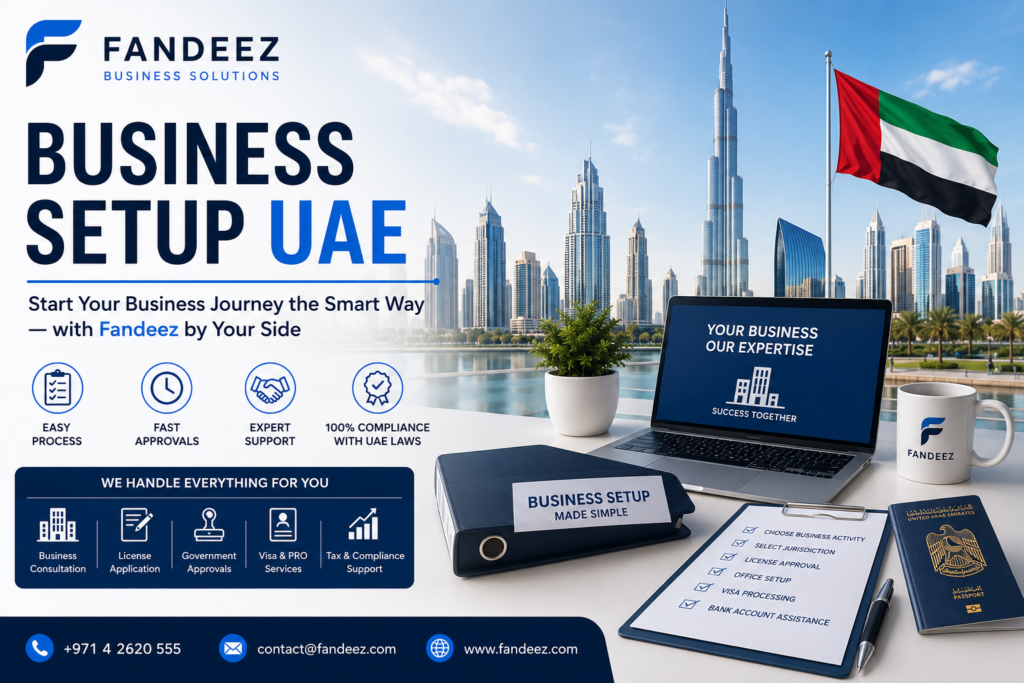
Our End-to-End Business Setup Support Includes:
- Business Activity Consultation: We help you choose the right activity for your business model.
- Mainland and Free Zone Setup Guidance: Our experts advise on the best jurisdiction for your goals.
- Trade Name Assistance: We ensure your business name meets all UAE regulations.
- License Application Support: We handle all paperwork and government approvals.
- Document Preparation: From MOA to shareholder agreements, we ensure everything is compliant.
- Office/Registered Address Guidance: We help you find the right office solution for your needs.
- Visa and PRO Support: We assist with establishment cards, medical tests, and biometrics.
- Corporate Bank Account Assistance: We streamline the process with UAE banks.
- Corporate Tax Registration: We register your business with the FTA for Corporate Tax.
- VAT Registration: We handle VAT registration and filing.
- Accounting and Bookkeeping: We provide ongoing financial management to ensure compliance.
- Ongoing Compliance: From UBO declarations to audit support, we keep you compliant.
At Fandeez, we make Business Setup UAE seamless so you can focus on growing your business, not navigating red tape.
Frequently Asked Questions
What is Business Setup UAE? Business Setup UAE is the process of legally establishing a company in the United Arab Emirates. It involves selecting a business activity, choosing between mainland and free zone jurisdictions, obtaining a trade license, and completing visa, bank account, and tax registrations.
How much does it cost to start a business in the UAE? Costs range from AED 12,000 to AED 75,000+ depending on your jurisdiction, business activity, office requirements, and visa needs. Free zones offer more affordable entry points, while mainland setup requires higher commitments for mandatory office space.
Can foreigners start a business in the UAE? Yes. Since 2021, 100% foreign ownership is permitted in most business activities on the mainland, while free zones have always allowed full ownership. Foreign entrepreneurs can establish sole proprietorships, LLCs, or free zone companies.
Is 100% foreign ownership available in the UAE? Yes for most business activities on the mainland (since 2021) and always in free zones. Certain “strategic impact” activities may still require Emirati ownership, but these are exceptions rather than the norm.
What is the difference between Mainland and Free Zone companies? Mainland companies can trade anywhere in the UAE, bid on government contracts, and open physical retail locations. Free zone companies offer 100% ownership and tax advantages but are restricted from direct local-market trade without a local distributor.
How long does company formation take in the UAE? License issuance typically takes 3–7 working days in free zones and 2–4 weeks on the mainland. Full setup including visas and bank account opening usually takes 4–8 weeks.
What documents are required to start a company in the UAE? Common requirements include passport copies of shareholders/directors, proof of address, business plan (for some), Memorandum of Association, lease agreement (for mainland), and visa/entry stamp copies if applicable.
Do UAE companies need a physical office? Mainland companies must have a physical office with Ejari registration. Free zone companies typically require a flexi-desk or coworking space as a registered address, with physical offices needed for certain activities or visa quotas.
Do new UAE businesses need Corporate Tax registration? Yes. All UAE companies must register with the Federal Tax Authority (FTA) for Corporate Tax. The 9% corporate tax applies to taxable income above AED 375,000. Qualifying Free Zone entities may qualify for 0% on qualifying income.
When is VAT registration required in the UAE? VAT registration is mandatory if annual taxable supplies exceed AED 375,000. Voluntary registration is available if turnover exceeds AED 187,500.
Can Fandeez help with business setup and tax registration? Yes. Fandeez provides end-to-end support including business activity consultation, jurisdiction selection, license application, document preparation, visa assistance, bank account support, Corporate Tax registration, VAT registration, and ongoing compliance services.
Conclusion
Starting a business in the UAE is one of the most exciting decisions you can make as an entrepreneur. With its strategic location, business-friendly policies, and global connectivity, the UAE offers unmatched opportunities for growth.
However, navigating the complexities of Business Setup UAE requires careful planning and expert guidance. From choosing the right jurisdiction to securing your license and completing tax registrations, each step matters.
Fandeez Business Solutions is here to guide you through every stage. As a trusted UAE consultancy, we provide comprehensive business setup support, ensuring you start right and stay compliant. Our end-to-end services include company formation, licensing, tax registration, accounting, and ongoing compliance.