

Table of Contents
ToggleAudit Readiness UAE: Complete Financial Health Check & Preparation Guide
In today’s UAE business landscape, the prospect of an audit — whether from the Federal Tax Authority (FTA), an external auditor, or a potential investor — can feel stressful. But audit season doesn’t have to be a frantic scramble. With the right preparation and consistent record-keeping, it can become a straightforward process that validates your business’s financial health and builds stakeholder confidence.
Being prepared for an audit is about more than paperwork — it’s about building a culture of financial discipline that runs year-round. That’s the core idea behind Audit Readiness UAE: a strategic approach that keeps your financial records, internal controls, and compliance frameworks always able to withstand scrutiny.
Fandeez Business Solutions is a trusted UAE-based accounting, audit-readiness, tax, and compliance partner, helping businesses move from reactive, last-minute preparation to a proactive state of constant audit readiness.
What Does “Audit-Ready” Actually Mean?
Being audit-ready means your business consistently keeps accurate, complete, and organized financial records that can be produced for review at any time — not something you scramble to fix the week before an audit.
An audit-ready business typically has:
- Updated, reconciled accounting records
- Organized supporting documents (invoices, contracts, bank statements)
- Properly maintained VAT and Corporate Tax records
- Clear, auditable trails for every transaction
- Strong internal controls and documented processes
- Accurate, compliant financial statements
The real difference: last-minute prep means a frantic hunt for missing documents, while true audit readiness means financial governance is a daily habit, not a year-end crisis.
Why Audit Readiness Matters for UAE Businesses
VAT and Corporate Tax compliance — FTA scrutiny has increased significantly; inspection visits jumped 135% in 2024, surpassing 93,000 visits.
FTA reviews and investigations — the FTA can request records at any time, and an audit-ready business can respond quickly, avoiding penalties and reputational damage.
Statutory audits — not every company needs an annual audit, but many do. Free Zone companies, financial free zone entities, and businesses with revenue above AED 50 million are legally required to maintain audited financials under Ministerial Decision No. 84 of 2025.
Bank and investor due diligence — lenders and investors need a clear, accurate financial picture before extending financing.
Business credibility — being audit-ready signals professionalism and integrity to stakeholders.
Requirements vary by legal structure, jurisdiction, and activity, so it’s worth confirming your specific obligations — but staying audit-ready is good practice regardless.
Financial Health Check: 7 Key Areas
1. Review financial statements — check that all transactions are recorded, assets and liabilities reconcile, and revenue/expenses are properly classified, with no unexplained spikes.
2. Reconcile all accounts — monthly reconciliation of bank accounts, petty cash, receivables, payables, credit cards, and loans is non-negotiable. Unexplained gaps are a major red flag for auditors.
3. Organize supporting documents — invoices, receipts, contracts, bank statements, payroll records, and tax filings should all be easy to produce. Digital document management helps a lot here.
4. Review VAT & Corporate Tax compliance — verify VAT registration and returns, reconcile input/output VAT, confirm proper Corporate Tax registration and calculations, and keep supporting documentation for every tax position. Software helps, but professional review is still essential.
5. Assess internal controls — auditors look closely at approval procedures, segregation of duties, and payment/access controls.
6. Review payroll and employee costs — confirm salary payments match WPS records, end-of-service benefits are calculated correctly, and reimbursements are backed by receipts.
7. Prepare an audit file — compile your trial balance, general ledger, bank reconciliations, aged receivables/payables, fixed asset register, tax records, and key contracts into one structured file.
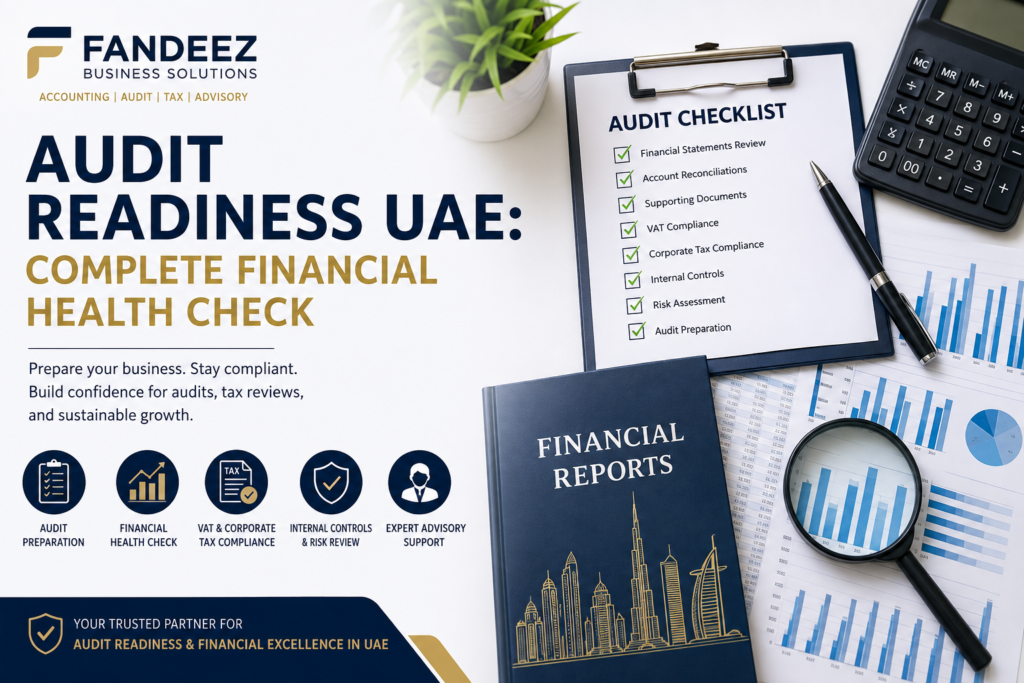
Audit Readiness Checklist
| Task | Status |
|---|---|
| Financial statements updated | ☐ |
| Bank accounts reconciled | ☐ |
| Receivables reviewed and aged | ☐ |
| Payables reviewed and aged | ☐ |
| Supporting documents organized | ☐ |
| VAT records reconciled | ☐ |
| Corporate Tax records reviewed | ☐ |
| Payroll records checked | ☐ |
| Fixed assets verified | ☐ |
| Internal controls reviewed | ☐ |
| Audit file prepared | ☐ |
Common Mistakes to Avoid
- Missing invoices, especially for input VAT claims
- Unreconciled bank accounts with unexplained differences
- VAT records that don’t match filed returns
- Delayed bookkeeping that creates a backlog
- Mixing personal and business expenses
- Weak internal controls (no segregation of duties)
- Ignoring small discrepancies that hint at bigger issues
- Waiting until the audit notice arrives to start preparing
How Often Should You Run a Financial Health Check?
- Monthly — bookkeeping and bank reconciliations
- Quarterly — a formal VAT/tax compliance review
- Annually — a complete financial health check before the audit cycle
- Pre-audit — a final review right before fieldwork begins
Audit Readiness vs. Last-Minute Preparation
| Audit Readiness | Last-Minute Preparation |
|---|---|
| Continuous, year-round process | Short-term, reactive process |
| Records updated regularly | Records updated hastily |
| Low risk of missing documents | High risk of missing documents |
| Strong financial visibility | Limited visibility |
| Faster, smoother audits | Delays and more auditor queries |
How Fandeez Helps With Audit Readiness
Fandeez Business Solutions doesn’t just prepare you for an audit — we help make audit readiness a permanent part of how your business runs. Our services include:
- Financial health checks
- Accounting cleanup
- Bank and VAT reconciliation
- Corporate Tax review
- Internal control assessment
- Audit schedule and file preparation
- FTA audit support
- Ongoing bookkeeping and financial reporting
Visit fandeez.com to learn more about our audit-readiness services.
Benefits of an Annual Financial Health Check
- Catches accounting errors before they become major problems
- Improves cash flow management
- Strengthens internal controls
- Reduces last-minute audit stress
- Makes it easier to secure bank financing
- Builds investor confidence
- Supports better business decisions
When Should You Contact an Audit-Readiness Professional?
Reach out to a partner like Fandeez if:
- You’re preparing for an external audit
- You’ve received an FTA review notice
- Your financial records are incomplete or inaccurate
- Your VAT reconciliations don’t match
- You need guidance on Corporate Tax compliance
- You’re applying for a bank loan or investment
- You want to strengthen your internal controls
Frequently Asked Questions
What is Audit Readiness UAE? Being fully prepared for a financial, tax, or regulatory audit at any time — accurate records, strong controls, and organized documentation maintained year-round.
How can I make my UAE business audit-ready? Start with a financial health check: reconcile accounts, organize documents, review VAT/Corporate Tax compliance, assess internal controls, and prepare a structured audit file. A partner like Fandeez can simplify the process.
What documents are usually required for an audit? Trial balance, general ledger, bank statements and reconciliations, invoices, contracts, VAT returns, Corporate Tax workings, a fixed asset register, and key legal documents like your trade license.
How often should a financial health check be done? At least annually, with quarterly compliance reviews and monthly reconciliations as best practice.
What is an FTA audit? A review by the UAE’s Federal Tax Authority to verify VAT and Corporate Tax compliance — either a desk audit (document review) or a field audit (on-site inspection).
Do all UAE businesses need an annual audit? No — it depends on legal structure, jurisdiction, and activity. Free Zone, DIFC/ADGM entities, and businesses with revenue over AED 50 million typically must undergo one.
What’s the difference between internal and external audits? An internal audit reviews and improves internal controls, often via an internal team or consultant. An external audit is an independent review of financial statements by a licensed auditor, often required for statutory compliance.
How long should financial records be kept? Generally 5–7 years, depending on the applicable law.
Can Fandeez help prepare my business for an audit? Yes — Fandeez offers financial health checks, accounting cleanup, tax reconciliation, internal control assessments, and full audit file preparation.
Conclusion
Audit Readiness UAE is about more than surviving an audit — it’s about building a financially sound, trustworthy business. Regular financial health checks, accurate records, and consistent VAT/Corporate Tax compliance turn the audit process from a source of stress into a strategic advantage.
Fandeez Business Solutions is your dedicated partner in this journey, providing the expertise to keep your business prepared, compliant, and ready for growth.
Contact Fandeez today for a financial health check and take the first step toward permanent audit readiness.