

Table of Contents
ToggleIf you run a business in the United Arab Emirates, you have likely heard the terms Input VAT and Output VAT in UAE thrown around by your accountant or within your finance team. While these phrases might sound like complex accounting jargon, they are actually the two simple gears that make the entire UAE VAT system work.
Understanding the difference between Input VAT UAE and Output VAT is not just a nice-to-have—it is a legal necessity. Miscalculations lead directly to penalties from the Federal Tax Authority UAE (FTA), cash flow problems, or losing money you could otherwise recover.
In this UAE VAT Guide, we will break down everything you need to know. Whether you are a startup issuing your first tax invoice or an SME trying to file your VAT returns in the UAE, this article will make the concepts of Input Tax vs Output Tax UAE crystal clear. By the end, you will know exactly how to calculate VAT Payable UAE, when you can Recover Input VAT UAE, and how to stay fully compliant with UAE VAT Rules.
Understanding VAT in the UAE: The Basics
Before we dive into the specifics, let us quickly recap how VAT works here. The UAE introduced Value Added Tax (VAT) on January 1, 2018, at a standard rate of 5%. Unlike income tax, VAT is a consumption tax levied on the supply of goods and services at each stage of the supply chain.
The beauty of this system is that it is largely self-policing. Businesses act as tax collectors for the government. You charge VAT to your customers, and you pay VAT to your suppliers. At the end of a designated tax period (usually quarterly or monthly), you settle the difference with the Federal Tax Authority UAE.
This difference is calculated simply as:
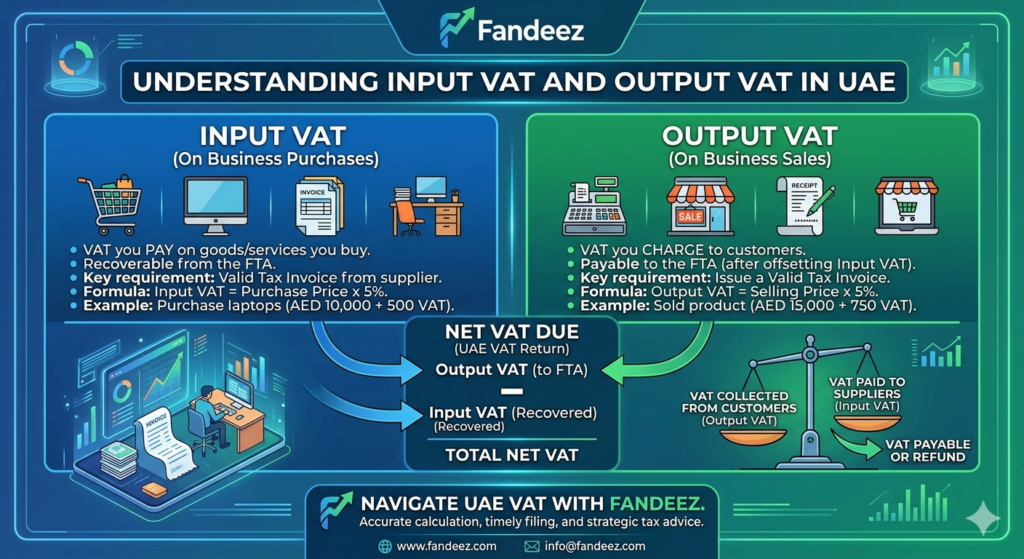
Output VAT (Collected) – Input VAT (Paid) = VAT Payable to FTA or VAT Refund Due
What is Output VAT? (The Tax You Charge)
Let us start with the side of the equation that brings money into your business.
Output VAT is the amount of Value Added Tax that a registered business charges to its customers when it sells goods or services. Think of it as the tax “going out” of your business to the customer via the invoice.
Who Charges Output VAT?
Any business that is registered for VAT in UAE (mandatory or voluntarily) must charge Output VAT on all taxable supplies. There are three main scenarios:
Standard-rated supplies (5%): Most goods and services (e.g., electronics, consulting, restaurant meals).
Zero-rated supplies (0%): Export of goods, international transport, certain education, and healthcare.
Exempt supplies: No VAT is charged (e.g., residential rent, local passenger transport, life insurance).
Output VAT Calculation Formula
The calculation is straightforward:
Output VAT = Selling Price (Excluding VAT) × 5%
Or, if you have a total including VAT:
Output VAT = (Total Invoice including VAT / 105) × 5
Practical Example of Output VAT (AED)
Imagine your company, “Tech Solutions LLC,” sells computer hardware to a client.
- Agreed Price (Excluding VAT): AED 10,000
- Output VAT Calculation: AED 10,000 × 5% = AED 500
- Total Invoice to Client: AED 10,500
That AED 500 is your Output VAT. You must report this on your VAT Returns UAE as money you owe to the FTA. However, you do not pay this entire AED 500 immediately—because you likely have Input VAT to offset.
Impact on Cash Flow
A common mistake new business owners make is thinking that Output VAT is revenue. It is not. That AED 500 you collected is the government’s money. Holding it in your account without remitting it to the FTA on time is a dangerous game that results in hefty penalties.
What is Input VAT? (The Tax You Pay)
Now, let us look at the other side of the coin. Input VAT is the tax you pay on your business-related purchases.
Specifically, Input VAT UAE refers to the VAT included in the price when you buy goods or services from a VAT-registered supplier for the purpose of running your business.
Eligible Business Purchases
You can claim Input VAT on most costs incurred to make taxable supplies. Common examples include:
- Inventory: Raw materials or finished goods bought for resale.
- Operating expenses: Office rent (commercial), utilities (DEWA), and internet.
- Capital assets: Computers, machinery, office furniture, and company vehicles.
- Professional services: Legal fees, accounting fees (like those from Fandeez), and consulting fees.
Recovering Input VAT
When you Recover Input VAT UAE, you are essentially asking the FTA to refund the tax you paid to your suppliers. This is not a hand-out; it is a credit because you are paying tax on the “value add” of your business.
Input VAT Formula Explanation
If you have a supplier invoice:
Input VAT = Total Supplier Invoice including VAT – (Invoice Price excluding VAT)
Or simply:
Input VAT = Total Invoice Including VAT ÷ 21 (Because 105% total / 5% tax = 21)
Practical Example of Input VAT (AED)
Tech Solutions LLC needs to buy laptops to resell to its client.
- Supplier Invoice (Including VAT): AED 31,500
- To find Input VAT: 31,500 / 105 × 5 = AED 1,500
- Cost of Laptops (Excluding VAT): AED 30,000
In this case, Tech Solutions paid AED 1,500 as Input VAT to its supplier. Because these laptops will be resold (taxable supply), Tech Solutions can claim this AED 1,500 back from the FTA.
Conditions for Claiming Input VAT
The FTA is strict. You cannot just claim any VAT receipt you find. According to UAE FTA VAT Rules, to recover Input VAT, you must have:
A valid Tax Invoice from the supplier (compliant with UAE Tax Invoice Requirements—must include supplier TRN, date, unique number, and VAT amount).
Proof that the goods/services were received by your business.
Proof of payment (the invoice must be paid; generally, you have 6 months from the agreed payment date to claim it).
Business purpose (The expense must be directly related to making taxable supplies. Personal expenses are strictly disallowed).
Input VAT vs Output VAT in UAE: The Comparison
To help you visualize the difference, here is a detailed comparison table of Input Tax vs Output Tax UAE.
Feature | Output VAT | Input VAT |
Definition | VAT you charge to customers on sales. | VAT you pay to suppliers on purchases. |
Direction | Money flowing into your business from clients. | Money flowing out of your business to vendors. |
Who Pays? | The end customer ultimately pays it (via you). | You pay it to your supplier. |
Role in VAT Returns | Increases your liability (You owe this to FTA). | Decreases your liability (Credit against FTA). |
Documentation | You issue Tax Invoices to clients. | You receive Tax Invoices from suppliers. |
Cash Flow Effect | Positive cash flow (if you collect before paying FTA). | Negative cash flow (cash leaves your bank account). |
Calculation | Selling Price × 5% | Cost Price × 5% |
Example (AED) | Sold goods for AED 10,000 + 500 VAT. Output = AED 500 | Bought goods for AED 6,000 + 300 VAT. Input = AED 300 |
The VAT Return Process in UAE: Putting It Together
Now that you understand the two components, let us look at how they interact during the UAE VAT Filing process.
Every registered business must file a VAT Return (Form VAT 201) with the FTA, usually every quarter. Here is how VAT Calculation UAE works on that form.
Step 1: Report Output VAT
You sum up the total value of all sales made during the tax period and the total Output VAT collected.
Example for Tech Solutions LLC (Quarter 1):
- Total Sales: AED 100,000
- Output VAT Collected: AED 5,000
Step 2: Report Input VAT
You sum up the total value of all eligible business purchases and the total Input VAT paid.
Example for Tech Solutions LLC (Quarter 1):
- Total Purchases (Including overheads): AED 60,000
- Input VAT Paid: AED 3,000
Step 3: Calculate Net VAT Payable or Refund
VAT Payable = Output VAT – Input VAT
VAT Payable = AED 5,000 – AED 3,000 = AED 2,000
Result:
- Positive amount (AED 2,000): Tech Solutions must pay AED 2,000 to the FTA.
- Negative amount: If Input VAT was AED 6,000 and Output was AED 5,000, the FTA would owe you a VAT Refund UAE of AED 1,000 (though this often triggers an audit).
The Golden Rule: Invoices and Record Keeping
The FTA requires you to keep all supporting documents for 5 years. Without a valid tax invoice, you cannot claim Input VAT. Without a record of your output, you will be penalized for under-reporting.
Important VAT Considerations for UAE Businesses
While the basic math is simple, real-world business adds complexity. Here are critical nuances every entrepreneur must know.
Partial Exemption (The “Blocked” Inputs)
You cannot recover Input VAT on certain “blocked” expenses, even if they are for business. According to UAE VAT Rules, you cannot claim Input VAT on:
- Motor vehicles used for personal transport (unless you are a car dealer or rental company).
- Entertainment expenses (staff parties, client golf days).
- Employee personal supplies (medical insurance and education for employees is actually recoverable, but personal phone bills are not—consult an expert).
- The Reverse Charge Mechanism
This is tricky. For certain domestic supplies (like crude oil) or imports of services from outside the GCC, you act as both the supplier and the receiver. You calculate Output VAT as if you sold it to yourself, and then immediately claim it as Input VAT. It nets to zero on cash, but must be reported on the return. Mistakes here are very common.
Cross-Border Transactions (Imports and Exports)
- Exports (Zero-rated): You charge 0% Output VAT, but you can still reclaim all your Input VAT. This is great for cash flow.
- Imports of Goods: You pay 5% VAT at customs (like Input VAT) but must declare it as Output VAT on your return to clear it
- Common VAT Compliance Mistakes to Avoid
Even experienced accountants slip up on these:
- Claiming Input VAT on invoices without a valid TRN (Tax Registration Number) from the supplier.
- Forgetting to adjust for Bad Debts: If a customer doesn’t pay you for 6 months, you can reduce your Output VAT.
- Mixing personal and business expenses: The FTA audits bank accounts. If you buy a family grocery haul with a business card, you cannot claim that VAT.
- Late filing: VAT penalties UAE start at AED 1,000 for late filing for the first time and 2,000 for subsequent offenses, plus 4% interest on late payments.
- UAE Tax Invoice Requirements
To claim Input VAT, the invoice must contain:
- The words “Tax Invoice” (clear).
- Supplier’s name, address, and TRN.
- Customer’s name and address (for amounts over AED 10,000).
- Unique sequential invoice number.
- Date of supply.
- Description of goods/services.
- Unit price, net value, VAT amount, and gross total.
How Fandeez Helps UAE Businesses Master VAT
Navigating the difference between Input VAT and Output VAT in UAE is just the tip of the iceberg. The real challenge is staying compliant while focusing on growing your business. Missing a filing deadline or misclassifying an expense can lead to severe financial penalties.
This is where Fandeez transforms your accounting experience.
At Fandeez, we don’t just crunch numbers; we partner with UAE startups, SMEs, and entrepreneurs to ensure every Dirham of VAT is accounted for correctly.
How Fandeez Simplifies Your VAT Journey:
- VAT Registration UAE: Not sure if you need to register? Fandeez handles the entire FTA application process to get your TRN quickly.
- Precision VAT Returns UAE: We review every transaction to ensure you never overpay the FTA (by missing Input VAT) or underpay (by forgetting Output VAT).
- VAT Compliance & Audit Support: Our team ensures your books meet UAE VAT Compliance standards. If the FTA knocks for an audit, we stand with you.
- VAT Refund UAE Assistance: If you have more Input VAT than Output, we help you file for a refund efficiently without triggering unnecessary red flags.
- Advanced Accounting & Bookkeeping: Using the latest cloud software, we track every tax invoice in real-time. We automate the VAT Calculation UAE process so you know your VAT Payable UAE before the period ends.
Stop worrying about whether that receipt qualifies for Input VAT. Let Fandeez handle the heavy lifting so you can focus on sales and strategy.
[Contact Fandeez Today] for a free consultation on your UAE VAT Guide needs.
Conclusion
Mastering Input VAT and Output VAT in UAE is the single most important step toward financial health and legal safety for any business operating in the Emirates. To recap:
- Output VAT is the tax you collect from customers. It belongs to the government, not you.
- Input VAT is the tax you pay to suppliers. If spent on your taxable business, you can recover it.
- The difference determines if you have VAT Payable UAE or a refund coming your way.
By keeping clean records, respecting UAE Tax Invoice Requirements, and leveraging experts like Fandeez for UAE VAT Filing, you turn a potential administrative headache into a smooth, manageable process.
Remember, in the world of VAT for Businesses UAE, knowledge is profit, and compliance is peace of mind.