

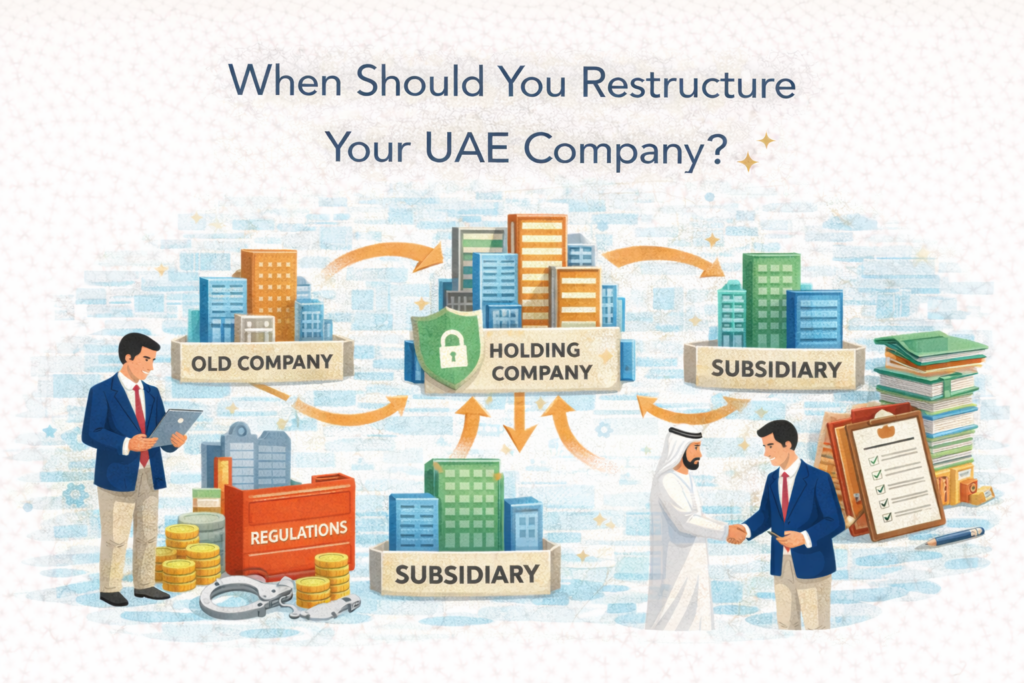
In the UAE’s evolving regulatory and tax landscape, restructuring is no longer limited to distressed businesses. With Corporate Tax implementation, increased compliance requirements, and changing ownership strategies, restructuring has become a strategic tool for growth and risk management.
Company restructuring in the UAE should be driven by tax efficiency, operational scalability, ownership changes, or regulatory compliance — not just financial difficulty.
Whether you operate in Mainland UAE or a Free Zone, knowing the right timing can protect profitability and future expansion.
1️⃣ When Corporate Tax Impacts Your Profit Structure
With Corporate Tax now applicable, many businesses are reassessing:
- Group company structures
- Intercompany transactions
- Profit allocation models
- Holding company arrangements
If your current structure leads to higher taxable income exposure or inefficient cost allocation, restructuring may improve tax efficiency.
2️⃣ When Expanding Into New Emirates or Free Zones
Businesses expanding from Dubai to Abu Dhabi or other Emirates often need structural adjustments.
Expansion triggers:
- New branch setup
- Separate legal entity formation
- Conversion from sole establishment to LLC
- Free Zone to Mainland migration
Growth without structural alignment can create licensing and compliance conflicts.
3️⃣ When Bringing in New Investors or Partners
If you plan to:
- Introduce equity investors
- Transfer shares
- Change ownership percentages
- Create different share classes
Your Memorandum of Association and legal structure may require amendment.
Restructuring ensures clarity in shareholder rights and profit distribution.
4️⃣ When Your Business Activities Change
If you:
- Add regulated services
- Move into high-risk sectors
- Expand into consultancy or trading
- Operate activities outside your license scope
You may need structural revision rather than just activity addition.
Regulatory authorities expect alignment between operational reality and legal structure.
5️⃣ When Facing Operational Inefficiencies
Operational red flags include:
- Overlapping business entities
- High administrative costs
- Complicated reporting lines
- Poor internal controls
Restructuring can consolidate operations, reduce overhead, and improve governance.
6️⃣ When Planning for Asset Protection
Business owners often restructure to:
- Separate operating company from asset-holding entity
- Protect intellectual property
- Isolate high-risk activities
- Create holding company frameworks
This reduces exposure in case of disputes or liabilities.
7️⃣ When Preparing for Sale or Exit
If you plan to:
- Sell the company
- Merge with another business
- Seek acquisition
- Prepare for valuation
A simplified and tax-efficient structure increases investor confidence and valuation multiples.
Messy corporate structures often delay deals.
8️⃣ When Compliance Risks Increase
With oversight from authorities such as the Federal Tax Authority and Free Zone regulators, companies with outdated structures may face:
- UBO compliance gaps
- Transfer pricing exposure
- Related-party risk
- Reporting inconsistencies
Restructuring aligns your legal framework with current regulations.
Common Types of UAE Company Restructuring
- Share transfer
- Change of legal form (Sole Prop → LLC)
- Group consolidation
- Holding company creation
- Free Zone to Mainland conversion
- Branch establishment
Each option carries legal and tax implications.
Warning Signs That You Should Not Ignore
⚠️ Continuous tax inefficiencies
⚠️ Frequent shareholder disputes
⚠️ Expansion without structural planning
⚠️ High compliance costs
⚠️ Regulatory notices
Ignoring structural issues often leads to expensive corrective actions later.
Benefits of Strategic Restructuring
✔ Improved tax efficiency
✔ Stronger investor appeal
✔ Reduced regulatory risk
✔ Better operational control
✔ Clear ownership transparency
In the UAE’s competitive business ecosystem, structure directly impacts profitability and scalability.
FAQs
1. Is restructuring expensive in the UAE?
Costs depend on entity type, authority, and complexity of changes.
2. Can Free Zone companies restructure easily?
Yes, but approval from the respective Free Zone Authority is required.
3. Does restructuring trigger tax?
Certain changes may have Corporate Tax implications and should be evaluated carefully.
4. How long does restructuring take?
Anywhere from 2–8 weeks depending on authority and documentation readiness.
Final Thoughts
Restructuring is not a sign of weakness it is a strategic realignment tool. In today’s UAE regulatory environment, proactive structural planning ensures tax optimization, regulatory compliance, and sustainable growth.