

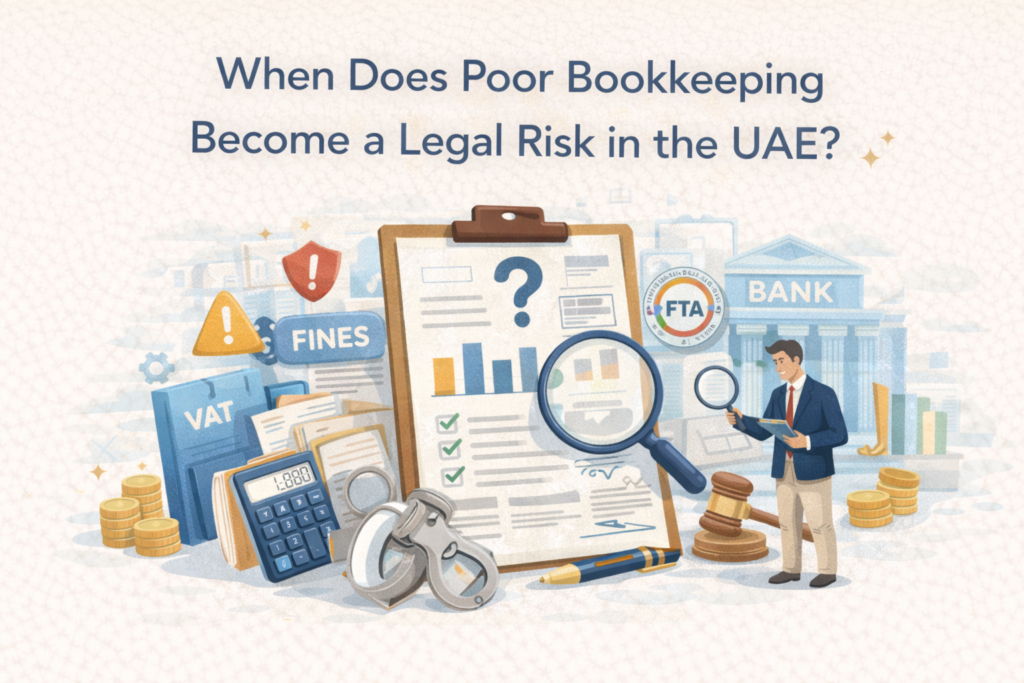
Many UAE business owners treat bookkeeping as an administrative task.
In reality, poor bookkeeping can quickly escalate into a legal, tax, and financial risk.
With the introduction of corporate tax, strict VAT compliance, and increased regulatory oversight, businesses operating in the UAE must maintain accurate and compliant financial records.
This guide explains when bookkeeping mistakes cross the line from inefficiency to legal exposure, and how to prevent serious consequences.
Why Bookkeeping Is Legally Important in the UAE
Under UAE regulations, businesses are legally required to:
- Maintain proper accounting records
- Retain financial documents for statutory periods
- Provide accurate information to tax authorities
- Produce records during audits
Failure to do so can lead to penalties, audits, license complications, and in serious cases, legal action.
Regulatory enforcement is overseen by the Federal Tax Authority, particularly for VAT and corporate tax compliance.
When Does Poor Bookkeeping Become a Legal Risk?
Bookkeeping becomes a legal risk when it affects compliance, tax reporting, or financial transparency.
Below are the most common trigger points in the UAE.
1️⃣ When VAT Returns Are Filed With Incorrect Figures
If bookkeeping errors result in:
- Underreported sales
- Incorrect input VAT claims
- Misclassified zero-rated supplies
- Missing tax invoices
You may face:
- Administrative penalties
- VAT reassessments
- FTA audits
- Late payment fines
Even unintentional errors can trigger penalties.
2️⃣ When Corporate Tax Filings Are Inaccurate
With UAE corporate tax now applicable to many businesses, inaccurate bookkeeping can cause:
- Understated taxable income
- Overstated deductible expenses
- Incorrect financial statements
- Miscalculated tax liability
This increases audit risk and potential financial penalties.
3️⃣ When Financial Records Cannot Be Produced During an Audit
If the FTA or another authority requests records and your company cannot provide:
- General ledger
- Trial balance
- VAT reports
- Supporting invoices
- Bank reconciliation
This becomes a compliance violation.
Missing documentation alone can result in fines, even if no fraud occurred.
4️⃣ When Bank Transactions Do Not Match Accounting Records
UAE banks conduct periodic compliance reviews.
If there is:
- Mismatch between revenue declared and bank deposits
- Unexplained large transactions
- Poor reconciliation
- Suspicious transaction patterns
Banks may:
- Freeze accounts
- Request documentation
- Escalate compliance reviews
Poor bookkeeping often leads to unnecessary banking risks.
5️⃣ When Payroll Records Are Inaccurate
Errors in payroll can result in:
- WPS non-compliance
- Incorrect gratuity calculations
- Employment disputes
- Labour complaints
These issues can escalate into legal disputes and fines.
6️⃣ When Business Expenses Are Poorly Documented
Unsubstantiated expenses can:
- Be disallowed for corporate tax
- Trigger reassessments
- Increase tax liability
- Raise audit red flags
Proper documentation is not optional, it is a legal requirement.
7️⃣ When There Is Intentional Manipulation
The risk becomes severe if bookkeeping involves:
- Falsified invoices
- Hidden income
- Inflated expenses
- Backdated transactions
This can move beyond administrative penalties into legal prosecution territory.
Legal Requirements for Record Keeping in the UAE
Businesses must generally:
- Maintain accounting records for at least 5 years
- Ensure records are accurate and complete
- Maintain tax invoices properly
- Use systematic accounting processes
Non-compliance exposes the company and sometimes its directors to liability.
Common Bookkeeping Mistakes That Lead to Legal Trouble
- Delayed recording of transactions
- No monthly reconciliation
- Manual bookkeeping without controls
- Mixing personal and business expenses
- Ignoring VAT reconciliation
- No documented accounting policies
Small errors accumulate into major compliance gaps.
Signs Your Bookkeeping Is Becoming a Risk
⚠ You cannot produce financial reports quickly
⚠ VAT payable fluctuates unpredictably
⚠ Bank reconciliations are months behind
⚠ Financial statements are inconsistent
⚠ You rely only on bank balance to assess performance
⚠ Your accountant is reactive, not proactive
If these apply, risk is already increasing.
Financial and Legal Consequences in the UAE
Poor bookkeeping can result in:
- VAT penalties
- Corporate tax penalties
- Administrative fines
- Audit investigations
- Banking restrictions
- Delayed license renewal
- Investor withdrawal
- Loss of credibility
In extreme cases, repeated violations can lead to license suspension.
How to Prevent Legal Risk From Poor Bookkeeping
✔ Maintain Monthly Reconciliations
Bank, VAT, and supplier reconciliation should be done monthly.
✔ Use Professional Accounting Systems
Avoid spreadsheet-only accounting.
✔ Separate Personal & Business Finances
This is one of the most common compliance errors.
✔ Conduct Internal Financial Reviews
Quarterly compliance reviews reduce risk.
✔ Outsource to Professionals if Needed
Professional oversight reduces legal exposure significantly.
How Fandeez Protects Businesses From Bookkeeping Risks
At Fandeez, we help UAE businesses:
✔ Maintain compliant accounting records
✔ Prepare audit-ready financial statements
✔ Ensure VAT & corporate tax alignment
✔ Conduct internal compliance checks
✔ Provide monthly management reporting
✔ Reduce regulatory exposure
Our goal is not just bookkeeping, it is compliance protection.
Conclusion
Poor bookkeeping becomes a legal risk the moment it affects compliance, transparency, or tax reporting.
In today’s UAE regulatory environment, proper accounting is no longer optional, it is a protective shield for your business.
The cost of fixing compliance issues later is always higher than maintaining proper records today.