

Table of Contents
ToggleWith VAT and corporate tax now fully implemented in the UAE, regulatory enforcement has become structured, data-driven, and increasingly stringent. The Federal Tax Authority (FTA) is the government body responsible for ensuring tax compliance.
The FTA penaltie has the authority to impose penalties on businesses that fail to meet their obligations regarding registration, return filing, payment, record-keeping, or disclosure.
Understanding what triggers these penalties is essential for protecting your cash flow, business reputation, and trade license status.
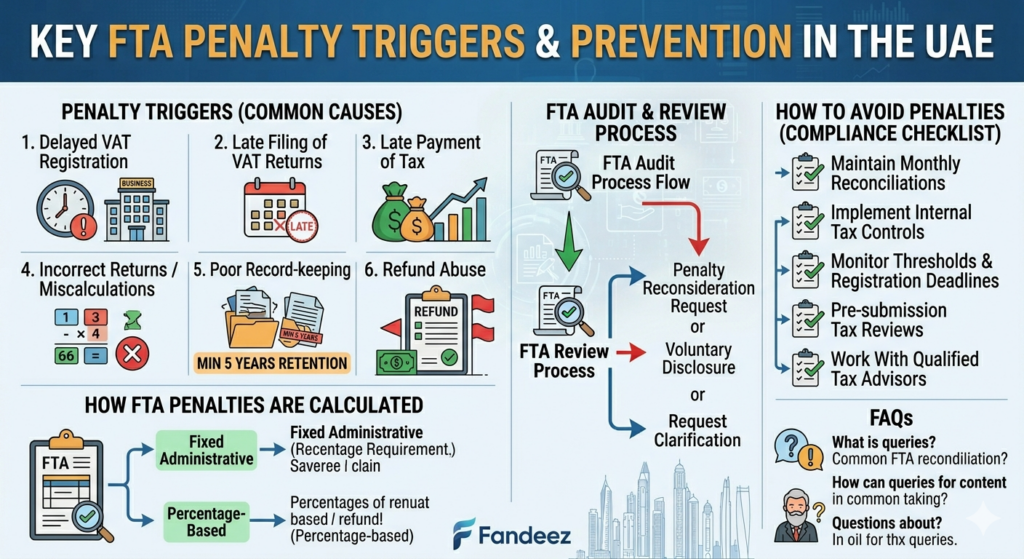
Failure to Register for VAT on Time
if your taxable supplies exceed the mandatory VAT registration threshold and you do not register within the required timeframe, the FTA can impose administrative penalties.
Common triggers include:
-
Delayed VAT registration
-
Ignoring compliance with voluntary registration thresholds
-
Issuing invoices without a valid VAT registration number (TRN)
Penalty risk increases if VAT should have been collected but was not.
Late Filing of VAT Returns
VAT returns must be filed by the deadline specified for your tax period.
The FTA may impose penalties for:
-
Filing after the due date
-
Repeated late submissions
-
Submitting incorrect returns without valid justification
Even if no VAT is payable, late filing alone can still result in fines.
Late Payment of VAT or Corporate Tax
Submitting returns without making the corresponding payment triggers financial penalties.
The FTA may impose:
-
Fixed penalties
-
Percentage-based penalties on unpaid tax
-
Daily accruing penalties for continued delays
This applies to both VAT and corporate tax obligations.
Incorrect Tax Returns or Miscalculations
Errors in tax returns can lead to penalties if they result in:
-
Underreported output VAT
-
Incorrect input VAT claims
-
Understated taxable income
-
Overstated expenses
Penalties are more severe if the error leads to underpayment of tax.
Failure to Maintain Proper Records
Under UAE tax law, businesses must retain records for at least five years (longer in certain cases).
The FTA can penalize businesses for:
-
Missing invoices
-
Lack of supporting documentation
-
Inability to produce records during an audit
-
Backdated or manipulated entries
Poor bookkeeping significantly increases enforcement risk.
Failure to Issue Proper Tax Invoices
A valid UAE tax invoice must include mandatory fields such as:
-
Tax Registration Number (TRN)
-
Invoice number and date
-
VAT amount clearly stated
Issuing non-compliant invoices can trigger penalties and result in VAT being disallowed.
VAT Refund Abuse or Incorrect Refund Claims
The FTA closely monitors refund applications.
Red flags include:
-
Repeatedly high refund claims
-
Inconsistent input VAT patterns
-
Lack of supporting import/export documentation
If a refund is claimed incorrectly, repayment plus penalties may apply.
Failure to Cooperate During an Audit
During a tax audit, businesses must:
-
Provide requested documentation
-
Allow access to records
-
Respond within specified timelines
Failure to cooperate can result in additional administrative penalties.
Lorem ipsum dolor sit amet, consectetur adipiscing elit. Ut elit tellus, luctus nec ullamcorper mattis, pulvinar dapibus leo.
Tax Evasion or Deliberate Non-Disclosure
Serious violations include:
-
Concealing income
-
Falsifying invoices
-
Claiming fictitious expenses
-
Destroying accounting records
These cases may escalate beyond administrative penalties into legal proceedings.
How Are FTA Penalties Calculated?
Penalties generally fall into the following categories:
-
Fixed Administrative Penalties – for late filings or procedural violations
-
Percentage-Based Penalties – calculated on unpaid tax
-
Escalating Penalties – increasing with repeated non-compliance
Penalty amounts vary depending on severity and recurrence.
Can FTA Penalties Be Reduced?
Yes, in certain cases:
-
If a voluntary disclosure is submitted before audit notification
-
If a penalty reconsideration request is filed within the permitted timeframe
-
If clear documentation supports a genuine error
However, proactive compliance is always safer than reactive correction.
How to Avoid FTA Penalties
-
Register on time – Monitor turnover thresholds regularly.
-
Maintain monthly reconciliations – VAT, bank, and expense reconciliation should be systematic.
-
Implement internal tax controls – Establish approval workflows for invoices and filings.
-
Conduct quarterly compliance reviews – Early detection reduces risk.
-
Work with qualified tax advisors – Professional oversight significantly reduces exposure
Frequently Asked Questions
1. Does the FTA audit small businesses?
Yes. Audits are risk-based, not size-based.
2. Are Free Zone companies exempt from penalties?
No. All registered entities must comply with UAE tax laws.
3. Can penalties affect trade license renewal?
Severe or repeated violations may impact business continuity.
4. What is the most common penalty?
Late filing and late payment penalties are the most frequent.
Final Thoughts
The FTA imposes penalties to enforce transparency and compliance — not to discourage business growth. However, failing to understand your regulatory obligations can result in costly consequences.
In the UAE’s structured tax environment, disciplined bookkeeping and timely reporting are no longer optional — they are essential for operational stability.