

Table of Contents
ToggleVAT Rules for Restaurants and Cafés in UAE: A Complete Compliance Guide
What are the VAT rules for restaurants and cafés in the UAE? Restaurants and cafés must register for VAT once taxable supplies exceed AED 375,000 annually, charge the standard 5% VAT rate on most food, beverage, and related service transactions, issue compliant tax invoices, and file VAT returns for the tax period assigned to them by the Federal Tax Authority (FTA).
For restaurants, cafés, cloud kitchens, food trucks, and catering businesses across the UAE, VAT compliance touches almost every part of daily operations — from the price printed on a menu to how a delivery order is reconciled at month-end. The food and beverage (F&B) sector faces some particularly nuanced VAT questions: how discounts should be treated, whether tips are taxable, how delivery platform commissions work, and what counts as a valid tax invoice at a busy till.
This guide breaks down the VAT rules for restaurants and cafés in UAE in practical terms — what’s legally required, what’s common industry practice, and where F&B operators most often get VAT wrong.
Do Restaurants and Cafés Need VAT Registration in the UAE?
Yes — restaurants and cafés must register for VAT once their taxable supplies and imports exceed AED 375,000 over the preceding 12 months, or are expected to exceed that threshold in the next 30 days. Voluntary registration is available once taxable supplies or expenses exceed AED 187,500.
For most F&B businesses, revenue from taxable supplies climbs past the mandatory threshold quickly, even for a single small outlet. Once a restaurant, café, cloud kitchen, or catering business crosses AED 375,000 in taxable turnover, VAT registration with the FTA becomes mandatory — not optional. Businesses that haven’t yet reached this threshold but want to register voluntarily (for example, to recover input VAT on setup costs) can do so once they pass AED 187,500 in taxable supplies or taxable expenses.
Newer F&B businesses — including food trucks and cloud kitchens that may not think of themselves as a “restaurant” in the traditional sense — are still taxable persons under UAE VAT law if they make taxable supplies of food and beverages. Business structure or size doesn’t exempt an F&B operator from registration once the threshold is met.
What Is the VAT Rate for Restaurants and Cafés in UAE?
The standard UAE VAT rate of 5% generally applies to food and beverage supplies made by restaurants and cafés, including dine-in meals, takeaway orders, delivery, and catering services. However, the correct VAT treatment should always be confirmed against the specific supply and any applicable exemptions or zero-rating that may apply in particular circumstances.
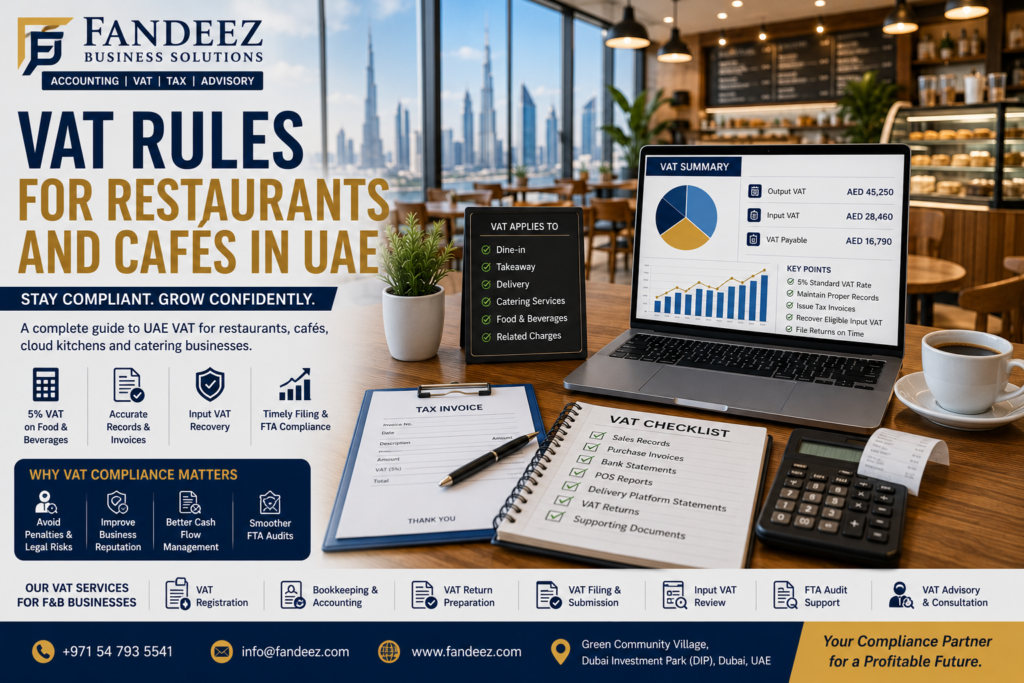
For the vast majority of everyday F&B transactions, 5% VAT applies consistently across:
- Dine-in meals and beverages served on the premises
- Takeaway food and drinks
- Delivery orders, whether fulfilled directly or through a third-party platform
- Catering services provided for events, offices, or private functions
It’s worth noting that UAE VAT law does provide limited zero-rating and exemption categories for certain goods and services elsewhere in the economy (such as specific healthcare, education, and residential real estate supplies). These categories are not generally relevant to standard restaurant and café food and beverage sales, but businesses with unusual supply arrangements — for example, bundled goods, retail grocery sales alongside prepared food, or specific export scenarios — should confirm the correct treatment rather than assume every transaction is automatically standard-rated in the same way.
VAT on Restaurant Delivery Platforms
When a restaurant sells through a third-party delivery platform (such as a food delivery aggregator), VAT applies at more than one level of the transaction, and it’s important to keep these separate.
- Sale to the customer: The restaurant is generally responsible for accounting for VAT on the value of the food and beverages sold to the end customer, even when the order is placed and paid through a delivery platform.
- Platform commission: The commission charged by the delivery platform to the restaurant is typically a separate taxable supply made by the platform to the restaurant, and VAT charged on that commission may be recoverable as input VAT by the restaurant, subject to normal input VAT recovery rules.
- Reconciliation: Because delivery platforms often settle payments to restaurants net of commission and other deductions, restaurants need to reconcile gross sales, platform commissions, and net payouts carefully to ensure output VAT is calculated on the correct sales value — not just the net amount received from the platform.
- Supporting tax invoices: Restaurants should retain proper tax invoices or platform-generated statements that clearly show the value of sales, commission charged, and VAT amounts, since these documents support both output VAT reported and input VAT claimed on commission fees.
The exact commercial and invoicing arrangement can vary between platforms, so restaurants should review their specific agreement with each delivery partner to confirm how VAT is being accounted for and documented, rather than assuming identical treatment across every platform.
VAT on Restaurant Discounts, Promotions and Free Items
VAT treatment differs depending on the type of discount, promotion, or giveaway involved, so these should not be treated as one single category.
- Straightforward discounts (e.g., 20% off the bill) — VAT is generally calculated on the discounted price actually paid by the customer, not the original pre-discount price, provided the discount is genuinely available to customers and properly reflected in the invoice.
- Buy-one-get-one-free (BOGOF) and similar bundled offers — the VAT treatment depends on how the offer is structured (for example, whether it’s treated as a discount on a bundle or as a free supply of goods). This is an area where businesses commonly get the treatment wrong, and it’s best confirmed based on the exact mechanics of the offer.
- Free items with no other purchase — a genuinely free item given away with no consideration paid by the customer may have different VAT implications than an item bundled into a paid offer, and rules around deemed supplies for free goods can apply above certain value thresholds.
- Vouchers — UAE VAT law distinguishes between different types of vouchers. Broadly, the VAT treatment can depend on whether the voucher entitles the holder to a supply of goods/services up to a stated monetary value versus a specific pre-identified item, and VAT timing can differ between the sale of the voucher and its later redemption. Restaurants issuing gift cards or promotional vouchers should confirm the applicable treatment rather than applying a single rule to every voucher type.
- Loyalty promotions (e.g., points redeemable for free items) — treatment depends on the specific scheme design and should be reviewed individually.
Because discount and voucher treatment is one of the most commonly misapplied areas of restaurant VAT, F&B businesses running frequent promotions should have their offer structures reviewed rather than assuming a single blanket rule covers every type of promotion.
VAT on Tips, Service Charges and Delivery Fees
Genuine voluntary tips paid directly by a customer to staff, where the restaurant has no contractual entitlement to the amount, generally fall outside the scope of VAT. However, mandatory service charges added to the bill by the restaurant are typically treated as part of the consideration for the supply and are subject to VAT.
The key distinction is whether the restaurant is contractually entitled to the amount as part of the price for the supply, or whether it’s a discretionary payment made directly by the customer that the restaurant has no legal claim to:
- Voluntary tips — left at the customer’s discretion, not itemized as a mandatory charge on the bill, and not something the restaurant has a contractual right to collect — are generally outside the scope of VAT.
- Mandatory service charges — a fixed percentage automatically added to every bill as a condition of the sale — are generally treated as consideration for the supply and subject to VAT, since the customer has no choice but to pay it.
- Delivery charges — where a restaurant charges a separate delivery fee as part of fulfilling an order, this fee is generally treated as part of the taxable supply and subject to VAT.
- Packaging charges — charges for takeaway or delivery packaging are typically treated the same way as the underlying food and beverage supply.
Restaurants should review how tips and service charges are structured on their POS systems and menus, since the way an amount is presented (voluntary vs. mandatory) directly affects its VAT treatment.
Can Restaurants Recover Input VAT?
Yes. Restaurants and cafés can generally recover input VAT paid on legitimate business expenses used to make taxable supplies, provided they hold valid tax invoices and the expense is not specifically blocked from recovery under UAE VAT law.
Common recoverable input VAT for F&B businesses includes VAT paid on:
- Food ingredients and raw materials
- Beverages purchased for resale
- Kitchen equipment and appliances
- Cleaning supplies and consumables
- POS systems, accounting, and other business software
- Furniture and fit-out costs
- Rent (where VAT applies to the lease)
- Utilities used for the business
- Delivery-related expenses, including platform commissions and delivery vehicle costs
Input VAT recovery is not automatic — it depends on the expense being incurred for business purposes, being supported by a valid tax invoice showing the supplier’s TRN and required invoice details, and not falling into any category specifically excluded from recovery under UAE VAT rules (such as certain entertainment expenses in some circumstances). Restaurants should keep organized, complete purchase records to support every input VAT claim, since the FTA can request this documentation during a review.
VAT Tax Invoice Requirements for Restaurants
A valid UAE VAT tax invoice generally needs to include:
- The supplier’s name, address, and Tax Registration Number (TRN)
- A unique invoice number
- The date of issue
- A description of the goods or services supplied
- The VAT amount charged
- The total amount payable, inclusive of VAT
- The customer’s name and address, for higher-value transactions where full invoice details are required
Simplified tax invoices are permitted for supplies where the total consideration is below the threshold set under UAE VAT legislation (AED 10,000), which covers the vast majority of individual restaurant and café transactions at the till. A simplified invoice requires fewer details than a full tax invoice — typically the supplier’s name, address, TRN, invoice date, description of the goods or services, and the total amount payable including VAT.
This distinction matters in practice: a restaurant doesn’t need to collect full customer details for every dine-in bill or takeaway order, but should be prepared to issue a full tax invoice where a transaction (such as a large corporate catering order) exceeds the simplified invoice threshold, or where a business customer specifically requests one to support their own input VAT recovery.
VAT Return Filing for Restaurants and Cafés
Restaurants and cafés registered for VAT must file VAT returns for the tax period assigned to them by the FTA, reporting output VAT collected on sales and input VAT recoverable on eligible purchases, and pay any net VAT due by the applicable deadline.
The tax period a business is assigned — commonly monthly or quarterly — depends on factors set by the FTA at the time of registration, and it should not be assumed that every restaurant automatically files on the same schedule. Businesses should confirm their specific tax period through their FTA registration details rather than assuming a standard quarterly cycle applies.
Preparing an accurate VAT return for an F&B business typically involves reconciling several different data sources:
- POS reports — showing total sales, VAT collected, discounts applied, and voids or refunds
- Delivery platform statements — showing gross sales, commissions deducted, and net payouts
- Bank statements — confirming actual cash received matches recorded sales and payouts
- Purchase invoices — supporting input VAT claimed on ingredients, supplies, and other expenses
Because F&B businesses often have high transaction volumes across multiple sales channels (in-store POS, multiple delivery platforms, and sometimes cash sales), reconciliation errors are common if these sources aren’t checked against each other before a VAT return is filed.
Common VAT Mistakes Made by Restaurants
Some of the most frequent VAT errors seen in the F&B sector include:
- Incorrect VAT treatment of discounts — applying the wrong base amount when calculating VAT on discounted sales.
- Missing tax invoices — for supplier purchases, meaning input VAT can’t be properly supported or claimed.
- Poor POS records — incomplete or unreconciled daily sales reports that don’t match bank deposits.
- Incorrect delivery platform reconciliation — reporting output VAT on net payouts received rather than gross sales value.
- Unclaimed eligible input VAT — missing out on legitimate recoverable VAT due to disorganized purchase records.
- Incorrect input VAT claims — claiming VAT on expenses that are blocked from recovery or lack proper supporting invoices.
- Mixing personal and business expenses — particularly common among small, owner-operated cafés and food trucks.
- Late VAT returns — missing filing deadlines due to disorganized record-keeping.
- Incorrect VAT calculations — errors in applying the 5% rate consistently across different sales channels.
- Poor record keeping — insufficient documentation to support figures reported on the VAT return.
These mistakes are rarely the result of intentional non-compliance — they’re usually the product of high transaction volumes, multiple sales channels, and manual reconciliation processes that leave room for error.
VAT Records Restaurants Should Maintain
UAE VAT law requires taxable persons to keep records supporting their VAT returns. For restaurants and cafés, this generally includes:
- Sales records and daily POS reports
- Purchase invoices from suppliers
- Tax invoices issued to customers (where applicable)
- Delivery platform statements and settlement reports
- Bank statements for all business accounts
- Filed VAT returns
- Credit notes and debit notes issued or received
- Expense records and receipts
- Any other supporting documentation relevant to VAT treatment applied
Organized, complete records not only support accurate VAT filing but also make it significantly easier to respond if the FTA requests documentation during a review or audit.
VAT Penalties for Restaurants and Cafés in UAE
Non-compliance with UAE VAT obligations can result in administrative penalties, though the exact amount and structure of penalties can vary depending on the specific violation, and penalty rules have been updated by the UAE Cabinet over time. As a general guide based on current FTA-aligned penalty structures:
- Late VAT registration carries an administrative penalty, aligned with the amounts applied to other UAE tax registrations.
- Late payment of VAT due is typically subject to a percentage-based penalty applied shortly after the due date, with an additional monthly percentage penalty accruing on any amount that remains unpaid, up to a capped maximum.
- Errors in VAT returns can result in penalties, with reduced penalties generally available where a business proactively corrects an error through a voluntary disclosure rather than waiting for the FTA to identify it.
- Failure to maintain required records can also result in administrative penalties.
Because penalty amounts and structures are set by Cabinet Decision and can be revised, restaurant and café owners should always confirm current penalty amounts directly through the FTA’s official published guidance rather than relying on older figures that may no longer be accurate.
How Fandeez Helps Restaurants and Cafés With VAT Compliance
Fandeez Business Solutions is a UAE-based accounting and tax consultancy that supports F&B businesses — restaurants, cafés, cloud kitchens, food trucks, and catering companies — with practical, day-to-day VAT compliance.
Our services for the F&B sector include:
- VAT registration — determining whether mandatory or voluntary registration applies and managing the FTA application process.
- VAT return preparation and filing — accurately reporting output and input VAT for your assigned tax period.
- Bookkeeping — keeping sales, purchase, and expense records organized and audit-ready.
- POS reconciliation — matching POS sales data against bank deposits and VAT reported.
- Delivery platform reconciliation — ensuring output VAT is calculated on gross sales, not net payouts, and that commission input VAT is properly claimed.
- Input VAT review — identifying eligible recoverable VAT and correcting misclassified claims.
- VAT health checks — reviewing your existing VAT processes for common F&B errors before they become filing problems.
- FTA audit support — helping you prepare organized records and respond confidently to FTA queries.
- VAT advisory — clarifying how VAT applies to your specific discounts, vouchers, delivery arrangements, and service charges.
We work with F&B operators to build VAT processes that hold up to scrutiny, without slowing down a busy kitchen or front-of-house team.
Conclusion
VAT compliance in the F&B sector is more layered than it first appears. While the standard 5% VAT rate applies to most restaurant and café transactions, the correct treatment of discounts, vouchers, tips, service charges, and delivery platform sales requires careful attention — and getting these details wrong is one of the most common sources of VAT errors in the industry.
Understanding the VAT rules for restaurants and cafés in UAE — from registration and invoicing through to input VAT recovery and return filing — puts F&B business owners in a far stronger position to stay compliant and avoid unnecessary penalties.
If your restaurant, café, or F&B business needs support getting VAT right — from registration through to ongoing filing and reconciliation — contact Fandeez Business Solutions for practical, UAE-specific VAT and accounting support.
Frequently Asked Questions
Do restaurants need VAT registration in the UAE? Yes, once taxable supplies exceed AED 375,000 over the preceding 12 months (or are expected to in the next 30 days), VAT registration is mandatory. Voluntary registration is available from AED 187,500.
What is the VAT rate on restaurant food in the UAE? The standard UAE VAT rate of 5% generally applies to food and beverage sales, though businesses with unusual supply arrangements should confirm treatment for their specific case.
Is takeaway food subject to VAT in the UAE? Yes. Takeaway food and beverages are generally subject to VAT at the standard 5% rate, the same as dine-in sales.
Is restaurant delivery subject to VAT? Yes. Both the food and beverage sale and any separate delivery fee charged are generally subject to VAT, whether delivered directly by the restaurant or through a third-party platform.
Can restaurants claim input VAT? Yes, on legitimate business expenses supported by valid tax invoices, such as ingredients, equipment, rent, and delivery platform commissions, subject to standard input VAT recovery rules.
Is VAT charged on restaurant service charges? Mandatory service charges added to the bill are generally treated as part of the taxable supply and subject to VAT, since the customer has no choice but to pay them.
Are tips subject to VAT in the UAE? Genuine voluntary tips, left at the customer’s discretion and not contractually owed to the restaurant, are generally outside the scope of VAT.
How often do restaurants file VAT returns? It depends on the tax period assigned by the FTA at registration, which is commonly monthly or quarterly. Businesses should confirm their specific assigned period rather than assuming a standard cycle.
What records should restaurants keep for VAT? Sales records, POS reports, purchase invoices, tax invoices, delivery platform statements, bank statements, filed VAT returns, and supporting documentation for all transactions.
What happens if a restaurant makes a VAT filing mistake? Errors can result in administrative penalties, though correcting mistakes proactively through a voluntary disclosure to the FTA is generally treated more favorably than waiting for the error to be identified during a review.