

Table of Contents
ToggleCash vs Accrual Accounting UAE: Which Method Is Right for Your Business?
Introduction
Choosing the right accounting method is one of the most important financial decisions for any UAE business. The choice between cash and accrual accounting affects how you record income and expenses, prepare VAT returns, calculate Corporate Tax, and present financial statements to banks and investors.
In the UAE, this decision is not merely a matter of preference—it has direct compliance implications under VAT regulations and the Corporate Tax Law. While cash accounting offers simplicity, accrual accounting is generally required for most businesses and provides a more accurate picture of financial performance. This guide explains both methods, their advantages and disadvantages, and which one is right for your UAE business. If you’re unsure where your business stands, Fandeez’s bookkeeping services can help you get your records in order from day one.
What Is Cash Accounting?
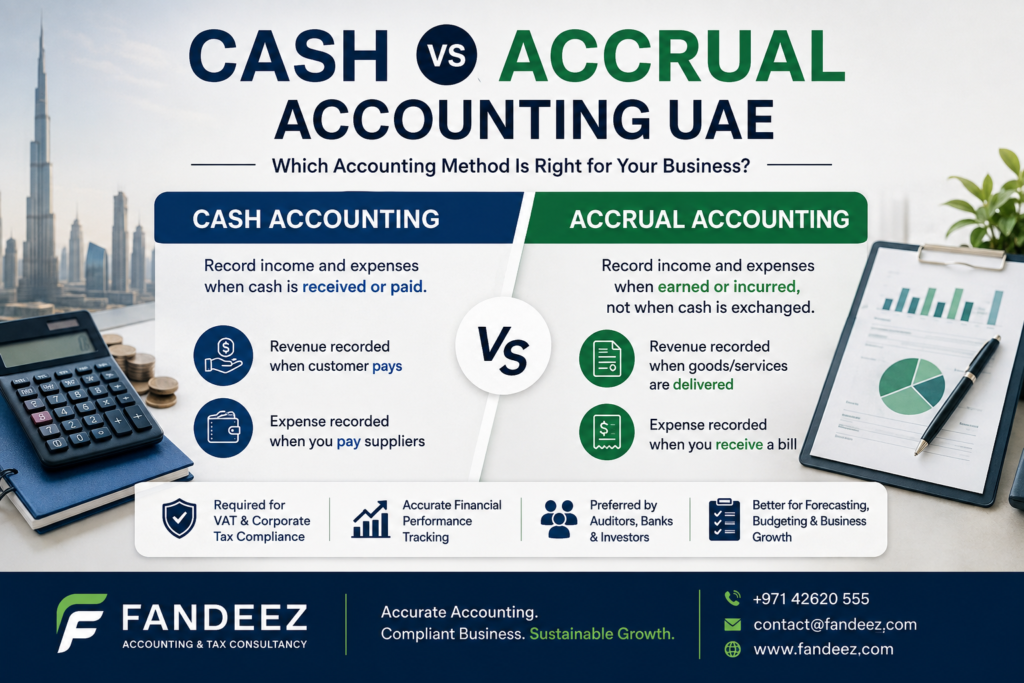
Cash accounting records income only when cash is received and expenses only when cash is paid. Under this method, you recognise revenue when a customer pays you, and you record expenses when you settle an invoice with a supplier. It does not matter when you issued the invoice or when the goods or services were delivered—only the actual movement of cash matters.
Example for a UAE Business: A Dubai-based consultancy completes a project in October 2026 and issues an invoice for AED 50,000. The client pays in December 2026. Under cash accounting, the revenue is recorded in December when the payment is received, not in October when the work was completed.
Advantages:
- Simple to understand and maintain
- Clear visibility of actual cash position
- Lower bookkeeping costs
- Suitable for very small businesses with straightforward transactions
Disadvantages:
- Does not provide an accurate picture of profitability
- Unpaid invoices and bills are not reflected
- Not suitable for VAT compliance
- Not accepted for most Corporate Tax purposes
- Can be misleading for businesses offering credit terms
What Is Accrual Accounting?
Accrual accounting records income when it is earned and expenses when they are incurred, regardless of when cash is received or paid. This method matches revenue with the expenses incurred to generate that revenue, providing a more accurate view of financial performance over a specific period.
Example for a UAE Business: A Dubai-based consultancy completes a project in October 2026 and issues an invoice for AED 50,000. The client pays in December 2026. Under accrual accounting, the revenue is recorded in October when the service was completed and the invoice was issued, not when payment is received.
Advantages:
- Provides a complete and accurate picture of profitability
- Matches revenue with related expenses
- Required for IFRS compliance
- Suitable for VAT and Corporate Tax reporting
- Preferred by banks and investors for financing
- Enables better long-term financial planning
Disadvantages:
- More complex to maintain
- Requires tracking of receivables and payables
- May require professional bookkeeping support
- Cash position is not immediately visible without additional analysis
Cash vs Accrual Accounting: Key Differences
| Feature | Cash Accounting | Accrual Accounting |
|---|---|---|
| Revenue Recognition | When cash is received | When revenue is earned (invoice issued) |
| Expense Recognition | When cash is paid | When expenses are incurred |
| Cash Flow Visibility | High—shows actual cash in hand | Medium—requires cash flow statement |
| Financial Accuracy | Low—may hide unpaid invoices and liabilities | High—shows true financial position |
| IFRS Compliance | Not compliant | Mandatory under IFRS |
| VAT Compliance | Not suitable | Required for VAT reporting |
| Corporate Tax | Allowed only for revenue ≤ AED 3 million | Required for most businesses |
| Complexity | Simple | Complex |
| Best Suited For | Micro businesses, freelancers | SMEs, growing businesses, VAT-registered entities |
Cash vs Accrual Accounting UAE: What Does the UAE Require?
The UAE’s regulatory framework has clear positions on accounting methods for VAT and Corporate Tax purposes.
UAE VAT Requirements
Accrual accounting is required for VAT purposes in the UAE. VAT becomes due when a tax invoice is issued, not when payment is received. A business maintaining cash-based books must keep separate records to track issued but unpaid invoices, increasing error risk. Using the wrong VAT accounting basis creates discrepancies that can trigger audits. Fandeez’s VAT compliance services can help you avoid these discrepancies before they become audit red flags.
UAE Corporate Tax Requirements
Under Federal Decree-Law No. 47 of 2022, the UAE Corporate Tax Law establishes specific guidelines for acceptable accounting methods.
The General Rule—Accrual is Mandatory Under Article 20(1), taxable income is determined based on financial statements prepared in accordance with accepted accounting standards in the UAE. IFRS, which mandates the accrual basis, is the required standard.
The Exception—Cash Basis Allowed for Small Businesses Ministerial Decision No. 114 of 2023 permits cash basis accounting only in specific circumstances:
A Taxable Person may prepare Financial Statements using the Cash Basis of Accounting if:
- Their Revenue does not exceed AED 3 million within the relevant Tax Period; or
- In exceptional circumstances and pursuant to an application submitted to the FTA.
IFRS Requirements for Businesses
Accounting standard requirements depend on revenue levels:
- Revenue above AED 50 million: Full IFRS
- Revenue below AED 50 million: IFRS for SMEs is permitted
Even businesses eligible for cash basis must maintain adequate records that can be reconciled with accrual-based figures for tax computation. For businesses that need help getting audit-ready financials in place, Fandeez’s Corporate Tax compliance services cover registration, filing, and ongoing reconciliation support.
Small Business Relief
The UAE Corporate Tax Law offers relief for small businesses. Entities with revenue not exceeding AED 3,000,000 in a relevant tax period and all previous tax periods ending on or before 31 December 2026 can elect for Small Business Relief, which deems that the entity has not derived any taxable income.
Accrual Accounting and UAE VAT
VAT in the UAE operates on an accrual-style system. Understanding the accounting implications of VAT is essential for proper bookkeeping.
VAT Accounting Basis
VAT becomes due at the time of supply, which is typically when the invoice is issued, not when payment is received. This means businesses must track output VAT on issued invoices and input VAT on received invoices.
Reverse Charge Mechanism
For imported services from overseas suppliers, UAE businesses may need to account for VAT under the reverse charge mechanism. This requires specific accounting entries to record both output and input VAT simultaneously.
Example—Reverse Charge Accounting Entry: A Dubai company purchases software licences from a US supplier for AED 20,000:
- Software Expense Dr 20,000
- Accounts Payable Cr 20,000
- Input VAT Recoverable Dr 1,000
- Output VAT Payable Cr 1,000
Key VAT Compliance Points
- VAT returns must report taxable supplies when invoices are issued
- Input VAT recovery depends on proper tax invoices
- Exempt supplies require careful tracking of recoverable input VAT
- VAT records must align with financial statements
Accrual Accounting and UAE Corporate Tax
The relationship between accounting profit and taxable income is central to UAE Corporate Tax compliance.
Accounting Profit as the Starting Point
The UAE Corporate Tax Law uses accounting profit as the starting point for determining taxable income. Taxable income is derived from accounting income, subject to specific adjustments prescribed under the law.
Cash Basis Exception
Businesses with revenue not exceeding AED 3 million may elect to use the cash basis for Corporate Tax purposes. This exemption aligns with Small Business Relief, which can effectively result in a 0% Corporate Tax liability for qualifying businesses.
Important Considerations:
- Approval to continue on a cash basis beyond the AED 3 million threshold is granted only in rare and exceptional cases
- Cash basis users may still need to prepare accrual-based figures for tax computation
- The choice between cash and accrual is a strategic compliance decision that affects tax exposure, reporting accuracy, and audit readiness
Common Accounting Errors Affecting Corporate Tax
Revenue Recognition Errors: Incorrect timing of revenue recognition—such as recognising income on a cash basis where accrual is required—can result in understatement or overstatement of taxable income.
Expense Classification: Entertainment expenditure may be only 50% deductible, while fines and penalties are specifically non-deductible.
Capital Assets Incorrectly Expensed: Treating capital assets as operating expenses can understate taxable income in the year of acquisition.
Which Accounting Method Is Best for UAE Businesses?
The choice depends on your business size, revenue, compliance obligations, and growth plans.
Startups and Early-Stage Businesses
If revenue is below AED 3 million, cash basis accounting may be permissible. However, startups planning for growth should consider accrual accounting from the beginning to avoid transition complications later. Fandeez’s accounting system setup service can help you build the right foundation from the start.
SMEs and Growing Companies
For most SMEs, accrual accounting is recommended and often required. Revenue above AED 3 million makes accrual mandatory for Corporate Tax purposes. Accrual also provides the accurate financial reporting needed for:
- Bank loan applications
- Investor due diligence
- VAT compliance
- Long-term financial planning
Freelancers and Micro Businesses
Freelancers with irregular cash flows may benefit from the simplicity of cash basis accounting, which aligns taxable income with actual cash receipts. However, even freelancers must consider their visa status and long-term business goals—those with investment-focused plans are better suited to accrual accounting.
Businesses with Inventory or Credit Terms
Businesses holding inventory, offering credit to customers, or using supplier credit should use accrual accounting. Cash basis does not provide the matching required to accurately track cost of goods sold or understand true profitability.
Businesses Seeking Loans or Investment
Accrual accounting is strongly preferred by banks and investors. Cash basis statements can be misleading for funding purposes, showing strong cash positions while hiding significant unpaid obligations or uncollected receivables. Fandeez’s financial reporting services can help you prepare IFRS-compliant statements that banks and investors trust.
Common Mistakes UAE Businesses Make
Mixing Cash and Accrual Records Using different methods for day-to-day bookkeeping and tax filings creates inconsistencies that trigger audit scrutiny.
Poor Invoice Tracking Unpaid invoices may be forgotten, leading to inaccurate revenue recognition and cash flow issues.
Ignoring Unpaid Invoices Under cash accounting, unpaid invoices are not recorded, creating a false impression of financial health.
Incorrect VAT Treatment Using cash accounting for VAT purposes is not compliant. VAT must be reported on invoice issuance.
Poor Expense Documentation Inadequate supporting documentation for expenses can result in disallowed deductions for Corporate Tax purposes.
Delaying Bookkeeping Late bookkeeping leads to incomplete records, missed deductions, and inaccurate VAT returns.
Transitioning Too Late Businesses approaching the AED 3 million revenue mark should transition to accrual accounting early to avoid compliance issues.
How Fandeez Helps UAE Businesses
Fandeez Business Solutions is a UAE-based accounting, tax, and advisory consultancy that helps businesses choose the right accounting method and maintain compliance with UAE regulations.
Services Offered:
- Bookkeeping: Professional bookkeeping services aligned with UAE requirements
- Accounting System Setup: Assistance in setting up the right accounting system for your business
- VAT Compliance: Support with VAT registration, filing, and compliance
- Corporate Tax Compliance: Assistance with Corporate Tax registration, filing, and ongoing compliance
- Financial Reporting: Preparation of IFRS-compliant financial statements
- Reconciliation: Bank reconciliation and financial record review
- Transition Support: Helping businesses transition from cash to accrual accounting when required
- Accounting Software Setup: Recommendations and setup for FTA-compliant accounting software
Fandeez provides practical, tailored advice to ensure your business uses the right accounting method for its size, activity, and compliance obligations.
Frequently Asked Questions
1. What is the difference between cash and accrual accounting in the UAE? Cash accounting records income and expenses only when cash is received or paid. Accrual accounting records income when earned and expenses when incurred, regardless of payment timing. Accrual provides a more accurate picture of financial performance and is required for most UAE businesses.
2. Is accrual accounting mandatory in the UAE? Accrual accounting is mandatory for most UAE businesses. Under the Corporate Tax Law, businesses with revenue exceeding AED 3 million must use accrual accounting. It is also required for IFRS compliance and VAT purposes.
3. Can a small business use cash accounting in the UAE? Yes, but only if annual revenue does not exceed AED 3 million. Even then, businesses must maintain proper records and be prepared to reconcile with accrual figures for tax purposes.
4. Which accounting method is better for VAT in the UAE? Accrual accounting is required for VAT compliance. VAT becomes due when invoices are issued, not when payments are received. Cash basis accounting cannot be used for VAT reporting.
5. What accounting method is used for UAE Corporate Tax? Accrual accounting is generally required. However, businesses with revenue not exceeding AED 3 million may elect to use the cash basis for Corporate Tax purposes, subject to FTA approval.
6. Is cash accounting suitable for freelancers in the UAE? Freelancers with irregular cash flows may benefit from cash accounting, provided their revenue is below AED 3 million. Those with long-term growth plans are better suited to accrual accounting.
7. When should a UAE business switch from cash to accrual accounting? Businesses should switch when approaching or exceeding the AED 3 million revenue threshold, before applying for bank loans or investment, or when becoming VAT-registered. Early transition is recommended to avoid compliance issues.
8. Which accounting method is better for SMEs in the UAE? Accrual accounting is better for most SMEs. It provides accurate financial reporting, is required for Corporate Tax and VAT compliance, and is preferred by banks and investors.
Choose the Right Accounting Method with Fandeez
Choosing between cash and accrual accounting in the UAE is not just a business decision—it is a compliance requirement that affects VAT returns, Corporate Tax filings, financial reporting, and business growth. While cash accounting may offer simplicity for micro businesses, accrual accounting is the standard required for most companies and provides the accurate financial information needed to make informed decisions.