

Table of Contents
ToggleVAT Registration for Home-Based Business UAE: Complete Guide
Introduction
If you are running a business from home in the UAE—whether as a freelancer, consultant, online seller, or service provider—you may be wondering whether you need to register for Value Added Tax (VAT). The short answer is: it depends on your taxable turnover and expenses.
VAT registration is not determined by whether you operate from a home office or a commercial space. The Federal Tax Authority (FTA) focuses on your taxable supplies and imports, not your business location. Understanding the rules is essential to avoid penalties and make informed decisions about your business.
This guide explains everything home-based entrepreneurs need to know about VAT registration in the UAE, including thresholds, compliance requirements, benefits, and common mistakes to avoid. If you’d rather have this handled for you, Fandeez’s VAT compliance services can assess your threshold and manage the entire registration process.
Does a Home-Based Business Need VAT Registration in the UAE?
A home-based business must register for VAT if its taxable supplies and imports exceed AED 375,000 over the past 12 months or are expected to exceed that threshold within the next 30 days.
The requirement applies regardless of whether you operate from home, a commercial office, or any other location. The FTA considers any natural or legal person conducting business in the UAE as potentially subject to VAT registration, even without a trade license.
Key point: The rules apply equally to home-based entrepreneurs, freelancers, and small businesses. Your physical location does not exempt you from VAT obligations if you meet the thresholds.
What Is the UAE VAT Registration Threshold?
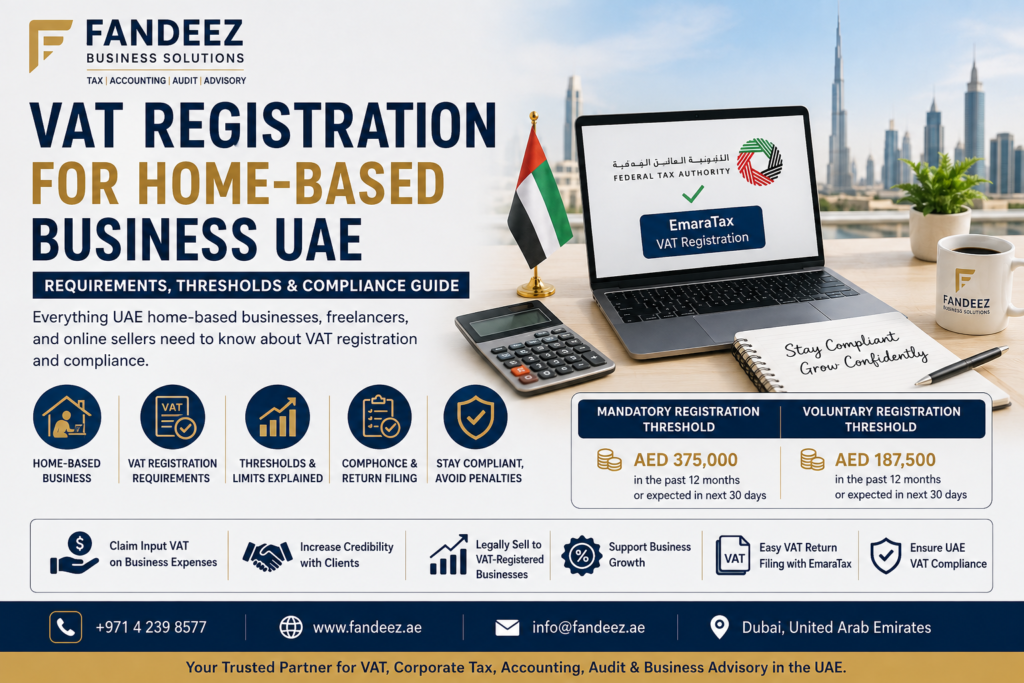
The UAE has two VAT registration thresholds established by the FTA:
| Registration Type | Threshold | Who Should Consider It |
|---|---|---|
| Mandatory Registration | AED 375,000 | Businesses with taxable supplies and imports exceeding this amount |
| Voluntary Registration | AED 187,500 | Businesses below the mandatory threshold but above this amount |
Mandatory Registration (AED 375,000)
A business must register for VAT if:
- The total value of taxable supplies and imports over the previous 12 months exceeds AED 375,000, or
- The business expects to exceed that threshold within the next 30 days
Once the threshold is met, the business has 30 days to submit a registration application to the FTA through the EmaraTax portal.
Voluntary Registration (AED 187,500)
A business may choose to register voluntarily if:
- The total value of taxable supplies, imports, or taxable expenses in the previous 12 months exceeds AED 187,500, or
- The business expects to exceed this amount within the next 30 days
Voluntary registration allows businesses to reclaim input VAT on purchases but also imposes the same compliance obligations as mandatory registration.
What Counts Toward the VAT Registration Threshold?
When calculating whether your home-based business has reached the threshold, include the following:
Taxable Supplies All sales of goods or services subject to 5% or 0% VAT count toward the threshold. This includes:
- Services provided to clients in the UAE
- Products sold online within the UAE
- Zero-rated supplies (such as exports or certain healthcare services)
Imports Goods and services imported into the UAE count toward the threshold. This is particularly relevant for home-based businesses selling physical products sourced from overseas.
Taxable Expenses For voluntary registration purposes, taxable expenses (business costs with VAT) also count. This can be beneficial for startups with significant VAT-bearing costs.
What Does NOT Count?
Exempt supplies—such as certain financial services or residential lease income—are excluded from the threshold calculation.
Example: A home-based online seller with AED 310,000 in annual sales who imports AED 9,000 of stock per month (AED 108,000 annually) has total taxable supplies and imports of AED 418,000—exceeding the mandatory threshold even though sales alone were below AED 375,000.
When Must a Home-Based Business Register for VAT?
Mandatory Registration Triggers
Past 12-month test: If your taxable supplies and imports exceeded AED 375,000 in the previous 12 months, you must register within 30 days of becoming aware.
Future 30-day test: If you expect to exceed AED 375,000 within the next 30 days, registration is required immediately.
Penalty for Late Registration
Failure to register within 30 days of exceeding the mandatory threshold results in an AED 10,000 penalty. The FTA may also require the business to account for VAT on all taxable supplies made from the date the registration obligation arose.
Can a Home-Based Business Register for VAT Voluntarily?
Yes, a home-based business may register voluntarily if its taxable supplies, imports, or taxable expenses exceed AED 187,500.
Who Might Benefit from Voluntary Registration?
- Freelancers and consultants with moderate revenue but significant VAT-bearing expenses
- Startups and side businesses spending heavily on tools, equipment, or supplies
- Online sellers importing goods for resale
- Businesses planning growth that expect to reach the mandatory threshold soon
Pros and Cons of Voluntary Registration
| Benefits | Challenges |
|---|---|
| Recover input VAT on business purchases | Must charge 5% VAT on taxable sales |
| Professional business image with TRN | Additional administration and compliance work |
| Better financial record-keeping | Quarterly VAT returns required |
| Prepared for business growth | Potential compliance errors and penalties |
| Attractive to corporate clients | Minimum 12-month registration period |
When Voluntary Registration May NOT Be Suitable
For consumer-facing businesses (B2C), voluntary registration may make pricing less competitive since customers cannot reclaim the VAT. For businesses selling primarily to VAT-registered businesses (B2B), registration is generally beneficial as clients can recover the VAT.
VAT for Freelancers in the UAE
Freelancers are treated as taxable persons under UAE VAT law and must register if they meet the AED 375,000 threshold.
Key Considerations for Freelancers
Turnover includes international clients: Even if you only have international clients paying at 0% VAT, those earnings count toward your total turnover for threshold purposes.
No exemption based on business structure: The FTA considers every individual with a freelance permit or license as a taxable person if their annual taxable turnover reaches the threshold.
Expenses-based voluntary registration: Freelancers spending significantly on VAT-bearing business costs may benefit from voluntary registration even below the mandatory threshold.
Documents Freelancers Need for VAT Registration
- Valid trade license or freelance permit
- Passport and Emirates ID copies
- Business bank account details (IBAN)
- Financial records showing supplies and expenses
- Signed contracts or invoices as supporting evidence
VAT for Online Businesses in the UAE
Online sellers must consider both sales and imports when assessing their VAT position. The threshold is calculated on taxable supplies and imports.
Practical Example
A home-based online store in Dubai selling products with AED 310,000 in annual domestic sales and importing AED 9,000 of stock per month has total taxable supplies and imports of AED 418,000—crossing the mandatory registration threshold even though sales alone did not.
Should an Online Store Register Voluntarily?
B2B businesses: Voluntary registration is often beneficial as business clients can reclaim VAT, and input VAT on stock, freight, and services becomes recoverable.
B2C businesses: The case is weaker because consumers cannot reclaim VAT, and prices must carry the 5% tax, potentially affecting competitiveness.
VAT Compliance Requirements for Home-Based Businesses
Once registered for VAT (whether mandatorily or voluntarily), home-based businesses must comply with the following obligations:
Record-Keeping Maintain proper accounting records of all sales, expenses, and VAT paid. Records must be retained for 5 years. Fandeez’s bookkeeping services can help you keep these records organized and audit-ready.
Tax Invoices Issue valid tax invoices for taxable supplies, containing:
- “Tax Invoice” prominently displayed
- Supplier’s name, address, and Tax Registration Number (TRN)
- Distinct, consecutive invoice number and date
- Description of goods/services and VAT amount
VAT Return Filing File VAT returns through the EmaraTax portal, typically quarterly. Each return reports output VAT (collected) and input VAT (paid) for the period.
Payment Pay any VAT due by the return filing deadline.
Deregistration If you stop making taxable supplies or your taxable supplies over the preceding 12 months fall below AED 187,500, you must apply for deregistration within 20 business days.
What Happens If a Business Should Register But Does Not?
Penalties for Non-Compliance
Late registration penalty: AED 10,000
Backdated VAT liability: The FTA may require accounting for VAT on all taxable supplies made from the date the obligation arose
Incorrect financial data: Submitting incorrect or misleading data during registration can result in further punitive action
Important: Under Cabinet Decision No. 129 of 2025 (effective 14 April 2026), the penalty framework was reformed but the AED 10,000 late registration penalty remains unchanged.
Common VAT Mistakes Made by Home-Based Businesses
Ignoring the threshold Many home-based entrepreneurs assume their business is too small to require VAT registration, failing to monitor their turnover on a rolling basis.
Forgetting to include imports The threshold includes both taxable supplies and imports. Businesses importing goods may cross the threshold earlier than sales figures alone suggest.
Mixing personal and business expenses For VAT recovery, only business-related expenses qualify. Personal expenses cannot reclaim input VAT.
Missing invoices Proper tax invoices are required to reclaim input VAT and to substantiate output VAT collected.
Late registration Waiting too long to register results in the AED 10,000 penalty and potential backdated VAT liability.
Poor bookkeeping Inadequate records make VAT return preparation difficult and increase the risk of errors and penalties.
Incorrect VAT treatment Misapplying VAT—such as treating exempt supplies as zero-rated or vice versa—leads to incorrect returns.
How Fandeez Helps Home-Based Businesses With VAT
Fandeez Business Solutions is a UAE-based accounting, VAT, Corporate Tax, audit, and business advisory consultancy that helps home-based entrepreneurs navigate VAT compliance.
Services for Home-Based Businesses
- VAT Threshold Assessment: Evaluating whether your business has reached mandatory or voluntary registration thresholds
- VAT Registration: Assisting with registration through the EmaraTax portal, including document preparation and submission
- EmaraTax Support: Guidance on using the FTA portal for registration and compliance
- VAT Return Filing: Preparing and filing accurate quarterly VAT returns
- Bookkeeping: Maintaining accurate financial records to support VAT compliance
- VAT Reconciliation: Ensuring accounting records align with VAT filings
- Compliance Reviews: Proactive reviews to identify and address compliance gaps
- FTA Audit Assistance: Support during FTA audits and inspections
- Tax Invoice Setup: Helping businesses set up compliant tax invoicing systems
- Accounting System Setup: Implementing FTA-compliant accounting solutions
Fandeez provides professional, practical support to ensure your home-based business meets its VAT obligations without unnecessary stress.
When Should a Home-Based Business Consider Voluntary VAT Registration?
Consider voluntary registration if:
- Your taxable expenses are significant: Recovering input VAT on business purchases improves cash flow
- You sell to VAT-registered businesses: Corporate clients prefer VAT-registered suppliers to recover input VAT
- You are planning for growth: Early registration prepares your systems and processes
- You import goods for resale: Reclaiming VAT on import costs can significantly reduce costs
- You want a professional image: A Tax Registration Number signals compliance and credibility
Caution: Voluntary registration requires a minimum 12-month commitment before deregistration is possible. Ensure the benefits outweigh the administrative burden.
Frequently Asked Questions
1. Does a home-based business need VAT registration in the UAE? A home-based business must register for VAT if its taxable supplies and imports exceed AED 375,000 over the past 12 months or are expected to exceed that within 30 days. Below this, voluntary registration is possible from AED 187,500.
2. What is the VAT registration threshold in the UAE? The mandatory registration threshold is AED 375,000 in taxable supplies and imports. The voluntary registration threshold is AED 187,500 in taxable supplies, imports, or taxable expenses.
3. Can a freelancer register for VAT in the UAE? Yes. Freelancers are treated as taxable persons and must register if they meet the AED 375,000 threshold. Freelancers with turnover above AED 187,500 may also register voluntarily.
4. What is the voluntary VAT registration threshold? The voluntary registration threshold is AED 187,500 in taxable supplies, imports, or taxable expenses over the previous 12 months.
5. What happens if a business crosses the VAT threshold? The business must register for VAT within 30 days. Failure to do so results in an AED 10,000 penalty, and VAT may be backdated to when the obligation arose.
6. Can a small business voluntarily register for VAT? Yes, provided taxable supplies, imports, or taxable expenses exceed AED 187,500. Benefits include recovering input VAT, but registration also imposes compliance obligations.
7. Does an online business need VAT registration in the UAE? Yes, if taxable supplies and imports exceed AED 375,000. Online sellers must include both domestic sales and imported goods when calculating their threshold position.
8. Can home-based businesses claim input VAT? Yes, once registered for VAT (mandatorily or voluntarily), home-based businesses can reclaim input VAT on business-related purchases.
9. What records should a VAT-registered business maintain? Businesses must maintain sales and expense records, VAT invoices, accounting records, and supporting documents for at least 5 years.
10. How often does a UAE business file VAT returns? Most registered businesses file VAT returns quarterly through the EmaraTax portal. Filing frequency can vary based on business type and FTA requirements.
11. What documents are required for VAT registration? Documents include trade license, passport and Emirates ID copies, Memorandum of Association, bank account details, financial records, and supporting invoices or contracts.
12. What is the penalty for late VAT registration? The penalty for failing to register within 30 days of exceeding the mandatory threshold is AED 10,000.
13. Can a home-based business deregister from VAT? Yes, if it stops making taxable supplies or if taxable supplies over 12 months fall below AED 187,500. Deregistration must be requested within 20 business days.
Key Takeaways
- Thresholds apply regardless of business location: Home-based businesses are subject to the same VAT rules as any other business
- Mandatory registration: Required above AED 375,000 in taxable supplies and imports, with registration required within 30 days
- Voluntary registration: Available above AED 187,500 in taxable supplies, imports, or taxable expenses—beneficial for businesses with significant VAT-bearing costs
- Imports count toward the threshold: Online sellers importing goods must include import values in their calculation
- Late registration penalty: AED 10,000, plus potential backdated VAT liability
- Compliance obligations: Once registered, businesses must file quarterly returns, issue tax invoices, and maintain records for 5 years
- Professional support: Engaging a qualified tax consultant helps ensure accurate compliance and avoids costly mistakes
Get VAT-Ready with Fandeez
Navigating VAT registration as a home-based business can be challenging. Understanding the thresholds, preparing the right documents, and maintaining ongoing compliance require time and attention to detail.
Fandeez Business Solutions provides professional VAT registration and compliance services tailored to UAE home-based entrepreneurs, freelancers, consultants, and online businesses. From threshold assessment to registration, return filing, and ongoing compliance support, Fandeez helps you meet your VAT obligations with confidence.