

Table of Contents
ToggleInput VAT and Output VAT UAE: Complete Guide for Businesses
Introduction: What Are Input VAT and Output VAT in the UAE?
If you run a VAT-registered business in the UAE, two terms will appear on every single VAT return you file: Input VAT and Output VAT. Understanding Input VAT and Output VAT UAE rules is not optional bookkeeping trivia — it is the foundation of how much tax you owe the Federal Tax Authority (FTA), or how much you may be able to recover.
In simple terms, Output VAT is the tax you charge your customers on sales, and Input VAT is the tax you pay your suppliers on purchases. The difference between the two determines whether you owe money to the FTA or have a refundable position. Many UAE businesses — especially startups and SMEs — struggle with this distinction, leading to incorrect VAT returns, missed recovery opportunities, and unnecessary penalties.
This guide breaks down Input VAT and Output VAT UAE rules in plain language, with formulas, a real business example, and practical guidance on filing accurate returns.
What Is VAT in the UAE?
Value Added Tax (VAT) is a consumption tax introduced in the UAE on 1 January 2018 at a standard rate of 5%. It applies to most goods and services supplied within the UAE, with some categories zero-rated or exempt.
VAT is collected at each stage of the supply chain. Businesses act as intermediaries — they collect VAT from customers and pay VAT to suppliers — and periodically report the net position to the FTA through the EmaraTax portal.
Any business with taxable supplies and imports exceeding AED 375,000 annually must register for VAT. Businesses above AED 187,500 may register voluntarily. Once registered, every taxable transaction generates either Output VAT or Input VAT, depending on which side of the transaction you’re on.
What Is Output VAT?
Output VAT is the VAT a business charges on its taxable sales of goods and services. When you sell to a customer in the UAE, you typically add 5% VAT to the invoice value. This amount belongs to the FTA, not to your business — you are simply collecting it on the government’s behalf.
Example of Output VAT
If a Dubai-based furniture retailer sells a sofa for AED 10,000, it charges an additional AED 500 (5%) as Output VAT. The customer pays AED 10,500 in total, and the retailer must report and remit the AED 500 to the FTA.
Key Points About Output VAT
- Charged on standard-rated supplies (5%)
- Zero-rated supplies (such as exports) carry 0% Output VAT
- Exempt supplies (such as certain financial services) do not attract Output VAT at all
- Must be shown clearly on a valid tax invoice
What Is Input VAT?
Input VAT is the VAT a business pays on its purchases of goods and services used for business purposes. When you buy stock, equipment, or services from a VAT-registered supplier, you pay 5% VAT on top of the purchase price. If the expense relates to your taxable business activities, you can generally reclaim this VAT from the FTA.
Example of Input VAT
If the same furniture retailer buys raw materials worth AED 6,000 from a supplier, it pays an additional AED 300 (5%) as Input VAT. Because this purchase supports the retailer’s taxable business, the AED 300 can typically be recovered.
Key Points About Input VAT
- Recoverable only if supported by a valid tax invoice
- Must relate to taxable business activities, not personal use
- Certain categories (like entertainment expenses) are non-recoverable, regardless of documentation
Input VAT vs Output VAT – Key Differences
| Feature | Output VAT | Input VAT |
|---|---|---|
| Definition | VAT charged on sales | VAT paid on purchases |
| Who pays it | Your customer | Your business (to suppliers) |
| Direction | Collected by the business | Paid out by the business |
| Effect on VAT return | Increases VAT liability | Reduces VAT liability |
| Recoverable? | Not applicable (it’s collected, not paid) | Yes, if conditions are met |
| Reported as | Output tax in VAT return | Input tax in VAT return |
Understanding this Input vs Output VAT distinction is essential because your VAT return essentially nets these two figures against each other for the tax period.
How to Calculate VAT Payable in the UAE
How is VAT payable calculated in the UAE? VAT payable is calculated using a simple formula:
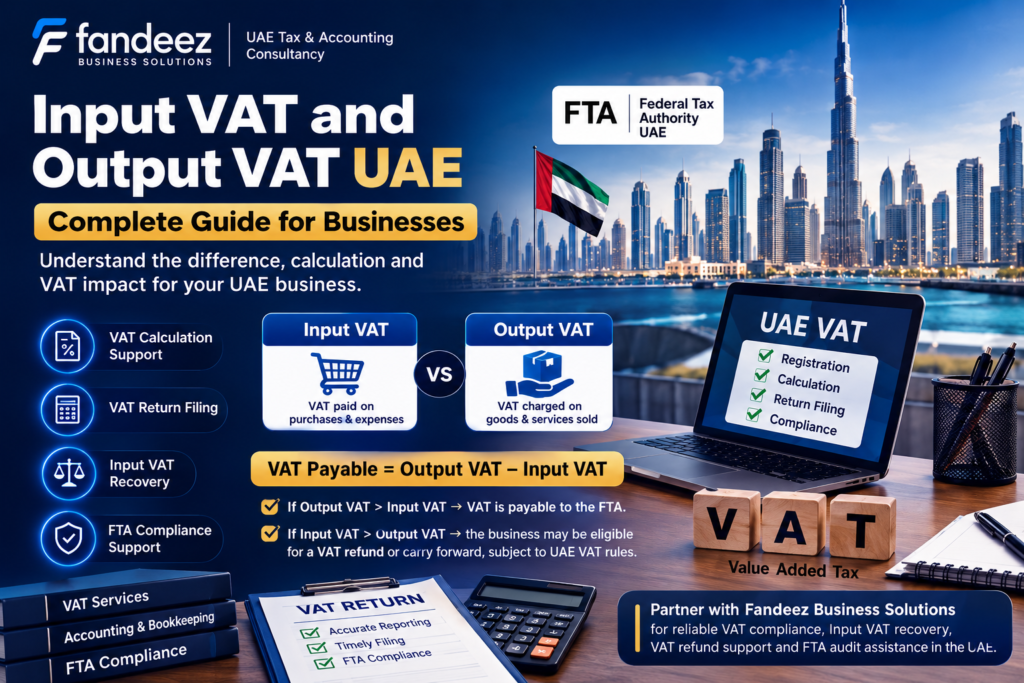
VAT Payable = Output VAT – Input VAT
This calculation happens for each VAT return period (usually quarterly, though some businesses file monthly).
Scenario 1: Output VAT is higher than Input VAT If your business collected more VAT on sales than it paid on purchases, the difference is payable to the FTA. This is the most common scenario for profitable trading and service businesses.
Scenario 2: Input VAT is higher than Output VAT If your business paid more VAT on purchases than it collected on sales — common for businesses in a growth phase, making large capital purchases, or dealing heavily in zero-rated exports — you may be eligible to carry the excess forward to offset future VAT liabilities, or apply for a refund, subject to FTA conditions.
Which Business Expenses Qualify for Input VAT Recovery?
Can businesses recover Input VAT? Yes, provided the expense meets FTA recovery conditions. Generally recoverable expenses include:
- Raw materials and stock purchases
- Office rent and utilities used for business
- Professional services (legal, accounting, consulting)
- Business-related equipment and machinery
- Marketing and advertising costs
- Business travel directly related to taxable activities
To recover Input VAT, the business must hold a valid tax invoice showing the supplier’s Tax Registration Number (TRN), and the expense must relate to taxable (not exempt) business activities.
Non-Recoverable and Partially Recoverable Input VAT
Not all Input VAT can be reclaimed. The FTA specifically restricts recovery on certain categories:
Fully Non-Recoverable Input VAT:
- Entertainment expenses for clients, shareholders, or non-employees
- Motor vehicles available for personal use
- Goods or services used for exempt supplies
Partially Recoverable Input VAT:
- Expenses used for both taxable and exempt activities (apportioned based on usage)
- Employee benefits that also serve a personal purpose, in specific circumstances
Businesses making both taxable and exempt supplies must apply a proportional recovery method, often called the input tax apportionment method, to determine the recoverable percentage.
Common Input and Output VAT Mistakes UAE Businesses Make
Claiming Input VAT without a valid tax invoice The FTA requires a compliant tax invoice — missing supplier details or incorrect formatting can result in disallowed claims.
Recovering VAT on non-qualifying expenses Businesses sometimes mistakenly claim VAT on entertainment or personal-use items, triggering penalties during an FTA audit.
Incorrect Output VAT treatment Treating zero-rated supplies as standard-rated (or vice versa) leads to inaccurate returns and potential overpayment or underpayment.
Failing to reconcile VAT accounts monthly Without regular reconciliation, discrepancies between accounting records and VAT filings often go unnoticed until the return deadline — or worse, an FTA audit.
Mixing personal and business expenses Only VAT-bearing expenses genuinely related to the business qualify for Input VAT recovery.
How Input and Output VAT Affect VAT Returns
How does Input VAT affect a VAT return? Every UAE VAT return requires businesses to report total Output VAT collected and total Input VAT paid for the period. The FTA’s VAT return form (VAT201) separates these into distinct boxes, and the system automatically calculates the net VAT payable or refundable position.
What happens if Output VAT is higher than Input VAT? The difference becomes payable to the FTA by the return’s payment deadline — typically the 28th day after the end of the tax period.
If figures are misreported, the business may either underpay (risking penalties and interest) or overpay (tying up cash unnecessarily). This is why accurate, well-reconciled bookkeeping throughout the period matters just as much as the return itself.
VAT Refunds in the UAE
When can a UAE business claim a VAT refund? A business may apply for a VAT refund when its Input VAT consistently exceeds its Output VAT, resulting in a recoverable position with the FTA. Common scenarios include:
- Export-heavy businesses with significant zero-rated sales
- Businesses making large capital investments in a given period
- New businesses in a startup or expansion phase with high input costs relative to sales
Refund applications are submitted through the EmaraTax portal, and the FTA reviews supporting documentation before approving the payment. Businesses can also choose to carry forward the excess credit to offset future VAT liabilities instead of requesting a cash refund.
How to File a UAE VAT Return Correctly
Filing an accurate VAT return requires more than plugging numbers into a form. Follow these steps for a clean filing:
- Reconcile your accounting records with your bank statements and sales/purchase ledgers before the filing period closes.
- Verify all tax invoices for completeness — TRN, invoice number, date, and correct VAT treatment.
- Separate standard-rated, zero-rated, and exempt supplies correctly in your accounting system.
- Calculate total Output VAT and total Input VAT for the period.
- Apply the VAT Payable = Output VAT – Input VAT formula to determine your net position.
- Submit the return via EmaraTax before the 28th-day deadline.
- Pay any VAT due by the same deadline to avoid late payment penalties.
Important VAT Compliance Considerations
Beyond the core calculation, UAE businesses should keep the following in mind:
- Record retention: VAT records and tax invoices must be kept for at least 5 years.
- Reverse charge mechanism: For certain imported services, the buyer must self-account for both Output and Input VAT simultaneously.
- Supplier verification: New FTA rules increasingly require businesses to verify supplier legitimacy before recovering Input VAT on large transactions.
- Voluntary disclosure: If an error is discovered in a previous return, correcting it proactively through a Voluntary Disclosure generally results in a lighter penalty than waiting for the FTA to find it.
Real UAE Business Example
Let’s walk through a realistic example for a small trading company based in Dubai.
Business: A general trading company importing and reselling electronics.
For the quarterly VAT period:
| Item | Amount (AED) | VAT (5%) |
|---|---|---|
| Total Sales (Output) | 500,000 | 25,000 (Output VAT) |
| Total Purchases (Input) | 320,000 | 16,000 (Input VAT) |
Step-by-step calculation:
VAT Payable = Output VAT – Input VAT VAT Payable = AED 25,000 – AED 16,000 VAT Payable = AED 9,000
In this scenario, the trading company must remit AED 9,000 to the FTA for the quarter.
Now consider a different quarter for the same business, where it made a large one-off capital purchase:
| Item | Amount (AED) | VAT (5%) |
|---|---|---|
| Total Sales (Output) | 200,000 | 10,000 (Output VAT) |
| Total Purchases (Input) | 400,000 | 20,000 (Input VAT) |
VAT Payable = Output VAT – Input VAT VAT Payable = AED 10,000 – AED 20,000 VAT Payable = –AED 10,000 (refundable/carry-forward position)
Here, the business has a recoverable position of AED 10,000, which it can either claim as a refund from the FTA or carry forward to offset VAT payable in future periods.
How Fandeez Can Help With VAT Compliance
Getting Input VAT and Output VAT UAE calculations right, quarter after quarter, takes more than a basic understanding of the formula — it requires disciplined bookkeeping, correct invoice handling, and up-to-date knowledge of FTA rules. Fandeez Business Solutions supports UAE businesses across the full VAT lifecycle:
- VAT Registration: Determining whether your business needs mandatory or voluntary registration
- VAT Return Filing: Preparing and submitting accurate quarterly or monthly returns through EmaraTax
- VAT Calculation and Reconciliation: Ensuring your Output VAT and Input VAT figures match your accounting records
- Input VAT Recovery: Identifying which expenses genuinely qualify for recovery, and which don’t
- VAT Refund Applications: Preparing and submitting refund claims with the correct supporting documentation
- Accounting and Bookkeeping: Maintaining clean, VAT-ready financial records throughout the year
- Corporate Tax Compliance: Aligning your VAT position with your broader UAE tax obligations
- FTA Audit Support: Helping your business respond confidently if the FTA requests VAT documentation or launches a review
Fandeez’s approach is practical and educational — helping business owners understand their VAT position, not just file paperwork on their behalf.
FAQs About Input VAT and Output VAT UAE
1. What is Input VAT in the UAE? Input VAT is the 5% VAT a business pays on eligible purchases of goods and services used for its taxable business activities. It can generally be reclaimed from the FTA, subject to valid documentation and recovery rules.
2. What is Output VAT in the UAE? Output VAT is the 5% VAT a business charges its customers on taxable sales of goods and services. This amount is collected on behalf of the FTA and must be reported and remitted through the VAT return.
3. What is the difference between Input VAT and Output VAT? Output VAT is charged to customers on sales and increases what a business owes the FTA. Input VAT is paid to suppliers on purchases and reduces what a business owes, provided the expense qualifies for recovery.
4. How do I calculate VAT payable in the UAE? VAT payable is calculated as Output VAT minus Input VAT for the relevant tax period. If the result is positive, the amount is payable to the FTA. If negative, the business may carry the balance forward or apply for a refund.
5. Can I claim Input VAT on business expenses? Yes, provided the expense is used for taxable business activities and supported by a valid tax invoice showing the supplier’s TRN. Certain expenses, such as entertainment and personal-use vehicles, are excluded from recovery.
6. When can I claim a VAT refund in the UAE? You can apply for a VAT refund when your Input VAT consistently exceeds your Output VAT, creating a recoverable position. Refund applications are submitted through the EmaraTax portal with supporting documentation.
7. How does Input VAT affect my VAT return? Input VAT is reported separately from Output VAT on your VAT return and is subtracted from Output VAT to determine your net VAT payable or refundable position for the period.
8. What happens if I report incorrect Input or Output VAT? Incorrect reporting can lead to underpayment or overpayment of VAT, and may trigger FTA penalties or an audit. If an error is found after filing, it should be corrected through a Voluntary Disclosure as soon as possible to minimise penalty exposure.
Conclusion and Call to Action
Understanding Input VAT and Output VAT UAE rules is fundamental to running a compliant, financially healthy business in the UAE. Getting the calculation right — Output VAT minus Input VAT — determines whether you owe the FTA or have a recoverable position, and errors in either direction can be costly.
Whether you need help with VAT registration, return filing, Input VAT recovery, or preparing for an FTA audit, Fandeez Business Solutions is ready to support your business. Contact Fandeez today for accurate VAT calculation, reconciliation, filing, and full FTA compliance support tailored to your business.