

Table of Contents
ToggleDeadline, Approved Auditors, Documents & Penalties
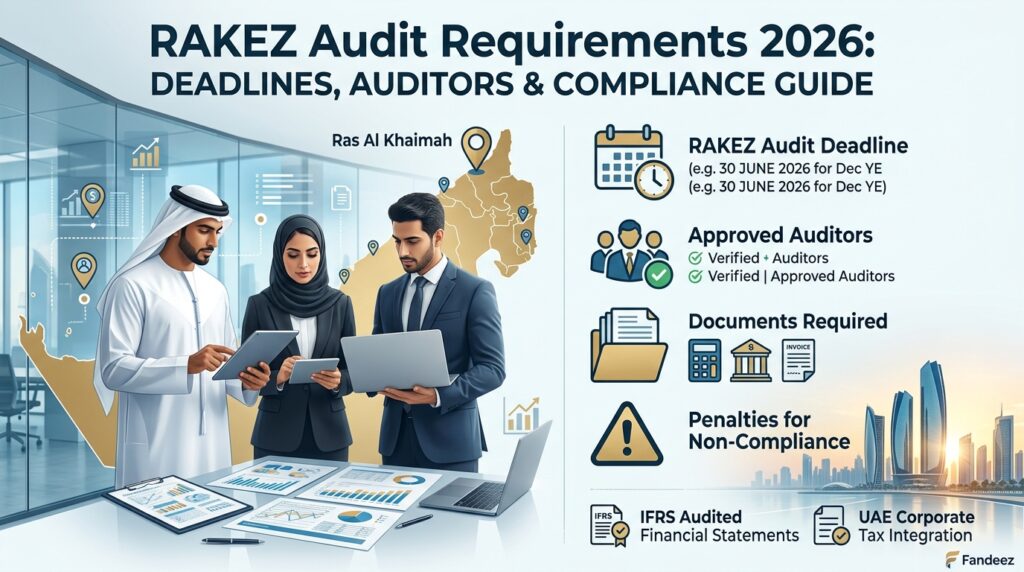
Are RAKEZ companies required to have an annual audit? Yes, all companies licensed in the Ras Al Khaimah Economic Zone (RAKEZ) must submit audited financial statements annually . This requirement applies regardless of company size, revenue, or activity level — including dormant entities .
Since the 2019 financial year, RAKEZ has mandated that every licensed company prepare and submit audited financial statements prepared by an auditor from the RAKEZ approved auditors list . Financial statements must be prepared in accordance with International Financial Reporting Standards (IFRS) .
This comprehensive guide explains RAKEZ audit requirements for 2026, including deadlines, approved auditor rules, required documents, penalties for non-compliance, and how these obligations connect to UAE Corporate Tax and VAT compliance.
What Are RAKEZ Audit Requirements?
RAKEZ audit requirements refer to the mandatory annual obligation for all RAKEZ-licensed companies to prepare, audit, and submit financial statements to the RAKEZ Authority .
The core requirements are:
Requirement | Detail |
Audit Mandatory? | Yes — all licensed entities must submit audited financial statements annually |
Submission Deadline | Within 6 months of financial year-end |
Accounting Standard | IFRS (International Financial Reporting Standards) |
Auditor Requirement | Must be on the RAKEZ approved auditors list |
Applicable Entities | All RAKEZ-licensed companies — FZEs, FZCOs, branches, and free zone entities |
Is an Audit Mandatory for RAKEZ Companies?
Yes. Every RAKEZ-licensed company is required to submit audited financial statements annually . The requirement applies to:
Entity Type | Audit Mandatory? | Submission Deadline | Accounting Standard |
Free Zone Establishment (FZE) | Yes | Within 6 months of financial year-end | IFRS |
Free Zone Company (FZCO) | Yes | Within 6 months of financial year-end | IFRS |
Branch of a Foreign Company | Yes* | Within 6 months of financial year-end | IFRS |
Offshore/RAK ICC Company | Yes* | Within 6 months of financial year-end | IFRS |
*Branch offices may, in some circumstances, submit consolidated accounts from their parent entity, provided the parent’s financials are IFRS-compliant and clearly reflect the branch’s operations . This requires written confirmation from RAKEZ in advance .
Important: There is no exemption based on trading status, revenue level, or company size. A dormant RAKEZ company must still appoint a RAKEZ-approved auditor, prepare IFRS-compliant financial statements, and submit the audit report by the deadline .
RAKEZ Audit Deadline 2026
The RAKEZ audit deadline is six months from the end of your financial year .
Standard Deadline Example
For the vast majority of RAKEZ companies whose financial year runs from 1 January to 31 December:
Financial Year End | Audit Submission Deadline |
31 December | 30 June of the following year |
Companies with Different Year-Ends
Financial Year End | Audit Submission Deadline |
31 March | 30 September |
30 June | 31 December |
30 September | 31 March |
RAKEZ tracks audit submissions through its portal separately from trade licence renewal timing — a company can renew its licence and still have an outstanding audit obligation that will surface at the next renewal cycle .
Extensions
Extensions can be requested from RAKEZ, but must be submitted in writing at least 30 days before the original deadline — not after it has passed .
RAKEZ Audit Requirements for Newly Incorporated Companies
For newly formed businesses, the first audit period may be shorter or longer than 12 months. RAKEZ allows the first accounting period to span between 6 and 18 months, depending on the incorporation date .
Examples
Example 1: A company incorporated in July 2024 would typically prepare its first set of audited accounts to December 2025 .
Example 2: A company incorporated in June 2024 could close its first year in December 2024, covering approximately seven months .
Key Considerations for New Companies
- Confirm your financial year-end with RAKEZ upon incorporation
- Appoint a RAKEZ-approved auditor early
- Plan for your first audit well in advance
- Ensure your first financial period is properly documented
Who Can Conduct a RAKEZ Audit?
RAKEZ maintains its own approved auditors list, separate from other UAE free zones such as DMCC or JAFZA . Only firms on this list can audit and sign off a RAKEZ company’s accounts .
What Happens If You Use a Non-Approved Auditor?
Using an auditor not on RAKEZ’s approved list results in outright rejection of the submission . The company would then need to appoint a listed firm and restart the audit engagement from the beginning — losing both time and the original audit fee .
How to Verify an Auditor’s RAKEZ Approval
- Check the official RAKEZ approved auditors list (available on the RAKEZ website)
- Contact the RAKEZ Authority directly to confirm a firm’s status
- Ask the firm to confirm its RAKEZ approval before signing an engagement letter
Note: The RAKEZ approved auditors list is updated periodically. Always verify your auditor’s current approved status before engaging them — approval from a prior year is not guaranteed to carry over .
RAKEZ Approved Auditors — What to Look For
When selecting a RAKEZ-approved auditor, consider:
Factor | Why It Matters |
RAKEZ approval | Your submission will be rejected without it |
IFRS expertise | Financial statements must comply with IFRS |
UAE Corporate Tax knowledge | Audited statements support Corporate Tax filing |
VAT awareness | VAT records may be reviewed during the audit |
Free Zone experience | Understanding of RAKEZ-specific requirements |
Communication | Clear and responsive throughout the audit process |
Compliance support | Assistance with submission and follow-up |
What Accounting Standard Does RAKEZ Require?
RAKEZ requires financial statements to be prepared in accordance with International Financial Reporting Standards (IFRS) .
The auditor’s report must confirm whether the accounts present a true and fair view of the company’s financial position and whether the company is complying with Anti-Money Laundering and Counter-Terrorist Financing (AML/CFT) regulations .
What Does a RAKEZ Statutory Audit Cover?
A RAKEZ statutory audit typically involves reviewing:
- Statement of Financial Position (Balance Sheet)
- Statement of Comprehensive Income (Profit & Loss)
- Statement of Cash Flows
- Statement of Changes in Equity
- Notes to financial statements
- Accounting policies
- Bank balances and confirmations
- Revenue recognition
- Expenses and deductions
- Invoices and contracts
- Payroll records
- Fixed assets and depreciation
- Financial controls and systems
RAKEZ Audit Documents
Financial Records
Document | Purpose |
Trial Balance | Supports financial reporting |
General Ledger | Provides transaction-level detail |
Bank Statements | Supports cash and bank balances |
Bank Confirmations | Verifies bank balances |
Sales Invoices | Supports revenue |
Purchase Invoices | Supports expenses |
Receipts & Payment Vouchers | Supports transactions |
Credit/Debit Notes | Supports adjustments |
Fixed Asset Register | Supports asset balances |
Payroll Records | Supports employee expenses |
Corporate Documents
Document | Purpose |
Trade Licence | Confirms company status and validity |
Memorandum of Association (MoA) | Constitutional documents |
Articles of Association (AoA) | Constitutional documents |
Shareholder/Ownership Records | Confirms ownership structure |
Lease Agreement | Supports registered address |
Tax & Regulatory Documents (where applicable)
Document | Purpose |
VAT Registration Certificate | Confirms VAT status |
VAT Returns | Supports VAT compliance |
Corporate Tax Registration | Confirms Corporate Tax status |
Corporate Tax Filings | Supports tax compliance |
AML/CFT Documentation | Supports regulatory compliance |
RAKEZ Audit Penalties for Non-Compliance
Late Submission or Non-Submission
Consequence | Details |
Fine | AED 2,500 for late or missing audited financials |
Licence Renewal Block | Outstanding audit submissions block licence renewal |
Service Suspension | RAKEZ may suspend access to services — including visa processing, licence renewal, and portal access |
Delayed FTA Corporate Tax Return | Late audit delays Corporate Tax return filing, triggering separate FTA penalties (AED 500–1,000 per return) |
Using a Non-Approved Auditor
Consequence | Details |
Submission Rejection | RAKEZ rejects the audit report |
Repeat Audit Required | Must appoint an approved firm and restart the engagement |
Time & Cost | Loss of original audit fee and time |
What Happens If You Miss the RAKEZ Audit Deadline?
If you miss the RAKEZ audit deadline, take these steps:
- Contact your approved auditor — Determine why the audit is delayed and what can be expedited
- Prepare missing documents — Complete all required financial records
- Complete the audit as quickly as possible — Work with your auditor to finalise the audit
- Contact RAKEZ — If necessary, communicate the delay and any steps being taken
- Pay applicable penalties — Be prepared to pay the AED 2,500 fine for late submission
- Submit and resolve — Submit the audited financial statements and resolve any licence or compliance issues
Do not ignore an overdue audit — RAKEZ may block licence renewal and suspend services .
RAKEZ Audit and UAE Corporate Tax
The RAKEZ audit requirement is directly connected to UAE Corporate Tax compliance, particularly for companies claiming Qualifying Free Zone Person (QFZP) status and the 0% Corporate Tax rate .
Key Connections
Requirement | Detail |
QFZP Condition | Having audited financial statements is a mandatory condition for QFZP eligibility |
Corporate Tax Return | Corporate Tax returns are built on audited financial statements |
Compliance Failure | A company that fails to complete its annual audit has two separate compliance failures — it breaches the RAKEZ audit obligation and the federal QFZP condition |
Consequence | Loss of 0% Corporate Tax rate and becomes subject to 9% Corporate Tax on all income for that tax period and potentially for the following four years |
Important: Audited financial statements do not automatically prove QFZP eligibility. Corporate Tax eligibility and Free Zone tax treatment depend on the applicable UAE Corporate Tax rules and conditions.
RAKEZ Audit and VAT Compliance
VAT records may interact with RAKEZ financial reporting:
Aspect | Connection |
VAT Returns | Sales and purchase records from VAT returns support revenue and expense figures in financial statements |
Tax Invoices | VAT invoices provide supporting documentation for transactions |
Revenue Reconciliation | VAT-reported turnover should reconcile with financial statement revenue |
The RAKEZ audit does not replace VAT compliance. Businesses must file VAT returns separately with the FTA.
RAKEZ Audit Compliance Checklist
Use this checklist to ensure your RAKEZ business is audit-ready:
Checklist Item | Status | Action Required (if not completed) |
Confirm financial year-end | [ ] | Verify your RAKEZ-approved financial year-end |
Confirm audit deadline (6 months from year-end) | [ ] | Calculate your specific deadline |
Select RAKEZ-approved auditor | [ ] | Verify auditor is on the current RAKEZ approved list |
Prepare trial balance | [ ] | Ensure all accounts are reconciled |
Prepare general ledger | [ ] | Complete transaction-level records |
Reconcile bank accounts | [ ] | Obtain and reconcile all bank statements |
Organise sales invoices | [ ] | Compile all sales invoices |
Organise purchase invoices | [ ] | Compile all purchase invoices |
Prepare fixed asset register | [ ] | Record all fixed assets and depreciation |
Review payroll records | [ ] | Confirm employee records are complete |
Prepare corporate documents | [ ] | Trade licence, MoA, AoA ready |
Review VAT records (where applicable) | [ ] | Confirm VAT returns reconcile |
Review Corporate Tax records (where applicable) | [ ] | Ensure records support tax filings |
Review AML/CFT documents (where applicable) | [ ] | Maintain compliance records |
Submit audited financial statements on time | [ ] | Submit before the deadline |
Keep evidence of submission | [ ] | Retain confirmation of submission |
RAKEZ Audit Preparation — Step by Step
Follow these steps to prepare for your RAKEZ annual audit:
Step 1: Confirm Your Financial Year-End
Verify your RAKEZ-approved financial year-end. For most companies, this is 31 December.
Step 2: Check the Applicable Deadline
Calculate your submission deadline — 6 months from your financial year-end.
Step 3: Appoint a RAKEZ-Approved Auditor
Verify the auditor is on the current RAKEZ approved auditors list before signing an engagement letter.
Step 4: Close and Reconcile the Accounts
Complete all bookkeeping, reconcile bank accounts, and verify the trial balance.
Step 5: Prepare Supporting Documentation
Gather all invoices, contracts, bank statements, and corporate documents.
Step 6: Resolve Bookkeeping Discrepancies
Address any inconsistencies or missing records before the audit begins.
Step 7: Complete the Audit
Work with your approved auditor to complete the audit process.
Step 8: Review the Auditor’s Report
Confirm the audit report is accurate and complete before submission.
Step 9: Submit According to RAKEZ Requirements
Submit the audited financial statements to RAKEZ by the deadline.
Step 10: Keep Records for Future Compliance
Retain copies of the audited financial statements and submission confirmation.
Common RAKEZ Audit Mistakes
Avoid these common errors:
Mistake | How to Avoid |
Waiting until the deadline | Start preparation at least 3 months before the deadline |
Hiring an auditor without checking approval | Verify the auditor is on the RAKEZ approved list before engagement |
Poor bookkeeping | Maintain accurate, timely accounting records year-round |
Missing bank reconciliations | Reconcile bank statements monthly |
Missing invoices | Keep all invoices organised and accessible |
Incorrect fixed asset records | Maintain a fixed asset register with depreciation |
Incomplete corporate documents | Keep trade licence, MoA, and AoA current |
Ignoring VAT/Corporate Tax records | Ensure tax records align with financial statements |
Failing to keep evidence of submission | Retain confirmation of audit submission |
Assuming a dormant company is exempt | Dormant companies must also submit audited financial statements |
Frequently Asked Questions
- Is a RAKEZ audit mandatory?
Yes. All RAKEZ-licensed companies must submit audited financial statements annually . - What are the RAKEZ audit requirements?
All RAKEZ companies must prepare audited financial statements under IFRS, using a RAKEZ-approved auditor, and submit within 6 months of the financial year-end . - What is the RAKEZ audit deadline?
Within 6 months of the financial year-end. For a 31 December year-end, the deadline is 30 June . - Who can conduct a RAKEZ audit?
Only firms on the RAKEZ approved auditors list may audit RAKEZ companies . - How do I find a RAKEZ-approved auditor?
Check the official RAKEZ approved auditors list on the RAKEZ website, or contact RAKEZ directly to verify a firm’s status . - What documents are required for a RAKEZ audit?
Trial balance, general ledger, bank statements, invoices, contracts, trade licence, MoA/AoA, and VAT/Corporate Tax records where applicable . - What accounting standard does RAKEZ require?
IFRS — International Financial Reporting Standards . - What happens if I miss the RAKEZ audit deadline?
A fine of AED 2,500 applies, and RAKEZ may block licence renewal and suspend services . - Can a dormant RAKEZ company skip the audit?
No. Dormant companies must also submit audited financial statements . - Does a RAKEZ company need audited financial statements?
Yes. Audited financial statements are mandatory for all RAKEZ-licensed companies . - Does RAKEZ audit replace Corporate Tax filing?
No. RAKEZ audit is separate from FTA Corporate Tax filing, though the audited statements support the Corporate Tax return and are a QFZP condition . - Does RAKEZ audit replace VAT compliance?
No. RAKEZ audit is a free zone requirement. VAT returns must be filed separately with the FTA. - Do Free Zone companies need annual audits?
Yes. All UAE Free Zone companies, including RAKEZ, must submit annual audited financial statements . - How should a new RAKEZ company prepare for its first audit?
Confirm the financial year-end, appoint a RAKEZ-approved auditor early, and ensure proper bookkeeping from day one . - What is the difference between a RAKEZ audit and a UAE Corporate Tax audit?
A RAKEZ audit is a free zone regulatory requirement to submit audited financial statements. A Corporate Tax audit is an FTA review of Corporate Tax returns for tax compliance.
How Fandeez Can Help RAKEZ Businesses
Fandeez is a trusted UAE accounting, tax, and audit consultancy that supports RAKEZ businesses with:
- Accounting and Bookkeeping Services — Accurate record maintenance, bank reconciliations, and monthly financial reports
- Audit Coordination — Assistance with RAKEZ-approved auditor selection and audit preparation
- Financial Statement Preparation — IFRS-compliant financial statements
- Corporate Tax Services — Corporate Tax registration, return filing, and QFZP compliance
- VAT Services — VAT registration, return filing, and reconciliation
- Tax Advisory — Strategic guidance on Free Zone status and tax efficiency
Contact Fandeez today for expert assistance with your RAKEZ audit requirements and UAE tax compliance.