

Table of Contents
ToggleComplete Guide to VAT Refund Time Limits, Eligibility & FTA Requirements (2026)
Introduction
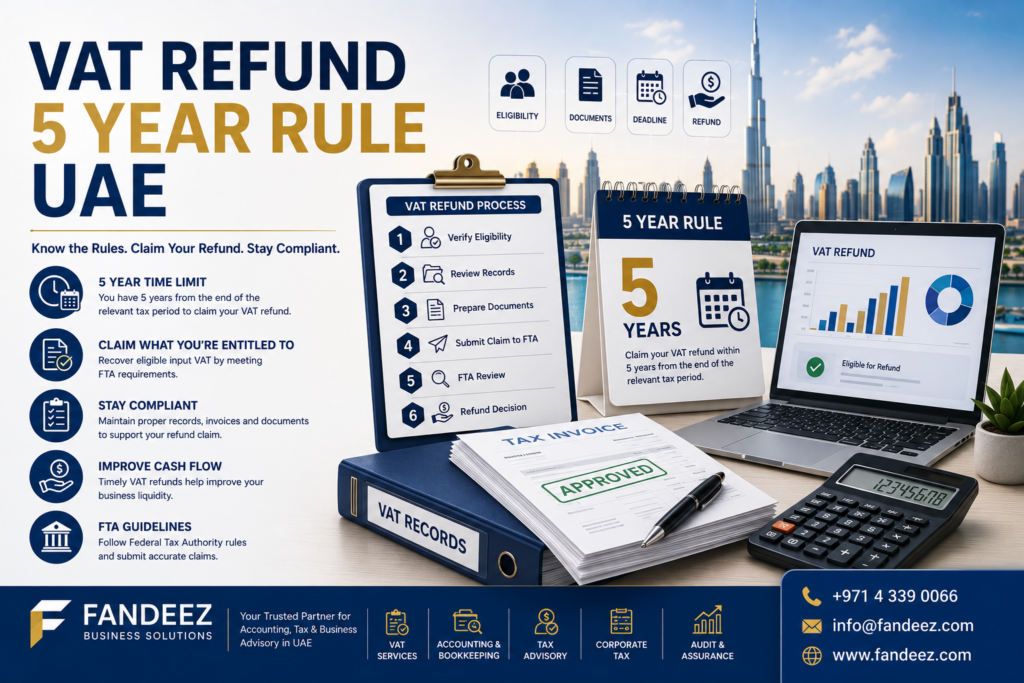
The VAT Refund 5 Year Rule UAE is now one of the most important compliance issues facing businesses across the country. Since 1 January 2026, unused VAT credit balances no longer sit on a company’s books indefinitely. Under amendments to the UAE Tax Procedures Law and VAT Law, businesses must submit a refund request — or use the credit against another tax liability — within five years from the end of the tax period in which it arose. Miss that window, and the credit can be forfeited permanently.
For mainland companies, Free Zone entities, exporters, and startups carrying forward VAT credits since the early years of UAE VAT, this is not a minor technical detail. It is a hard deadline with real financial consequences. Understanding how the rule works, who it applies to, and what documentation the Federal Tax Authority (FTA) expects can mean the difference between recovering thousands of dirhams and losing them for good. This guide from Fandeez Business Solutions breaks down everything UAE businesses need to know.
What is the VAT Refund 5 Year Rule UAE?
Quick Answer: The VAT Refund 5 Year Rule UAE is a statutory time limit that requires businesses to submit a VAT refund request, or apply their VAT credit balance against other tax liabilities, within five years from the end of the relevant tax period. Once this window closes, the right to recover that specific credit generally lapses.
The rule stems from recent amendments to UAE federal tax legislation that took effect on 1 January 2026. These changes updated the VAT Law and the Tax Procedures Law so that limitation periods for claiming refunds, and for the FTA’s own audit and assessment powers, are now addressed consistently under the tax procedures framework rather than scattered across separate laws.
In practical terms, this means every VAT credit balance a business generates now carries an expiry clock. That clock starts ticking from the end of the tax period in which the credit was created — not from when the business notices it, and not from when it eventually files a return. The purpose of the rule is to give both taxpayers and the FTA legal certainty: businesses know exactly how long they have to act, and the government is not left administering open-ended claims from years past.
The FTA has indicated it will apply closer scrutiny to refund requests filed near the end of the five-year window, so businesses should not treat the deadline as something to push right up against. If you’re unsure where your business stands, Fandeez’s VAT Advisory team can review your credit position and flag any urgent action needed.
Understanding the UAE VAT Refund Time Limit
Quick Answer: The five-year period is calculated from the end of the tax period in which the input VAT credit first arose, not from your VAT registration date or the date you file your return. Each tax period’s credit has its own independent expiry date.
This is the part many finance teams get wrong. Businesses sometimes assume the clock starts when they realize they have an unused credit, or when they eventually file a refund claim. In reality, every tax period generates its own countdown. A credit created in a VAT period from early 2021, for example, moves toward expiry during 2026 — five years later — regardless of what happens in later periods.
Because VAT credits accumulate across dozens of tax periods over a company’s lifetime, older balances are typically the ones at greatest risk. Businesses that have simply carried forward VAT credit year after year, without formally claiming a refund or offsetting it against liabilities, are the most exposed.
There are two limited exceptions worth understanding:
- If a credit balance arises very close to the end of the five-year window (within roughly the last 90 days), businesses may still be allowed extra time to file.
- If a credit technically expires but special transitional conditions apply, a request may still be considered — though these situations are handled case by case and face additional scrutiny.
Illustrative VAT Refund Timeline
Tax Period Credit Arose | Approximate 5-Year Expiry | Risk Level in 2026 |
Early 2019 | Early 2024 | Already expired — check transitional rules |
Early 2020 | Early 2025 | Very high — likely at or past expiry |
Early 2021 | Early 2026 | High — act immediately |
2022 | 2027 | Medium — plan ahead |
2023–2024 | 2028–2029 | Lower, but should still be tracked |
This table is illustrative only. Businesses should verify exact expiry dates for each tax period against their own EmaraTax records rather than relying on approximate ranges. Fandeez’s VAT Compliance Review service can build this timeline for you tax period by tax period.
Who Can Claim a VAT Refund in the UAE?
Quick Answer: Any VAT-registered taxable person in the UAE with an eligible input VAT credit can apply for a refund, including mainland companies, Free Zone entities, exporters, and certain foreign businesses, subject to standard eligibility conditions.
- VAT-Registered Businesses – Any entity holding a valid Tax Registration Number (TRN) with an input VAT credit position can apply through EmaraTax.
- Mainland Companies – Standard commercial and industrial businesses across the UAE that pay more input VAT than they collect in output VAT.
- Free Zone Companies – Free Zone businesses are subject to the same five-year limitation rule as mainland companies. Because many Free Zone entities generate significant input VAT from imports and zero-rated exports, this group is particularly exposed to unclaimed credit risk. See our Free Zone Company Tax Guide for more detail.
- Export Businesses – Companies that make zero-rated exports frequently accumulate input VAT credit and should monitor balances closely.
- Eligible Taxable Persons – This includes UAE nationals under the New Residence VAT Refund Scheme and eligible foreign businesses under the Business Visitor Refund Scheme, each governed by their own specific conditions.
- Other Qualifying Entities – Government entities and other bodies designated under UAE VAT legislation may also have refund rights under specific provisions.
Fandeez Business Solutions works with all these categories, helping determine whether a claim is eligible before time runs out.
VAT Refund Eligibility Requirements
Quick Answer: To qualify for a VAT refund, a business must hold valid VAT registration, have genuine recoverable input VAT, maintain proper tax invoices, and submit the claim within the five-year statutory window.
Core eligibility conditions include:
- Valid VAT Registration – The claimant must hold an active TRN at the time the credit arose and, generally, at the time of claiming. If your registration status needs review, Fandeez’s VAT Registration UAE service can help confirm and update it.
- Eligible Input VAT – The VAT being reclaimed must relate to legitimate business expenses used to make taxable supplies, not blocked or restricted items such as certain entertainment or personal-use expenses.
- Proper Tax Invoices – Every claimed amount needs a compliant tax invoice showing the supplier’s TRN, VAT amount, and transaction details.
- Supporting Records – VAT returns (Form VAT 201), ledgers, and reconciliation records must match the figures being claimed.
- Compliance Standing – Businesses with overdue returns, unresolved audits, or pending penalties may face delays until compliance gaps are resolved.
- No Connection to Tax Evasion – The FTA can deny input VAT recovery where a transaction is linked to a supply chain involved in tax evasion and the claimant knew, or should have known, this at the time.
Required Documents for a VAT Refund Claim
Quick Answer: A complete VAT refund claim in the UAE typically requires tax invoices, filed VAT returns, accounting records, proof of payment, and import documentation where relevant.
Use this checklist before submitting a claim:
- ✅ Valid tax invoices matching the claimed input VAT
- ✅ Filed VAT returns (Form VAT 201) showing the credit balance
- ✅ General ledger and accounting records supporting the figures
- ✅ Proof of payment for the underlying purchases or expenses
- ✅ Import/customs declarations, where the credit relates to imported goods
- ✅ Bank account validation letter matching the exact registered business name
- ✅ Supporting contracts or agreements for larger transactions
- ✅ Reconciliation showing how the credit balance built up across tax periods
Expert Tip: Keep a rolling schedule of VAT credit by tax period so you always know how much is approaching its five-year expiry. Fandeez’s Accounting & Bookkeeping team can maintain this register for you as part of your monthly close.
Step-by-Step VAT Refund Process UAE
Quick Answer: Businesses apply for a VAT refund by verifying eligibility, reviewing VAT records, preparing documentation, and submitting a refund request through the EmaraTax portal, then responding to any FTA queries before receiving a decision.
- Verify Eligibility – Confirm the credit balance is genuine, correctly recorded, and still within the five-year window.
- Review VAT Records – Reconcile VAT returns against accounting and invoice records to confirm accuracy.
- Prepare Supporting Documents – Gather invoices, bank validation letters, and any import documentation.
- Submit the VAT Refund Claim – File the refund request through the EmaraTax portal, following the on-screen application process. Fandeez’s VAT Return Filing team can prepare and submit this on your behalf.
- Respond to FTA Requests – The FTA may request clarification or additional documents; respond promptly to avoid delays or rejection.
- Receive the Refund Decision – Once approved, refunds are typically processed within the FTA’s published service timelines, with payment following shortly after approval.
Common Reasons VAT Refund Claims Are Rejected
Understanding why claims fail helps businesses avoid the same mistakes:
- Filing the claim after the five-year deadline has passed
- Missing or non-compliant tax invoices
- Mismatches between the VAT return and underlying accounting records
- Claiming input VAT on blocked or restricted expense categories
- Incomplete or outdated bank validation letters
- Poor record-keeping making it impossible to trace the credit’s origin
- Transactions linked, even unknowingly, to non-compliant supply chains
- Outstanding VAT returns or unresolved compliance issues
- Incorrect TRN details or business name mismatches
- Failing to respond to FTA information requests within given timeframes
- Treating the refund claim as optional rather than time-sensitive
If any of these sound familiar, Fandeez’s FTA Compliance Support service can help you correct course before your next claim is due.
Best Practices to Maximize VAT Refund Success
- Maintain Strong Record-Keeping – Keep invoices, contracts, and reconciliations organized by tax period, not just by year.
- Track the Five-Year Clock Actively – Build a simple register showing when each period’s credit will expire.
- Submit Claims Early, Not at the Deadline – Filing well before expiry reduces the risk of rejection due to last-minute scrutiny.
- Reconcile VAT Regularly – Monthly or quarterly reconciliation between VAT returns and the general ledger catches errors early.
- Strengthen Internal Controls – Assign clear responsibility for VAT compliance and refund tracking within the finance team.
- Undertake Periodic Compliance Reviews – A professional VAT health check can flag aging credit balances before they become a problem. Fandeez’s Business Advisory team offers this as a standalone service or as part of ongoing support.
How Fandeez Business Solutions Can Help
Navigating the VAT Refund 5 Year Rule UAE requires more than a basic understanding of the deadline — it requires disciplined tracking, accurate records, and timely action. Fandeez Business Solutions supports UAE businesses across the full compliance lifecycle:
- VAT Registration – Getting your TRN set up correctly from day one.
- VAT Return Filing – Accurate, on-time VAT 201 submissions through EmaraTax.
- VAT Refund Assistance – Identifying eligible credit balances and preparing complete, audit-ready refund claims before deadlines pass.
- Accounting & Bookkeeping – Clean, reconciled financial records that support every VAT position you take.
- Corporate Tax Services – Aligning VAT and corporate tax compliance under one coordinated strategy.
- Financial Reporting – Clear reporting that gives management visibility into VAT credit positions.
- VAT Advisory – Practical guidance on eligibility, documentation, and risk areas specific to your industry.
- FTA Compliance Support – Representation and support during FTA queries, audits, or reconsideration requests.
If your business has unclaimed VAT credits from prior years, don’t wait until the deadline is days away. Contact Fandeez Business Solutions today for a VAT credit review and let our team help you recover what you’re entitled to before it’s too late.
Frequently Asked Questions
- What is the VAT Refund 5 Year Rule UAE? It is a statutory limit requiring businesses to claim VAT refunds, or use credit balances against other tax liabilities, within five years from the end of the tax period in which the credit arose.
- Who is eligible for a VAT refund in the UAE? Any VAT-registered taxable person with a genuine input VAT credit, including mainland companies, Free Zone businesses, and certain eligible foreign entities.
- How is the five-year period calculated? It runs from the end of the tax period in which the credit balance first arose, not from the registration date or filing date.
- What documents are required for a VAT refund claim? Tax invoices, filed VAT returns, accounting records, proof of payment, bank validation letters, and import documents where applicable.
- Can Free Zone companies claim VAT refunds? Yes. Free Zone companies follow the same eligibility rules and the same five-year limitation as mainland businesses.
- What happens if the five-year deadline is missed? The right to claim that specific credit balance generally lapses permanently, subject to limited transitional exceptions that should be verified with a tax professional.
- How long does the FTA take to process a VAT refund? Processing times vary by case complexity; straightforward claims are typically reviewed and paid within a matter of weeks, while complex cases can take longer.
- Can a rejected VAT refund claim be corrected or resubmitted? In many cases, businesses can address the FTA’s concerns and pursue reconsideration, provided this is done within the applicable procedural timeframes.
- What expenses qualify for a VAT refund? Input VAT on legitimate business expenses used to make taxable supplies generally qualifies, excluding blocked categories such as certain entertainment costs.
- Is there a minimum amount required to claim a VAT refund? Minimum thresholds apply to certain specific schemes, such as the Business Visitor Refund Scheme; standard registered businesses should confirm current thresholds directly with the FTA or a tax advisor.
- Does the five-year rule apply only to VAT? No. Related amendments extend similar limitation principles across VAT, corporate tax, and excise tax refund and audit matters.
- Should businesses seek professional VAT advice? Given the financial risk of forfeited credits, professional guidance from a firm like Fandeez Business Solutions is strongly recommended, especially for older, unreviewed balances.
- Can older, expired-looking credit balances still be recovered? Some transitional provisions may allow limited recovery in specific circumstances. These cases require careful legal and procedural review before assuming a credit is lost.
- Does filing close to the deadline increase audit risk? Yes. The FTA has signaled that claims submitted near the end of the five-year window may receive more detailed scrutiny.
- How can businesses track their VAT credit expiry dates? By maintaining a period-by-period VAT credit register reconciled against filed returns — a service Fandeez Business Solutions can set up and manage.
Conclusion
The VAT Refund 5 Year Rule UAE has changed how businesses need to think about VAT credit balances. What was once a figure that could sit quietly on the books is now an asset with a real expiry date. Mainland companies, Free Zone entities, exporters, and startups alike need accurate records, active tracking, and timely refund claims to avoid losing money they are legally entitled to recover.
The safest approach is simple: know when each tax period’s credit expires, keep documentation audit-ready, and file well before any deadline approaches. Fandeez Business Solutions helps UAE businesses manage VAT Registration, VAT Returns, VAT Refunds, Accounting, Bookkeeping, and Corporate Tax compliance under one roof. Contact our team today to review your VAT credit position before the clock runs out.