

Table of Contents
ToggleComplete Guide to the AED 3 Million Revenue Threshold (2026)
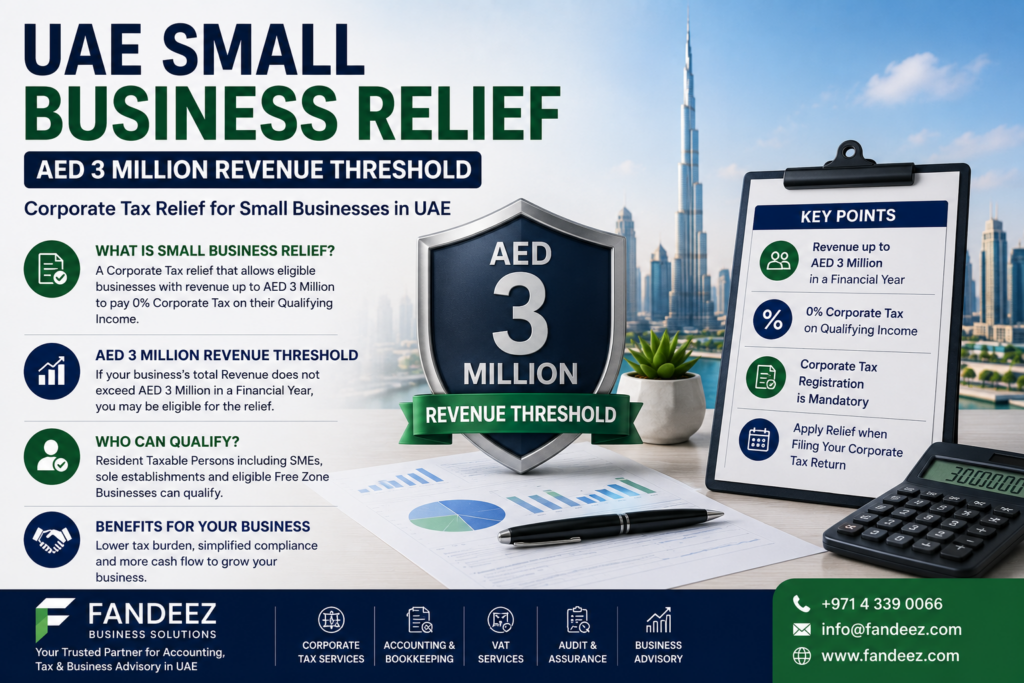
Quick Answer: UAE Small Business Relief lets eligible resident businesses with revenue at or below AED 3 million elect to be treated as having zero taxable income — meaning zero Corporate Tax — for qualifying tax periods. It’s a transitional measure available only for tax periods ending on or before 31 December 2026, with no extension announced.
If your business earns AED 3 million or less a year, UAE Small Business Relief could mean paying zero Corporate Tax — but only if you elect it correctly, and only for a limited time. This relief has already helped thousands of SMEs, freelancers, and startups reduce their compliance burden, but 2026 is its final year. This guide explains exactly how the AED 3 million threshold works, who qualifies, and how to claim it before the window closes.
Key Takeaways
- UAE Small Business Relief lets qualifying resident businesses elect zero taxable income for a tax period, resulting in zero Corporate Tax.
- Eligibility requires revenue at or below AED 3 million in the current tax period and every prior tax period since Corporate Tax began.
- The relief is available only for tax periods ending on or before 31 December 2026 — no extension has been announced.
- Qualifying Free Zone Persons and members of large multinational groups (consolidated revenue above AED 3.15 billion) cannot claim it.
- Election is not automatic — it must be actively selected on EmaraTax when filing the Corporate Tax return.
- Once revenue exceeds AED 3 million in any tax period, the business is permanently disqualified for all future periods, even if revenue later drops back down.
What is UAE Small Business Relief?
Quick Answer: UAE Small Business Relief is a transitional Corporate Tax concession under Article 21 of the Corporate Tax Law that allows eligible resident businesses to be treated as having no taxable income for a tax period — resulting in zero Corporate Tax payable, even though the return itself must still be filed.
Definition: UAE Small Business Relief is an elective Corporate Tax relief, introduced under Ministerial Decision No. 73 of 2023, that treats a qualifying resident person’s taxable income as nil for tax periods ending on or before 31 December 2026, provided revenue stays at or below AED 3 million.
Purpose. The relief was designed to ease the Corporate Tax compliance burden on small businesses during the early years of the regime, giving SMEs, startups, and freelancers time to build accounting systems before facing full Corporate Tax obligations.
Corporate Tax objectives. By reducing both the tax and administrative load on small businesses, the FTA supports SME growth while still requiring basic filing and record-keeping — since simplified compliance isn’t the same as no compliance.
Benefits for SMEs. Eligible businesses avoid Corporate Tax entirely for the relief period, can use simplified cash-basis accounting, and are exempt from transfer pricing documentation requirements.
Understanding the AED 3 Million Revenue Threshold
Quick Answer: The AED 3 million threshold is a cumulative revenue test — a business qualifies only if its revenue has never exceeded AED 3 million in the current tax period or any earlier tax period since UAE Corporate Tax began in June 2023. Revenue means total business turnover, not net profit, and is calculated excluding VAT.
What the threshold means. This isn’t a simple “check this year’s revenue” test — it’s cumulative across every tax period the business has operated under Corporate Tax.
How revenue is calculated. Revenue is total business turnover before deducting expenses, excluding VAT, and measured consistently against the AED 3 million line for each relevant period.
Important consideration — the cumulative trap. A business that recorded AED 3.5 million in revenue in 2024 is permanently disqualified from Small Business Relief for every subsequent period, even if revenue drops to AED 800,000 in 2026.
Comparison table:
Scenario | 2024 Revenue | 2025 Revenue | 2026 Revenue | SBR Eligible in 2026? |
Consistently small business | AED 1.2M | AED 1.8M | AED 2.5M | Yes |
One-time spike, then decline | AED 3.5M | AED 900K | AED 800K | No — disqualified permanently |
Steady growth, still under threshold | AED 2.0M | AED 2.7M | AED 2.95M | Yes, for now |
Qualifying Free Zone Person | AED 1.5M | AED 1.5M | AED 1.5M | No — QFZPs are excluded regardless of revenue |
Who is Eligible for UAE Small Business Relief?
Quick Answer: Eligibility is open to UAE resident taxable persons — including mainland companies, sole establishments, startups, and eligible individuals conducting business — whose revenue has never exceeded AED 3 million in the current or any prior tax period, and who are not Qualifying Free Zone Persons or part of a large multinational group.
- Resident Taxable Persons — UAE tax residents subject to Corporate Tax.
- SMEs — small and medium businesses across sectors, provided the cumulative revenue test is met.
- Mainland Companies — standard mainland-licensed businesses under the AED 3 million threshold.
- Sole Establishments — individual business owners operating under the threshold.
- Startups — newer businesses whose revenue naturally sits below AED 3 million in their early years.
- Eligible Free Zone Businesses — only where the entity has not elected Qualifying Free Zone Person status.
Who Cannot Claim Small Business Relief?
Quick Answer: Qualifying Free Zone Persons, members of multinational enterprise groups with consolidated group revenue above AED 3.15 billion, and any business that exceeded AED 3 million in revenue during any tax period since Corporate Tax began are excluded from Small Business Relief.
- Qualifying Free Zone Persons (QFZPs) — businesses that elected 0% treatment on qualifying income under the Free Zone regime cannot also claim Small Business Relief.
- Members of large multinational groups — entities within a group with consolidated revenue above AED 3.15 billion are excluded, regardless of the individual entity’s own revenue.
- Businesses with a revenue breach in any prior period — a single period above AED 3 million permanently disqualifies the business going forward.
- Businesses that miss the active election — failing to select Small Business Relief on the Corporate Tax return means it cannot be applied retroactively for that period.
Benefits of Small Business Relief UAE
Quick Answer: Small Business Relief reduces the Corporate Tax burden to zero for qualifying periods, simplifies compliance through cash-basis accounting, removes transfer pricing documentation requirements, and improves cash flow during a business’s early growth years.
- Reduced Corporate Tax burden — zero Corporate Tax payable for qualifying periods.
- Easier compliance — a shorter, simpler Corporate Tax return.
- Simplified accounting — eligible businesses can use cash-basis accounting instead of full accrual accounting.
- No transfer pricing documentation — SBR electors are exempt from preparing Local File and Master File documentation.
- Better cash flow — funds that would go to Corporate Tax stay in the business for reinvestment.
- Business growth runway — extra breathing room for startups and SMEs still building financial systems.
How to Claim UAE Small Business Relief
Quick Answer: Claiming the relief takes six steps: register for Corporate Tax, confirm eligibility against the cumulative AED 3 million test, prepare financial records, complete the Corporate Tax return, actively elect Small Business Relief within the return, and keep supporting records afterward.
- Register for Corporate Tax. All UAE resident persons must register, even with low or zero expected tax — late registration can trigger the AED 10,000 penalty regardless of revenue.
- Check eligibility. Confirm revenue has stayed at or below AED 3 million in the current period and every prior period, and that the business isn’t a QFZP or part of an excluded multinational group.
- Prepare financial records. Track revenue, expenses, contracts, invoices, and bank statements — cash-basis accounting is permitted but records must still be clean.
- Submit the Corporate Tax return. File through EmaraTax within the standard nine-month deadline after the tax period ends.
- Elect Small Business Relief within the return. This is not automatic — EmaraTax requires an explicit election; skipping this step means no relief is applied, even if the business qualifies.
- Maintain proper records afterward. Keep documentation supporting the revenue figures used to claim eligibility, since the burden of proof sits with the business.
Documents Required
Quick Answer: Businesses need their trade license, financial statements, accounting records, revenue reports, Corporate Tax registration details, and bank statements to support a Small Business Relief election.
- Trade license and incorporation documents
- Financial statements (or cash-basis records, if eligible)
- Accounting records covering the full tax period
- Revenue reports for the current and all prior tax periods
- Corporate Tax Registration Number (TRN)
- Bank statements supporting revenue and expense figures
- Contracts and invoices evidencing business activity
Common Mistakes Businesses Make
Quick Answer: The most common mistakes are assuming SBR applies automatically, misunderstanding the cumulative revenue test, and confusing “small business” status with no filing obligation at all.
- Assuming the election is automatic. EmaraTax does not apply Small Business Relief by default — it must be selected within the return.
- Misunderstanding the cumulative revenue test. A single prior-period breach permanently disqualifies the business, not just the year it happened.
- Believing “small business” means no filing is required. Registration and filing remain mandatory even with zero tax due.
- Missing the election deadline. The election must be made within the standard nine-month filing deadline — it can’t be added afterward for that period.
- Confusing revenue with net profit. The AED 3 million test applies to total revenue, not profit — a business can have thin margins and still fail the test.
- Not realizing QFZP status excludes SBR. Businesses can’t claim both Qualifying Free Zone Person treatment and Small Business Relief.
- Overlooking the trade-off with tax losses. Electing SBR means forfeiting any tax losses and disallowed interest from that period — this can matter for businesses with growth plans.
- Failing to keep clean records despite cash-basis accounting. Simplified accounting still requires organized, defensible records.
- Assuming the relief will be extended. No extension beyond 31 December 2026 has been announced — planning around an assumed extension is risky.
- Ignoring group revenue for multinational structures. Consolidated group revenue above AED 3.15 billion excludes a business regardless of its own standalone revenue.
Best Practices for Corporate Tax Compliance
Quick Answer: SMEs should track cumulative revenue against the AED 3 million threshold every period, decide on the SBR election well before filing, and plan for the standard 9% Corporate Tax rate that applies once the relief expires after 2026.
- Track cumulative revenue every tax period, not just the current year, to catch a threshold breach early.
- Run the SBR trade-off calculation before electing — if your business is loss-making or expects a jump in profitability soon, forfeiting tax losses may not be worth it.
- Confirm your Free Zone or QFZP status before assuming Small Business Relief eligibility.
- Prepare for 2027 now. From tax periods after 31 December 2026, the standard 0%/9% Corporate Tax rates apply to every business, whether or not SBR was previously used.
- Work with a tax advisory partner to confirm eligibility and run the numbers before each filing.
- Keep bookkeeping and accounting current year-round, even under cash-basis accounting, so revenue figures are always defensible.
How Fandeez Business Solutions Can Help
Making the most of UAE Small Business Relief — while it’s still available — is exactly where Fandeez Business Solutions supports SMEs and startups. Our team helps with:
- Corporate Tax Registration and Return Filing, including the active Small Business Relief election on EmaraTax
- Accounting and Bookkeeping to keep your revenue records clean and defensible
- VAT services alongside your Corporate Tax compliance
- Financial reporting to track your cumulative revenue against the AED 3 million threshold
- Business advisory and tax planning to run the SBR trade-off calculation before you elect
- Ongoing FTA compliance support as your business grows beyond the relief period
With Small Business Relief closing permanently after 31 December 2026, now is the time to confirm your eligibility and plan ahead. Contact Fandeez Business Solutions today for a Small Business Relief eligibility review.
Frequently Asked Questions
- What is UAE Small Business Relief? It’s a Corporate Tax concession that lets eligible resident businesses with revenue at or below AED 3 million elect to be treated as having zero taxable income, resulting in zero Corporate Tax for qualifying periods.
- Who qualifies for UAE Small Business Relief? UAE resident taxable persons — including mainland companies, sole establishments, and startups — whose revenue has never exceeded AED 3 million in the current or any prior tax period since Corporate Tax began.
- What is the AED 3 Million Revenue Threshold? It’s the cumulative revenue limit for Small Business Relief eligibility — total business turnover, excluding VAT, that must stay at or below AED 3 million in every tax period, not just the current one.
- How is revenue calculated for Small Business Relief? Revenue means total business turnover before expenses, calculated excluding VAT — not net profit.
- Can Free Zone companies claim the relief? Only if they haven’t elected Qualifying Free Zone Person status. Businesses claiming the 0% QFZP regime on qualifying income cannot also claim Small Business Relief.
- Is Corporate Tax registration still required if I qualify for Small Business Relief? Yes. All UAE resident persons must register for Corporate Tax and file a return, even with zero tax payable — registration and filing are separate from the relief itself.
- How do I apply for Small Business Relief? By actively electing it within your Corporate Tax return on EmaraTax when filing — it is not applied automatically, even if your business is eligible.
- What records should businesses maintain? Revenue reports, financial statements or cash-basis records, bank statements, contracts, and invoices supporting the eligibility figures claimed.
- Can eligibility change from year to year? Eligibility can be lost if revenue exceeds AED 3 million in any tax period — but once lost, it cannot be regained in later periods, even if revenue falls back below the threshold.
- What happens if revenue exceeds AED 3 million? The business is permanently disqualified from Small Business Relief for that period and all future periods, and standard Corporate Tax rates apply going forward.
- When does UAE Small Business Relief end? It applies only to tax periods ending on or before 31 December 2026. No extension has been announced, and standard Corporate Tax rates apply to all businesses from 2027 onward.
- Does electing Small Business Relief have any downsides? Yes. Electing SBR means forfeiting any tax losses and disallowed interest from that period, which can matter for businesses expecting future profitability or carrying forward losses.
- Can multinational group members claim Small Business Relief? No. Entities that are part of a multinational enterprise group with consolidated revenue above AED 3.15 billion are excluded, regardless of their own standalone revenue.
- Is Small Business Relief the same as being exempt from Corporate Tax? No. It’s an elective relief that results in zero taxable income for a qualifying period — the business remains a registered taxable person and must still file returns.
Conclusion
UAE Small Business Relief offers a genuine zero-tax opportunity for SMEs, startups, and sole establishments under the AED 3 million revenue threshold — but only through tax periods ending on or before 31 December 2026, and only if the cumulative revenue test is met and the election is made correctly on EmaraTax. With no extension announced, businesses that qualify shouldn’t leave this relief unclaimed.
Fandeez Business Solutions helps UAE SMEs confirm their eligibility, run the SBR trade-off calculation, and file correctly before the window closes. Contact Fandeez Business Solutions today to make sure your business claims every relief it’s entitled to.