

Table of Contents
ToggleCorporate Tax Penalty Waiver UAE: Complete Guide to the AED 10,000 Penalty Relief (2026)
Corporate Tax Penalty Waiver UAE: Complete Guide to the AED 10,000 Penalty Relief (2026)
If your business registered late for UAE Corporate Tax, there’s good news: the Corporate Tax Penalty Waiver UAE initiative lets eligible businesses have the AED 10,000 late registration penalty fully waived — but only if action is taken within a strict window tied to your first tax period. Thousands of UAE businesses have already benefited from this relief, and many more still qualify. This guide explains exactly what the waiver covers, who’s eligible, and how to make sure you don’t miss it.
What is the Corporate Tax Penalty Waiver UAE?
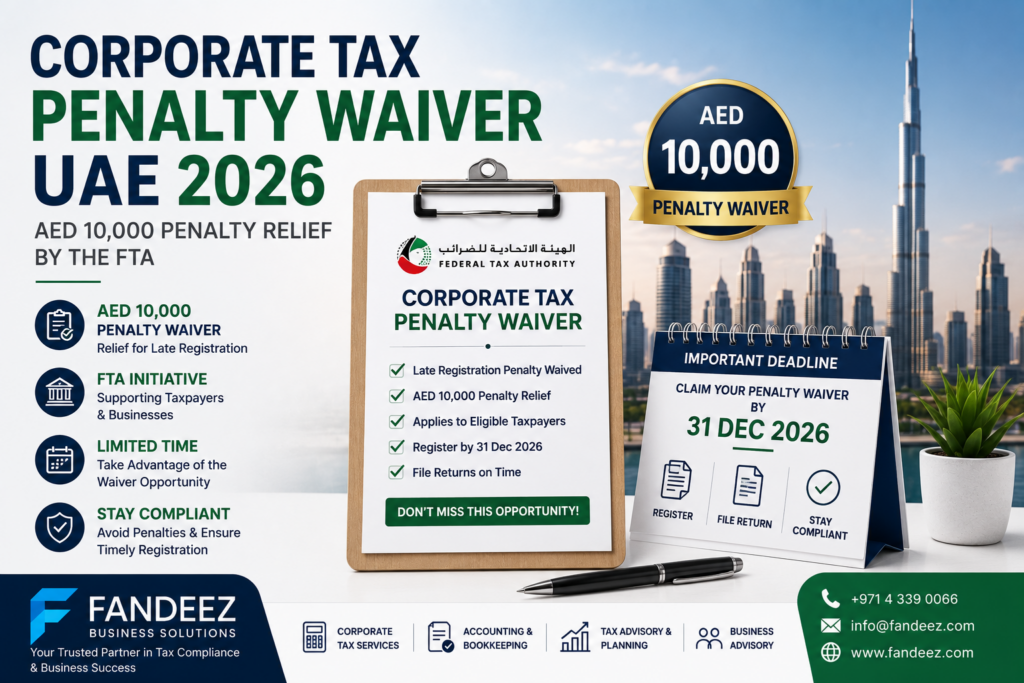
The Corporate Tax Penalty Waiver UAE is an FTA initiative that removes the AED 10,000 administrative penalty imposed on businesses that missed their original Corporate Tax registration deadline.
Purpose of the waiver. When UAE Corporate Tax rolled out, many businesses — particularly SMEs, freelancers, and smaller Free Zone entities — missed their registration deadline simply because the requirement was new and unfamiliar. Rather than penalizing every late registrant indefinitely, the Federal Tax Authority (FTA) introduced a relief mechanism to encourage voluntary compliance instead.
The AED 10,000 late registration penalty. Under the standard rules, failing to register for Corporate Tax on time triggers an automatic AED 10,000 fine, applied per entity, regardless of the business’s size or revenue.
Why the UAE introduced the relief. According to the FTA, the initiative is designed to support taxable persons in meeting their obligations, strengthen the UAE’s ease-of-doing-business standing, and promote voluntary compliance through a more flexible framework — rather than punishing businesses that are willing to correct course quickly.
Who is Eligible for the Penalty Waiver?
The Corporate Tax penalty waiver applies broadly, covering:
- Mainland companies that registered late for Corporate Tax.
- Free Zone companies, including those seeking Qualifying Free Zone Person status.
- Resident freelancers and self-employed individuals with business income.
- Foreign companies with a UAE Permanent Establishment.
- Natural persons earning business income above the relevant threshold.
The core requirement: the business must file its first Corporate Tax return — or annual declaration, for exempt persons — within seven months of the end of its first tax period, rather than the standard nine months.
Key deadline example: for a business with a first tax period ending 31 December 2025, the standard filing deadline is 30 September 2026 (nine months later). But to qualify for the penalty waiver, that same business must file by 31 July 2026 — seven months after year-end, two months earlier than the normal deadline.
AED 10,000 Late Registration Penalty Explained
When it applies. The penalty is triggered automatically when a taxable person fails to submit their Corporate Tax registration application within the timeline set by the FTA, under Cabinet Decision No. 75 of 2023 on administrative penalties.
Common reasons businesses receive it:
- Assuming a Free Zone license means Corporate Tax registration isn’t required.
- Being unaware that natural persons with business income above the threshold must register too.
- Confusing VAT registration with Corporate Tax registration — the two are separate.
- Delaying registration while waiting on internal restructuring or licensing changes.
- Simply missing the registration window due to unfamiliarity with a still-new tax regime.
Practical example. A Dubai mainland trading company incorporated in early 2024 assumed Corporate Tax registration could wait until closer to its first filing deadline. By the time it registered, it had already missed its assigned window and received the AED 10,000 penalty automatically. Because it later filed its first Corporate Tax return within seven months of its first tax period end, the penalty was waived in full.
How to Qualify for the FTA Corporate Tax Penalty Waiver
- Confirm your first tax period. This is usually your company’s first full financial year under the Corporate Tax regime — check your Corporate Tax registration certificate on EmaraTax if you’re unsure.
- Calculate your seven-month deadline. Count seven months from the end of your first tax period, not from your registration date.
- Complete or verify your Corporate Tax registration on EmaraTax. If you haven’t registered yet, do this first — the waiver cannot apply without an active registration.
- Prepare your financial statements for the first tax period, including your income statement and balance sheet.
- File your first Corporate Tax return (or annual declaration, if exempt) through EmaraTax before your seven-month deadline.
- Pay any Corporate Tax due. Filing on time secures the waiver; paying late is treated separately and can still incur late-payment interest.
- Check your EmaraTax account for the credit. If the AED 10,000 penalty was already charged and paid, it should be automatically credited back once the waiver condition is met — no separate application is required.
Required Documents and Compliance Checklist
- Valid Corporate Tax registration (Tax Registration Number) on EmaraTax
- Trade license and incorporation documents
- Financial statements for the first tax period (income statement and balance sheet)
- Records of related-party transactions, if applicable
- Supporting schedules for any Corporate Tax elections or adjustments
- Confirmation of first tax period start and end dates
- Proof of any Corporate Tax already paid, for reconciliation
- Free Zone status documentation, if claiming Qualifying Free Zone Person treatment
Keeping these organized well before your deadline is far easier with clean, up-to-date bookkeeping and accounting records — trying to reconstruct a full year of financials in the final weeks is where most businesses run into trouble.
Common Mistakes That Can Prevent Penalty Relief
- Missing the seven-month window by confusing it with the standard nine-month filing deadline.
- Assuming the waiver is automatic without filing — the return still has to be submitted on time; the waiver isn’t a blanket exemption.
- Filing an incomplete or rejected return, which doesn’t count as meeting the deadline until it’s accepted.
- Leaving financial statement preparation until the last few weeks, then running out of time when adjustments are needed.
- Assuming Free Zone companies are automatically exempt from Corporate Tax registration entirely.
- Not checking EmaraTax for pending registration amendments, which can delay the ability to file.
- Overlooking natural persons and freelancers, who often assume the rules only apply to companies.
- Paying the AED 10,000 penalty and forgetting to verify the refund credit once the waiver conditions are met.
- Waiting for FTA reminders instead of proactively tracking the first tax period deadline.
- Treating the waiver as a one-time general exemption, when it applies specifically to the first tax period only — future late filings are penalized normally.
Benefits of Claiming the Penalty Waiver
- Cost savings. AED 10,000 is a meaningful amount for most SMEs and freelancers — avoiding it protects cash flow.
- Better compliance standing. Filing correctly and on time establishes a clean compliance record with the FTA going forward.
- Reduced financial burden. Removing an unexpected penalty frees up funds for operations rather than fines.
- Improved business reputation. A clean tax compliance history matters for banking relationships, investor due diligence, and licensing renewals.
- Peace of mind. Businesses that secure the waiver early can focus on regular operations instead of resolving a lingering FTA liability.
Best Practices to Avoid Future Corporate Tax Penalties
- Mark your Corporate Tax deadlines on a compliance calendar the moment your first tax period is confirmed, rather than relying on memory.
- Separate VAT and Corporate Tax obligations clearly, since they run on different registration and filing timelines.
- Review your Free Zone status annually to confirm whether you still qualify for Qualifying Free Zone Person treatment.
- Keep monthly bookkeeping current so your financial statements are ready well before any filing deadline, not assembled in a rush.
- Work with a tax advisory partner who tracks FTA updates on your behalf, since penalty rules and thresholds continue to evolve.
- Set internal deadlines earlier than the FTA’s, giving yourself a buffer for document collection, review, and any last-minute corrections.
How Fandeez Business Solutions Can Help
Navigating the Corporate Tax Penalty Waiver UAE — and staying compliant afterward — is exactly where Fandeez Business Solutions supports UAE businesses. Our team helps with:
- Corporate Tax registration for businesses that haven’t yet registered
- Corporate Tax return filing, timed correctly to secure penalty relief where eligible
- Accounting and bookkeeping to keep your financial statements audit-ready year-round
- VAT services alongside your Corporate Tax compliance
- Tax advisory tailored to your business structure, whether Mainland, Free Zone, or freelance
- Ongoing FTA compliance support, so deadlines don’t catch you off guard again
If your first tax period ended on 31 December 2025, the window to secure your penalty waiver closes on 31 July 2026 — there isn’t much time left. Contact Fandeez Business Solutions today to confirm your eligibility and get your return filed before the deadline.
Frequently Asked Questions
- What is the Corporate Tax Penalty Waiver UAE? It’s an FTA initiative that fully waives the AED 10,000 late Corporate Tax registration penalty for businesses that file their first Corporate Tax return within seven months of their first tax period end.
- Who qualifies for the AED 10,000 penalty waiver? Mainland companies, Free Zone companies, resident freelancers, foreign companies with a UAE Permanent Establishment, and natural persons with business income — provided they file within the seven-month window.
- Can Free Zone companies apply for the waiver? Yes. Free Zone companies are fully eligible, including those seeking Qualifying Free Zone Person status, as long as the seven-month filing condition is met.
- What documents are required to claim the waiver? Corporate Tax registration details, financial statements for the first tax period, and a completed, accepted Corporate Tax return filed through EmaraTax.
- What happens if I miss the deadline? If the return isn’t filed within seven months of the first tax period end, the AED 10,000 penalty stands and becomes payable in full, with no further relief available for that period.
- How can I avoid future Corporate Tax penalties? Track your filing deadlines proactively, keep bookkeeping current throughout the year, and file well ahead of each deadline rather than at the last moment.
- Can the penalty be refunded if I already paid it? Yes. If the AED 10,000 penalty was already paid and the waiver conditions are later met, the FTA credits the amount back to the business’s EmaraTax account automatically.
- Is professional assistance recommended for claiming the waiver? Yes, particularly if your registration status, financial statements, or first tax period dates are unclear — a tax advisor can confirm eligibility and help you file correctly before the deadline.
- Does the waiver apply to every year, or just the first tax period? Only the first tax period. Late filings or late registrations in subsequent years are subject to standard penalties with no automatic waiver.
- Is the penalty waiver automatic once I file my return? The waiver applies automatically once the seven-month filing condition is met — there’s no separate waiver application to submit, but the return itself must still be filed correctly and on time.
- What is the deadline for businesses with a 31 December 2025 first tax period? 31 July 2026 — seven months after the tax period ends, two months earlier than the standard 30 September filing deadline.
- Does the waiver cover late-filing or late-payment penalties too? No. It specifically covers the AED 10,000 late registration penalty. Late-filing penalties (starting at AED 500 per month) and late-payment interest apply separately if the return or payment itself is late.
Conclusion
The Corporate Tax Penalty Waiver UAE gives businesses that missed their original registration deadline a genuine chance to avoid the AED 10,000 penalty — but only within a strict seven-month window tied to their first tax period. With thousands of businesses already benefiting, there’s no reason to leave this relief unclaimed if you’re eligible, especially with the 31 July 2026 deadline fast approaching for December year-end businesses.
Fandeez Business Solutions helps UAE businesses confirm their eligibility, prepare accurate financial statements, and file on time to secure the waiver. Contact Fandeez Business Solutions today before your window closes.