

Table of Contents
ToggleHow to Open a Corporate Bank Account in UAE: Complete Guide for Businesses (2026)
What is a Corporate Bank Account in UAE?
A corporate bank account — also called a business bank account — is a bank account registered in your company’s legal name rather than your personal name. It is used exclusively for business transactions: receiving payments, paying suppliers, processing salaries, and managing business expenses.
Every registered UAE business — mainland LLC, free zone company, or foreign branch — needs a separate corporate account to operate legally and professionally. Using a personal account for business creates serious problems for VAT compliance, Corporate Tax filing, and financial audits.
Benefits of a UAE Business Bank Account
Business Credibility
Clients and suppliers take your business more seriously when payments are made to and from a company account. It builds trust and professional credibility from day one.
International Payments
UAE corporate accounts support SWIFT international wire transfers — essential for businesses dealing with overseas suppliers and international clients.
Payroll Management
Paying employee salaries through a WPS-linked corporate account is a legal requirement for UAE businesses with staff.
Financial Compliance
Maintaining separate business finances makes your VAT return filing and Corporate Tax filing significantly more accurate. The FTA expects businesses to have clearly separated accounts.
Business Growth
A corporate account with a clean transaction history makes it easier to access business financing and credit facilities as your business grows.
Who Can Open a UAE Business Bank Account?
The following business types can open a corporate account in UAE:
Mainland Companies: LLCs and sole establishments registered with the DED of any emirate. All major UAE banks readily accept mainland companies.
Free Zone Companies: Companies registered in any UAE free zone — DMCC, JAFZA, RAKEZ, IFZA, and others. Most banks accept well-established free zones.
Offshore Companies: RAK ICC and similar structures can open UAE accounts, though the process is more involved.
SMEs and Startups: New businesses can open accounts immediately after receiving their trade licence.
Foreign Investors: Non-resident shareholders can open accounts with additional documentation and a longer compliance review.
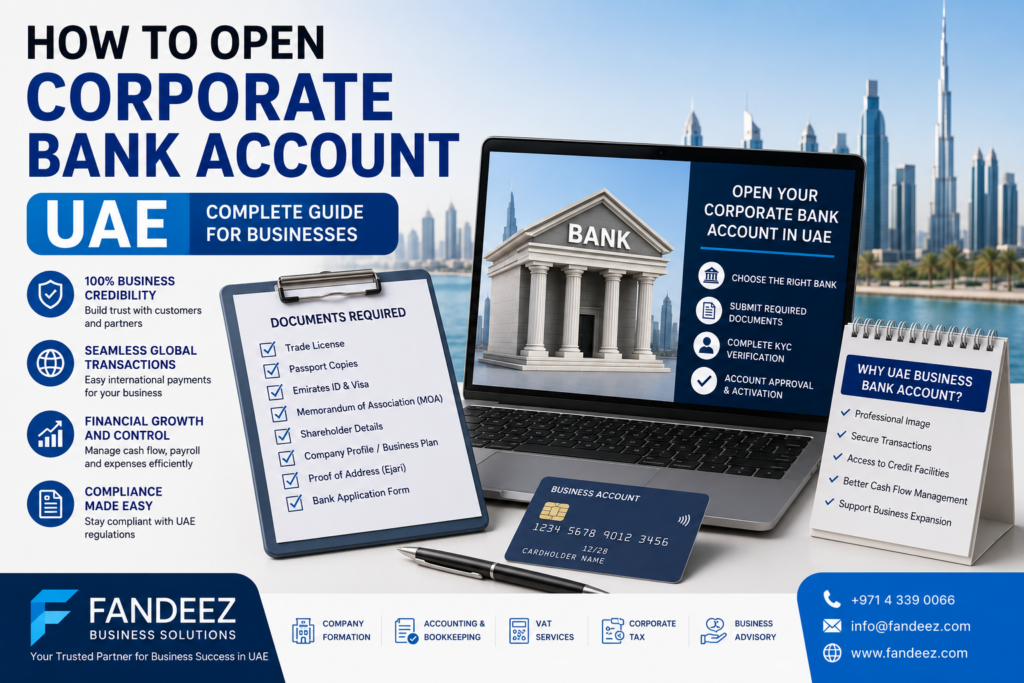
Documents Required for a UAE Corporate Bank Account
This is the most critical part of your preparation. Incomplete documentation is the number one reason for delays and rejections.
Trade Licence: Valid UAE trade licence issued by DED or your free zone authority. Must be current.
Emirates ID: All UAE-resident shareholders, directors, and signatories. Non-residents provide passport copies instead.
Passport Copies: Clear, valid passport copies of all shareholders and directors.
Visa Copy: UAE residence visa copies for all resident shareholders and directors.
MOA or AOA: Notarised Memorandum of Association or Articles of Association showing company structure, shareholders, and activities.
Shareholder Documents: Share certificates for each shareholder. Corporate shareholders require parent company documents.
Company Profile: A clear overview of your business — what you do, who your clients are, your markets, and revenue model.
Business Plan: Required by some banks for new businesses or higher-risk activities.
Office Lease Agreement: Ejari-registered tenancy contract for mainland companies. Free zone tenancy or virtual office agreement for free zone companies.
Proof of Business Activity: Client contracts, supplier agreements, purchase orders, or a company website.
Key Requirements for a UAE Corporate Bank Account
KYC Verification
Know Your Customer verification is mandatory for every UAE corporate account. Banks verify the identity of all shareholders, directors, and ultimate beneficial owners in line with UAE Central Bank regulations.
AML Compliance
Anti-Money Laundering compliance is strictly enforced. Banks assess your business model, client base, transaction countries, and source of funds.
UBO Declaration
All Ultimate Beneficial Owners — any individual with 25% or more ownership — must be declared and verified. This is non-negotiable under UAE banking law.
Minimum Balance
Traditional banks require AED 25,000 to AED 50,000 minimum monthly balance. Digital banks like Wio and Liv Business have no minimum balance requirement.
Initial Deposit
Some banks require an initial deposit of AED 10,000 to AED 50,000 to activate the account.
Step-by-Step Process
Step 1: Register Your Business
You need a valid trade licence before applying for any bank account. Complete your company formation first through DED or your chosen free zone.
Step 2: Get Your Corporate Tax Registration
Many UAE banks now ask for your FTA Tax Registration Number during the application process. Our team at Fandeez handles Corporate Tax registration quickly so you have it ready.
Step 3: Prepare All Documents
Gather every document from the checklist above. Submit everything together — incomplete applications cause delays.
Step 4: Choose the Right Bank
Not every bank suits every business. Research which banks accept your business activity, free zone, and shareholders’ nationalities before applying.
Step 5: Submit Your Application
Submit your complete document package online, through a business banking manager, or in person. Piecemeal submissions significantly slow the process.
Step 6: Complete KYC Verification
The compliance team reviews your documents and business model. Respond promptly to any additional information requests — delays extend the overall timeline.
Step 7: Attend Bank Interview (If Required)
Some banks require an in-person or video meeting with account signatories. Be ready to explain your business clearly and confidently.
Step 8: Account Activation
Once approved, receive your account details, IBAN, online banking credentials, and corporate debit card.
Best Banks for Corporate Accounts in UAE
Emirates NBD: One of the UAE’s largest banks with excellent online banking and strong international transfer capabilities. Best for established businesses with higher turnovers.
Mashreq Bank: Relatively accessible for SMEs with a strong digital platform. Good for growing businesses.
ADCB: Solid business banking products, particularly strong for mainland and Abu Dhabi-based businesses.
FAB (First Abu Dhabi Bank): Largest UAE bank by assets. Strong international capabilities but more selective in onboarding.
RAKBANK: Competitive packages for SMEs and trading businesses. Generally more accessible for new businesses.
Wio Bank: UAE digital business bank with fast onboarding, no minimum balance, and a streamlined mobile experience. Popular with startups and free zone companies.
The right bank depends on your business activity, turnover, free zone, and shareholder profile. The team at Fandeez Business Solutions helps clients identify the most suitable banking option before they apply.
Common Reasons Applications Get Rejected
- Incomplete Documentation: Missing documents or expired passports. Banks will not chase you — they will decline.
- Vague Business Plan: Generic descriptions raise immediate red flags. Be specific about clients, revenue model, and markets.
- Unclear Source of Funds: Banks must satisfy AML obligations. Document where your business capital comes from.
- High-Risk Business Activity: Cryptocurrency, money services, and certain financial activities face higher scrutiny.
- Transactions with High-Risk Jurisdictions: Businesses regularly transacting with watchlisted countries face additional compliance checks.
- Poor Personal Banking History: Returned cheques or defaults in shareholder personal accounts affect corporate applications.
- Wrong Free Zone: Some newer free zones have weaker banking relationships. Research bank acceptance before choosing your free zone.
- No Evidence of Real Business Activity: A freshly registered company with no clients, contracts, or website looks like a shell company.
- Incomplete UBO Declaration: Failing to properly declare all ultimate beneficial owners results in immediate rejection.
- Shareholder Nationality Scrutiny: Certain nationalities face additional compliance screening — not rejection, but more documentation and time.
Tips for Faster Approval
Be specific in your business plan. Replace “we provide consulting services” with “we provide financial consulting to UAE-based SMEs in the construction and retail sectors.”
Start with a digital bank. Wio Bank and Liv Business have faster, more flexible onboarding. Getting a working account quickly while traditional bank applications are in process makes business sense.
Apply to two or three banks simultaneously. Parallel applications hedge against rejection and speed up the overall process.
Respond to queries immediately. Every day you delay responding to a bank request adds another day to your timeline.
Have a company website ready. Banks want to verify your business is real. A professional website makes a significant difference during KYC.
Common Mistakes to Avoid
Using a personal account for business transactions: This creates serious problems for bookkeeping, VAT filing, and Corporate Tax compliance. Keep finances completely separate from day one.
Applying to the wrong bank: Spending weeks with a bank that is a poor fit for your profile wastes valuable time.
Submitting documents piecemeal: Send everything together in one complete package.
Not having a company website: A basic professional website significantly improves your credibility during KYC review.
Ignoring minimum balance requirements: Falling below minimum balance with a traditional bank triggers monthly penalties. Plan your initial deposit carefully.
How Fandeez Business Solutions Can Help
The process to open a corporate bank account in UAE is straightforward when you are properly prepared — but preparation requires understanding UAE banking regulations, KYC requirements, AML compliance, and which banks suit your specific profile. [2nd use]
At Fandeez Business Solutions, our team supports businesses through every stage:
Company Formation and Business Setup — We handle complete company registration so your trade licence and formation documents are ready for bank submission.
Corporate Tax Registration — We register your business with the FTA so your TRN is ready when banks ask.
VAT Registration and Compliance — We manage VAT registration and quarterly filing, keeping your banking and tax records aligned.
Accounting and Bookkeeping — We maintain accurate financial records so your accounts are always clean and bank-ready.
Auditing Services — We provide audit reports where required to support your banking application.
View our service pricing or contact us today for a free consultation.
Frequently Asked Questions
Q1: How do I open a corporate bank account in UAE?
Register your business and obtain your trade licence, prepare all required documents, choose a suitable bank, submit your complete application, and complete KYC verification. The process to open a corporate bank account in UAE typically takes 2 to 6 weeks. [3rd use]
Q2: Who can open a UAE business bank account?
Any registered UAE business — mainland LLC, free zone company, offshore company, SME, or startup — can open a business bank account. Both resident and non-resident shareholders are eligible.
Q3: What documents are required?
You need your trade licence, MOA or AOA, passport copies of all shareholders and directors, Emirates ID, visa copies, office lease agreement, company profile, business plan, and proof of business activities.
Q4: How long does account approval take?
Traditional banks typically take 2 to 6 weeks from complete document submission. Digital banks like Wio Bank can approve accounts in as little as 3 to 7 working days.
Q5: Can foreign nationals open a UAE business bank account?
Yes. Foreign nationals can open a UAE business bank account as shareholders or directors of a registered UAE company. Non-residents typically require additional documentation and face a longer compliance review.
Q6: Which bank is best for a corporate account in UAE?
There is no single best bank for every business. Digital banks like Wio are ideal for startups and free zone companies. Emirates NBD and Mashreq are strong options for established businesses with higher turnovers. The right choice depends on your activity, turnover, and shareholder profile.
Q7: Is a physical office required?
Mainland companies need a physical office with Ejari registration. Free zone companies can often use a virtual office, though a physical presence strengthens your application.
Q8: What are the minimum balance requirements?
Traditional banks require AED 25,000 to AED 50,000 minimum monthly balance. Wio Bank and Liv Business have no minimum balance requirement.
Q9: Can free zone companies open a UAE corporate bank account?
Yes. Most banks accept well-established free zones like DMCC, JAFZA, RAKEZ, and IFZA. Digital banks are often the easiest option for companies in smaller or newer free zones.
Q10: What causes applications to be rejected?
Common rejection reasons include incomplete documentation, vague business plans, unclear source of funds, high-risk activities, transactions with high-risk jurisdictions, poor personal banking history, and incomplete UBO declarations.
Q11: Do I need a Corporate Tax TRN before applying?
Not all banks require it, but many now ask for your FTA Tax Registration Number during KYC. Having it ready removes a potential delay.
Q12: Can I use my personal account for my UAE business?
No — this is strongly discouraged. Mixing personal and business finances creates serious problems for VAT compliance, Corporate Tax filing, and financial audits.
Conclusion
Setting up a proper business bank account in the UAE is one of the most important steps when establishing your company. Banks operate under strict KYC and AML regulations, and a well-prepared application makes the difference between smooth approval and months of delays.
The key is preparation: complete documents, a specific business plan, a clear source of funds explanation, and choosing the right bank from the start.
At Fandeez Business Solutions, we help businesses navigate the entire process — from company formation and Corporate Tax registration to documentation preparation and banking guidance. If you need help with how to open a corporate bank account in UAE for your specific business, our team is ready to assist.