

Table of Contents
ToggleComplete Guide to Requirements, Timeline & Compliance (2026)
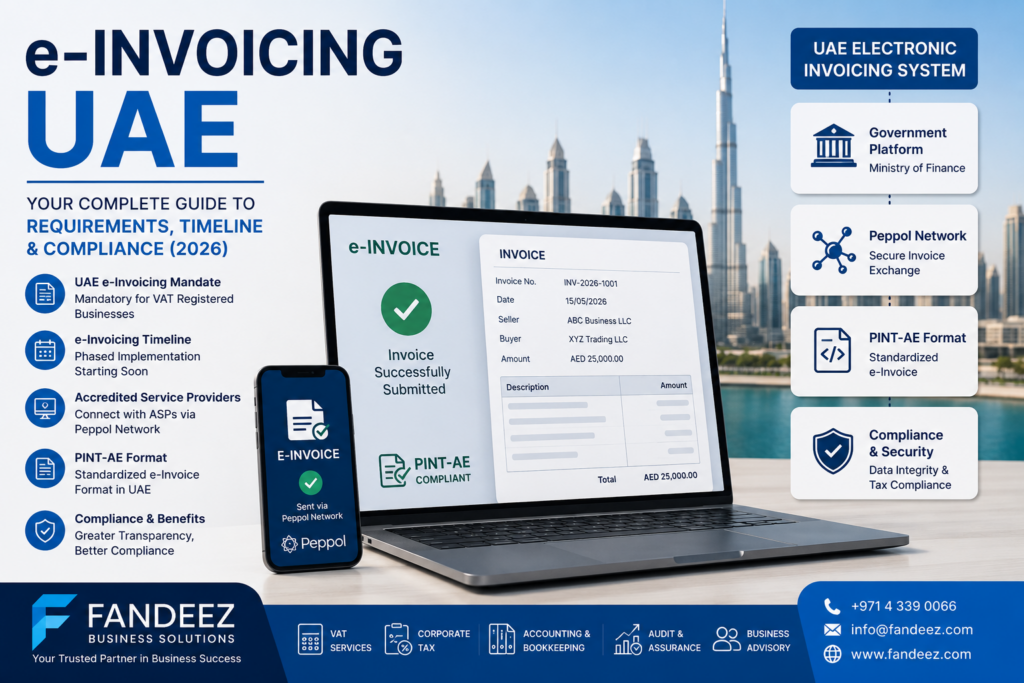
e-Invoicing UAE is no longer a future plan — it’s already live. The voluntary pilot phase opened on 1 July 2026, and mandatory compliance begins on 1 January 2027 for larger businesses. If your company issues invoices to other businesses or government entities in the UAE, this mandate will change how you invoice, store records, and stay VAT compliant. This guide walks through what e-Invoicing UAE actually means, the full rollout timeline, who’s affected, and exactly how to prepare — without the technical jargon overload.
What is e-Invoicing UAE?
e-Invoicing UAE refers to the government-mandated system requiring businesses to issue, exchange, and report invoices as structured digital data — not as PDFs, scanned copies, or paper documents.
The key difference is machine-readability. A PDF invoice looks like an invoice to a human but means nothing to a computer system; it still has to be manually re-entered into accounting software. A true e-invoice is created in a structured XML format that software can read, validate, and process automatically — no manual data entry, no re-typing, no scanning.
Under the UAE Electronic Invoicing System (EIS), every e-invoice and e-credit note is transmitted through an Accredited Service Provider (ASP), validated against government rules, and reported to the Federal Tax Authority (FTA) in near real time. If you’ve been relying on VAT-compliant PDF invoices until now, this is a fundamentally different system.
Why is UAE Introducing e-Invoicing?
Digital transformation. The UAE is moving its entire invoicing infrastructure onto a Peppol-based digital network, aligning with how leading economies handle business-to-business transactions.
Stronger VAT compliance. Real-time, structured invoice data gives the FTA far more visibility into VAT reporting, making mismatches between filed returns and actual transactions much easier to detect.
Fraud prevention. Structured, validated invoices are harder to falsify or duplicate than PDFs, reducing opportunities for invoice fraud and fake input VAT claims.
Faster business transactions. Automated invoice processing means faster approvals, faster payments, and fewer disputes over missing or incorrect invoice details.
International standards. By adopting Peppol and the PINT-AE format, the UAE is aligning itself with the same e-invoicing standards used across Europe, Australia, Singapore, and other Peppol-member countries — useful for businesses trading internationally.
UAE e-Invoicing Timeline
The rollout follows a phased schedule based on annual revenue:
Taxpayer Category | ASP Appointment Deadline | Mandatory e-Invoicing From |
Businesses with revenue ≥ AED 50 million | 31 October 2026 | 1 January 2027 |
Businesses with revenue < AED 50 million | 31 March 2027 | 1 July 2027 |
Government entities | 31 March 2027 | 1 October 2027 |
The voluntary pilot phase has already opened, giving businesses a window to test their systems before the legal deadlines apply. Businesses in a UAE VAT group transacting with each other intra-group get additional breathing room, with full compliance required by 1 January 2029.
If your revenue is close to the AED 50 million threshold, don’t wait for the deadline to approach — ERP integration, ASP onboarding, and staff training typically take longer than businesses expect.
Who Will Need e-Invoicing in UAE?
The mandate applies broadly, with very few exceptions:
- VAT-registered businesses issuing B2B or B2G invoices.
- Mainland companies across all sectors.
- Free Zone companies — DMCC, JAFZA, IFZA, RAKEZ, ADGM, DIFC, and others are explicitly in scope, with no Free Zone exemption.
- SMEs, once their revenue crosses the applicable threshold.
- Large enterprises and multinationals, who fall into the first compliance wave.
- Government entities, transacting on the B2G side.
Business-to-consumer (B2C) transactions are currently outside the mandate’s scope, though this could change in a future phase. If you sell to both businesses and consumers, only your B2B and B2G invoices need to comply for now.
UAE e-Invoicing Requirements
Complying with e-Invoicing UAE involves several moving parts:
Registration and TIN. Every business needs a Tax Identification Number (TIN) — for VAT-registered entities, this is the first 10 digits of your Corporate Tax Registration Number. Businesses not required to register for Corporate Tax still need to register with the FTA to obtain a TIN.
Accredited Service Provider (ASP). You cannot self-transmit e-invoices directly to the FTA. Invoices must be routed through an FTA-recognized ASP, which converts your data, validates it against the rules, and transmits it through the network.
Peppol network. The UAE’s system runs on the Peppol network — the same decentralized exchange model used internationally — so your ASP acts as your access point into this network.
PINT-AE format. Every invoice must follow the PINT-AE data dictionary, the UAE-specific implementation of the international Peppol Invoice (PINT) standard, covering around 50 mandatory fields — TRN, tax breakdown, seller and buyer details, and more.
Invoice validation. Invoices pass through a layered validation process (schema, business rules, and regulatory checks) before being accepted — errors get rejected rather than silently passed through.
Digital record keeping. Structured invoice data must be securely stored and retrievable by the FTA on request, generally within a matter of days during an inspection.
Understanding the UAE Electronic Invoicing System
The EIS operates on what’s known as the DCTCE model (Decentralized Continuous Transaction Control and Exchange) — sometimes called the “5-corner model.”
How it works in practice: the seller’s ASP generates and validates the invoice, transmits it to the buyer’s ASP through the Peppol network, and both ASPs report the transaction data to the FTA. This happens automatically, in near real time, without either party needing to manually email or upload documents.
Government framework. The legal basis sits under Ministerial Decision No. 243 of 2025 on the Electronic Invoicing System and Ministerial Decision No. 244 of 2025 on its implementation, both issued under the UAE VAT law, with Cabinet Decision No. 100 of 2025 amending the VAT Executive Regulations to support the mandate.
Business benefits. Once integrated, businesses typically see faster invoice processing, fewer manual reconciliation errors, and cleaner data feeding directly into their accounting and bookkeeping records.
What is Peppol and PINT-AE?
Peppol (Pan-European Public Procurement Online) is an international network and set of standards originally built for electronic procurement, now widely adopted for structured e-invoicing across dozens of countries. It allows invoices to move securely between different software systems and countries, regardless of what accounting platform either party uses.
PINT-AE is the UAE’s localized version of the Peppol International Invoice specification — essentially, Peppol’s global rulebook adapted with UAE-specific VAT and tax fields.
Why they matter: Peppol gives the UAE a proven, internationally interoperable backbone rather than building a closed domestic system from scratch, while PINT-AE ensures the format still captures everything the FTA needs for VAT and Corporate Tax purposes.
How businesses use them: in practice, your ERP or accounting software connects to your ASP, which handles the Peppol and PINT-AE technical layer for you — most businesses won’t need to understand the XML structure directly, but their finance team will need to understand what data must be captured correctly at the point of invoicing.
Benefits of e-Invoicing for UAE Businesses
- Faster payments — structured invoices move through approval workflows faster than PDFs requiring manual review.
- Better VAT compliance — automated, validated data reduces the risk of VAT reporting errors and discrepancies.
- Reduced errors — no more manual re-typing of invoice data from PDFs into accounting systems.
- Lower costs — less time spent on data entry, invoice chasing, and dispute resolution.
- Increased efficiency — invoices are processed automatically end-to-end.
- Improved cash flow — faster invoice validation generally means faster payment cycles.
- Better financial reporting — clean, structured data makes month-end closing and reporting more accurate.
Common Challenges and How to Prepare
Software and ERP updates. Your accounting or ERP system needs to map its internal invoice fields to the PINT-AE data dictionary — this isn’t a plug-and-play switch for most legacy systems.
Choosing an Accredited Service Provider. Not all ASPs offer the same integration quality, support, or pricing. Evaluate technical capability and track record before committing.
Employee training. Finance teams need to understand what data must be captured correctly at the point of sale or contract signing — errors upstream become validation failures downstream.
Data accuracy. TRNs, buyer details, and tax breakdowns must be accurate and complete; the system rejects incomplete submissions rather than accepting them with gaps.
Running parallel systems. Many businesses will run legacy invoicing alongside e-invoicing during the transition — plan a clear cutover date rather than dragging this out indefinitely.
Compliance for retention billing. Sectors like construction and real estate, which often use retention billing, need to reflect only the net payable amount per invoice event, with a separate invoice issued when retained sums are released.
Best Practices for e-Invoicing Compliance
- Start early, even if your revenue is below the AED 50 million threshold — ASP onboarding and ERP testing take months, not weeks.
- Audit your current invoicing data for gaps — missing TRNs, inconsistent buyer details, or incomplete tax breakdowns will all cause validation failures later.
- Test in the voluntary pilot phase before your mandatory deadline arrives, so issues surface while there’s still time to fix them.
- Confirm your Free Zone status doesn’t create a false sense of exemption — Free Zone companies are fully in scope.
- Keep your VAT compliance and Corporate Tax registration details up to date, since your TIN is tied to your Corporate Tax Registration Number.
- Build a realistic internal timeline working backward from your mandatory compliance date, including ASP selection, ERP mapping, sandbox testing, and staff training.
- Loop in your business advisory team early, especially if you operate across multiple entities or a VAT group.
How Fandeez Business Solutions Can Help
Preparing for e-Invoicing UAE touches your accounting systems, VAT compliance, and internal processes all at once — and that’s exactly where Fandeez Business Solutions can help. Our team supports UAE businesses with:
- e-Invoicing readiness assessments to identify gaps before your deadline arrives
- Ongoing VAT compliance support aligned with the new e-invoicing data requirements
- Accounting and bookkeeping services that keep your financial records clean and audit-ready
- Corporate Tax registration and filing support, since your TIN depends on it
- Financial reporting built around structured, e-invoicing-ready data
- ERP and accounting system guidance to help your finance team through the transition
- Business advisory and tax compliance support tailored to your industry
Whether you’re a large enterprise facing the January 2027 deadline or an SME with more runway before July 2027, the earlier you start preparing, the smoother the transition. Contact Fandeez Business Solutions today for an e-Invoicing readiness review.
Frequently Asked Questions
- What is e-Invoicing UAE? It’s the UAE’s mandate requiring businesses to issue, exchange, and report invoices as structured electronic data — typically in XML format — instead of PDFs or paper documents.
- Is e-Invoicing mandatory in UAE? Yes. It becomes mandatory in phases: from 1 January 2027 for businesses with revenue of AED 50 million or more, and from 1 July 2027 for smaller businesses.
- When will e-Invoicing start in the UAE? The voluntary pilot phase began on 1 July 2026. Mandatory compliance follows in phases through 2027, based on business revenue.
- Who needs to comply with UAE e-Invoicing? VAT-registered businesses issuing B2B or B2G invoices, including Mainland companies, Free Zone companies, SMEs, and large enterprises. B2C transactions are currently excluded.
- What is Peppol? Peppol is an international network and standard for exchanging structured electronic documents like invoices, used by many countries for e-invoicing and e-procurement.
- What is PINT-AE? PINT-AE is the UAE-specific implementation of the international Peppol Invoice (PINT) standard, defining the mandatory data fields and structure for UAE e-invoices.
- What is an Accredited Service Provider (ASP)? An ASP is an FTA-recognized provider that businesses must use to generate, validate, and transmit their e-invoices through the Peppol network — direct FTA submission isn’t an option.
- Will Free Zone companies be affected by e-Invoicing UAE? Yes. Free Zone companies, including DMCC, JAFZA, IFZA, RAKEZ, ADGM, and DIFC entities, are explicitly in scope with no Free Zone exemption.
- How should businesses prepare for e-Invoicing UAE? By auditing current invoicing data, selecting an ASP, updating ERP/accounting systems, training finance staff, and testing during the voluntary pilot phase before the mandatory deadline.
- What happens if a business isn’t ready by its deadline? Non-compliant invoices can be rejected, disrupting payment cycles, and businesses risk penalties under the UAE’s tax procedures framework for failing to meet mandatory e-invoicing requirements.
- Does e-Invoicing UAE apply to B2C transactions? Not currently. The initial mandate covers B2B and B2G transactions only; B2C remains outside scope until a further phase is announced.
- Do businesses need a TIN for e-Invoicing even if they’re not Corporate Tax registered? Yes. Businesses not required to register for Corporate Tax must still register with the FTA to obtain a Tax Identification Number for e-invoicing purposes.
Conclusion
e-Invoicing UAE marks one of the most significant shifts in how businesses handle invoicing and VAT compliance in the country’s history. With the voluntary pilot already live and mandatory deadlines arriving in phases through 2027, the businesses that start preparing now — auditing their data, selecting an ASP, and updating their systems — will avoid the last-minute scramble that trips up so many mandates.
Fandeez Business Solutions helps UAE businesses navigate e-Invoicing readiness alongside VAT compliance, accounting, bookkeeping, and Corporate Tax services. Contact Fandeez Business Solutions today to get your business ready for the e-Invoicing mandate before your deadline arrives.