

Table of Contents
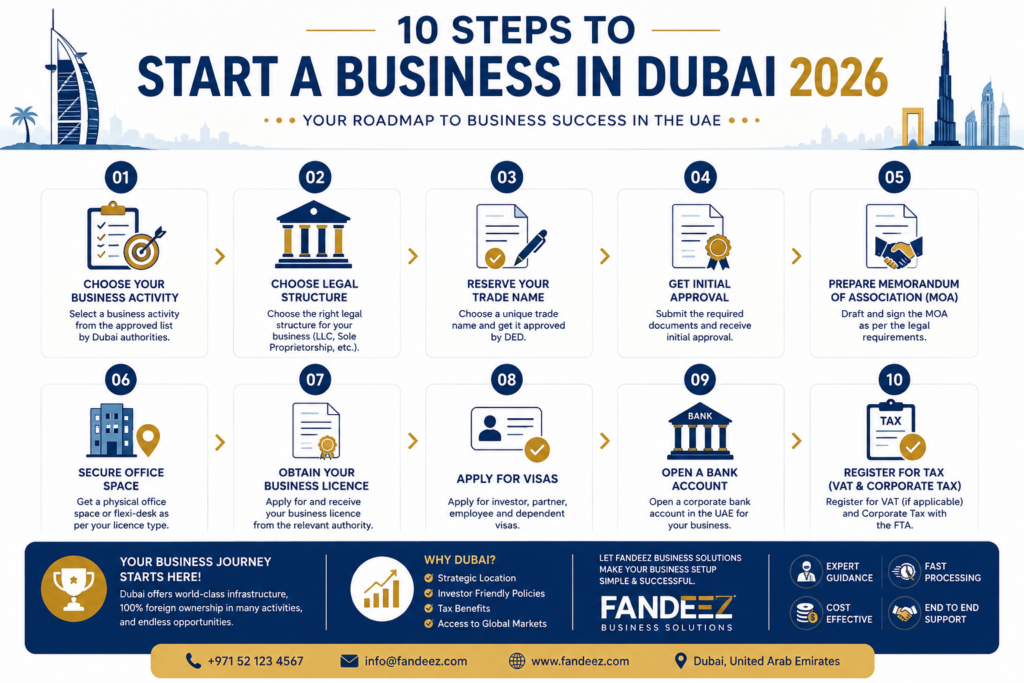
ToggleHow to Start a Business in Dubai 2026 — Complete Step-by-Step Guide
Dubai is one of the most exciting places in the world to start a business. No personal income tax, world-class infrastructure, a strategic location between East and West, and a government that genuinely makes it easy for foreign entrepreneurs to set up and grow. It’s no surprise that thousands of people — including many Pakistanis — are asking how to start a business in Dubai every single year.
But here’s the reality: the process can feel overwhelming if you don’t know where to start. There are choices to make — mainland or free zone, which licence type, which legal structure, which free zone — and if you make the wrong choices early on, it can cost you time and money to fix later.
This guide is designed to walk you through the entire Dubai business setup process step by step, in plain English, updated for 2026. Whether you’re starting from scratch or just trying to understand your options, by the end of this article you’ll have a clear roadmap.
Let’s get into it.
Why Start a Business in Dubai in 2026?
Before we dive into the steps, let’s quickly understand why Dubai remains one of the top destinations for business setup in 2026:
- No personal income tax — your salary and personal income are not taxed
- 9% Corporate Tax on profits above AED 375,000 — still one of the lowest rates globally
- 100% foreign ownership allowed for most business activities
- World-class banking — access to international banking infrastructure
- Strategic location — Dubai sits between Europe, Asia, and Africa, making it ideal for global trade
- Strong legal system — businesses are protected by clear commercial laws
- Golden Visa and investor visa — residency options for business owners
- Growing economy — Dubai’s GDP continues to grow, with strong demand across sectors
Now, let’s go through the complete UAE Business Setup Guide step by step.
Step 1: Choose Your Business Activity
The first and most important decision is: what will your business actually do?
In Dubai, your business activity determines your licence type, which authority you register with, and in some cases, what legal structure you can use. You need to choose your activity before anything else.
The main licence types in Dubai are:
Licence Type | For |
Commercial Licence | Trading, buying and selling goods, retail, import/export |
Professional Licence | Services — consulting, accounting, IT, marketing, design |
Industrial Licence | Manufacturing, production, processing |
Tourism Licence | Travel agencies, tour operators, hotels |
The Department of Economic Development (DED) has a list of over 2,000 approved business activities. You can choose multiple activities under one licence in some cases, but each additional activity may have a small additional cost.
Important tip: Be specific when choosing your activity. “General trading” sounds broad and flexible, but it comes with higher licence costs. If you’re a consultant, choose your specific consulting activity rather than a general trading licence.
Step 2: Choose Your Legal Structure
Once you know your business activity, you need to decide your legal structure. This determines how your company is owned and how it operates.
The most common options for foreign entrepreneurs in Dubai are:
Limited Liability Company (LLC) — Mainland
The most popular structure for mainland Dubai company formation. Since 2021, foreigners can own 100% of a mainland LLC for most activities. An LLC gives you full trading rights across the UAE, access to government contracts, and the ability to open a physical office anywhere in Dubai.
Free Zone Company (FZC / FZE)
A company registered within one of Dubai’s many free zones — DMCC, JAFZA, Dubai Silicon Oasis, Dubai Airport Free Zone, etc. 100% foreign ownership has always been allowed in free zones. Great for international trade and businesses that don’t need to sell directly to UAE mainland customers.
Branch of a Foreign Company
If you already have a company outside the UAE and want to open a Dubai office, you can register a branch. The parent company retains 100% ownership.
Sole Establishment
A single-owner business registered in your personal name. Suitable for freelancers and solo professionals. You are personally liable for the business’s debts.
For most foreign entrepreneurs, the choice is between a Mainland LLC and a Free Zone Company. For a detailed comparison including the tax implications of each, read our Mainland vs Free Zone UAE — Tax Comparison 2026 guide.
Step 3: Choose Between Mainland and Free Zone
This decision is critical and deserves its own section. Here’s a quick summary to help you decide:
Choose Mainland if:
- Your customers are in the UAE
- You want to bid for government contracts
- You need a physical retail or office presence anywhere in Dubai
- You want maximum flexibility in where you can operate
Choose Free Zone if:
- You’re selling internationally or online
- You want a remote/virtual setup from outside the UAE
- You’re in e-commerce, consulting for overseas clients, trading internationally
- You want to benefit from the 0% Corporate Tax rate as a Qualifying Free Zone Person
Key tax point: Both mainland and free zone companies are subject to UAE Corporate Tax at 9% on profits above AED 375,000. Free zone companies can potentially access a 0% rate on qualifying income, but only if they meet specific QFZP conditions. Don’t choose a free zone purely for tax reasons without understanding the full picture — read our UAE Corporate Tax Registration Guide for details.
Step 4: Choose Your Free Zone (If Applicable)
If you’ve decided to go the free zone route, Dubai alone has over 20 free zones to choose from. Here are the most popular ones:
Free Zone | Best For |
DMCC (Dubai Multi Commodities Centre) | Trading, commodities, crypto, general business |
JAFZA (Jebel Ali Free Zone) | Logistics, heavy industry, large trading |
Dubai Silicon Oasis (DSO) | Technology, IT, software |
Dubai Airport Free Zone (DAFZA) | Aviation, cargo, high-value goods |
Dubai Internet City (DIC) | Digital, tech, media companies |
Dubai Media City (DMC) | Media, PR, advertising, content |
IFZA (International Free Zone Authority) | Cost-effective general business |
Each free zone has its own fee structure, approved activities list, and office requirements. The cheapest option is not always the best — consider whether the free zone is recognised by UAE banks (some newer free zones have banking access issues), and whether your specific activity is permitted.
Step 5: Reserve Your Trade Name
Your trade name is your company’s official name in the UAE. Before you can proceed with registration, you need to reserve this name with the relevant authority — DED for mainland, or the free zone authority if you’re going free zone.
Rules for UAE trade names:
- Cannot contain offensive, religious, or politically sensitive words
- Cannot copy or closely resemble an existing registered name
- Should not include the names of rulers or government entities
- For LLCs, the name can be a made-up name, an activity description, or include your personal name
Cost: Trade name reservation typically costs AED 620–720 for mainland. Free zones usually include this in their package fee.
Validity: Reserved names are valid for a limited period (usually 60–90 days) so you need to proceed quickly with the next steps.
Step 6: Get Initial Approval
Initial Approval (sometimes called Pre-Approval or No Objection Certificate) is the government’s confirmation that your proposed business activity and structure are acceptable, and that you can proceed with the registration.
For mainland companies, initial approval is obtained from the DED. For regulated activities (healthcare, education, finance, food, real estate etc.), you also need approvals from the relevant sector regulator — the Dubai Health Authority for healthcare, KHDA for education, and so on.
Initial approval does not mean your company is registered yet — it simply means you’re approved to proceed. Most mainland initial approvals are issued within 1–3 working days.
Step 7: Draft and Sign the Memorandum of Association (MOA)
The Memorandum of Association (MOA) is the legal document that defines:
- The company name and registered address
- The business activities
- The shareholders and their ownership percentages
- The share capital
- The roles of directors and managers
For a mainland LLC, the MOA must be drafted in Arabic (with an English translation), notarised at the Dubai Courts Notary Public, and signed by all shareholders.
Important: If you’re a single foreign shareholder, you’ll need to be present in Dubai to sign the MOA, or grant a Power of Attorney (POA) to a representative who can sign on your behalf.
For free zone companies, the equivalent document is usually called the Articles of Association, and the process is handled directly by the free zone authority — often much simpler.
Step 8: Secure Your Office Space
Every Dubai business needs a registered office address. The type of office you need depends on your structure:
Mainland Companies
You need a physical office with a valid tenancy contract registered with Ejari (Dubai’s official rental registration system). Virtual offices are not accepted for mainland licences in most cases.
Office options:
- Flexi-desk / shared office: AED 10,000–20,000 per year — suitable for small teams
- Serviced office: AED 20,000–50,000+ per year — professional setup with reception and meeting rooms
- Dedicated office: Price varies significantly based on size and location
Free Zone Companies
Most free zones offer virtual office packages starting from AED 5,000–8,000 per year, which gives you a registered address without needing a physical space. If you need a physical desk or office, free zones offer flexi-desks and dedicated offices at various price points.
Step 9: Obtain Your Business Licence
Once your MOA is signed, office is secured, and all approvals are in place, you can apply for your Business Licence — this is the official document that allows you to legally operate your business in Dubai.
The Business License Dubai is issued by:
- DED (Department of Economic Development) for mainland companies
- The relevant free zone authority for free zone companies
Your licence will show:
- Company name
- Business activities
- Licence type (commercial, professional, industrial)
- Issue date and expiry date (licences are valid for 1 year and must be renewed annually)
Licence issuance typically takes 3–7 working days after all documents are submitted and fees are paid.
Step 10: Apply for Your Investor Visa (Dubai Investor Visa)
Once your company is registered and your licence is issued, you can apply for a Dubai Investor Visa — this is the UAE residence visa that allows you to live in the UAE as a business owner.
Investor visa process:
- Entry permit — issued first, allows you to enter the UAE
- Medical fitness test — mandatory health check in the UAE
- Emirates ID registration — biometrics and ID card application
- Residence visa stamping — visa stamped in your passport
Investor Visa validity: Typically 2 or 3 years, renewable.
Investor Visa cost: Approximately AED 3,500–5,000 for the complete process.
Golden Visa: If you’re investing AED 2 million or more in UAE property or business, you may qualify for a 10-year UAE Golden Visa, which provides long-term residency security.
Once you have your investor visa, you can also sponsor your family (spouse and children) for UAE residence visas.
Dependant visa cost: Approximately AED 3,000–4,000 per family member.
Step 11: Open a UAE Corporate Bank Account
This is often the most challenging step for new business owners, but it’s essential. You need a UAE corporate bank account to receive payments, pay suppliers, and run your business properly.
Popular UAE banks for business accounts:
- Emirates NBD
- Mashreq Bank
- Abu Dhabi Commercial Bank (ADCB)
- First Abu Dhabi Bank (FAB)
- Wio Bank (digital, faster approval)
- Liv Business (Emirates NBD digital banking)
Documents typically required:
- Trade licence copy
- MOA / Articles of Association
- Passport copies of all shareholders and managers
- Emirates ID (once issued)
- Proof of office address
- Business plan (some banks require this)
- 6 months bank statements from your home country (for new businesses)
Tips for successful bank account opening:
- Choose a bank that is familiar with your business activity
- Have a clear business plan ready to explain your business model
- Digital banks like Wio are often faster and more flexible for new businesses
- Avoid banks that have a history of closing accounts for your nationality or business type
Timeline: Bank account opening typically takes 2–6 weeks depending on the bank and your documentation.
Step 12: Register for Corporate Tax
This step is mandatory for every business in the UAE and one that many new business owners overlook. Once your company is registered, you must register for UAE Corporate Tax with the Federal Tax Authority (FTA) through the EmaraTax portal.
Deadline for Corporate Tax Registration:
- Newly incorporated mainland LLCs: within 3 months of licence issuance
- Failure to register on time: AED 10,000 penalty
Corporate Tax rates in 2026:
- 0% on profits up to AED 375,000
- 9% on profits above AED 375,000
- 0% for businesses with revenue under AED 3 million (Small Business Relief)
For a complete step-by-step guide, read our How to File Corporate Tax Return in UAE guide.
At Fandeez Business Solutions, we handle Corporate Tax registration and ongoing filing for businesses across Dubai and the UAE.
Step 13: Register for VAT (If Applicable)
If your business revenue exceeds — or is expected to exceed — AED 375,000 per year, you must register for VAT in UAE at 5%.
VAT registration is mandatory above this threshold and voluntary between AED 187,500 and AED 375,000.
Once registered, you must:
- Charge 5% VAT on applicable sales
- File quarterly VAT returns with the FTA
- Keep proper VAT records for at least 5 years
Penalty for late VAT registration: AED 20,000.
For help with VAT registration in UAE, the team at Fandeez handles the complete process from registration to quarterly filing.
Business Setup Cost in Dubai 2026
One of the most common questions is: how much does it actually cost? Here’s a realistic breakdown:
Mainland LLC — Estimated Cost
Item | Estimated Cost (AED) |
Trade name reservation | 620 – 720 |
Initial approval | 100 – 300 |
MOA notarisation | 1,500 – 2,500 |
DED licence fee | 8,000 – 15,000 |
Office / flexi-desk (1 year) | 10,000 – 20,000 |
Investor visa (1 person) | 3,500 – 5,000 |
Corporate Tax registration | 0 (government portal) |
Professional setup fees | 3,000 – 7,000 |
Total Estimate | AED 26,720 – 50,520 |
Free Zone Company — Estimated Cost
Item | Estimated Cost (AED) |
Free zone licence + visa package | 7,000 – 20,000 |
Virtual office (if not included) | 3,000 – 8,000 |
Investor visa (if not included) | 3,500 – 5,000 |
Professional setup fees | 2,000 – 5,000 |
Total Estimate | AED 15,500 – 38,000 |
Note: Costs vary significantly based on your specific activity, chosen authority, office size, and number of visas. The figures above are estimates for planning purposes.
Business Setup Timeline — What to Expect
Stage | Estimated Time |
Business activity and structure decision | 1–3 days |
Trade name reservation | 1–2 days |
Initial approval | 1–3 days |
MOA drafting and notarisation | 2–5 days |
Office lease and Ejari registration | 3–7 days |
Licence issuance | 3–7 days |
Investor visa process | 7–14 days |
Bank account opening | 14–30 days |
Corporate Tax registration | 1–3 days |
VAT registration (if needed) | 5–10 days |
Total from start to fully operational | 4–8 weeks |
Free zone companies can often complete the company formation stage in 5–10 working days, though bank account opening always adds time regardless of structure.
Common Mistakes to Avoid When Starting a Business in Dubai
Having helped many entrepreneurs through the business setup process, these are the mistakes we see most often:
Mistake 1: Choosing the Wrong Structure for Your Business Picking a free zone when your customers are in the UAE mainland — or vice versa — is the most expensive mistake to fix. Think carefully about where your customers are before deciding.
Mistake 2: Ignoring Corporate Tax Registration Deadline Many new business owners focus on getting their licence and visa, and completely forget about the 3-month Corporate Tax registration deadline. Missing it costs AED 10,000. Set a reminder the day you receive your licence.
Mistake 3: Choosing the Cheapest Free Zone Without Research Some budget free zones have poor banking relationships, which means major UAE banks may refuse to open accounts for companies registered there. Always check banking access before choosing a free zone.
Mistake 4: Not Planning for Office Costs Many entrepreneurs budget for the licence fee but forget that the office requirement is a recurring annual cost. Factor this into your financial planning from day one.
Mistake 5: Skipping Professional Advice The UAE business setup process involves multiple government authorities, legal documents, and regulatory requirements. Trying to do everything yourself to save money often leads to errors, delays, and ultimately higher costs. Professional guidance from a firm like Fandeez Business Solutions typically pays for itself.
Mistake 6: Opening a Personal Bank Account Instead of Corporate This seems obvious, but some new business owners use a personal account to receive business payments. This creates serious problems for accounting, tax filing, and compliance.
Mistake 7: Not Registering for VAT on Time If your revenue is approaching AED 375,000, you need to register for VAT proactively. Late registration carries a AED 20,000 penalty.
Complete Business Setup Checklist — Dubai 2026
Use this checklist to track your progress:
PRE-SETUP
☐ Business activity decided
☐ Legal structure chosen (mainland / free zone)
☐ Free zone selected (if applicable)
☐ Budget planned
REGISTRATION
☐ Trade name reserved
☐ Initial approval obtained
☐ MOA drafted and notarised
☐ Office lease signed and Ejari registered
☐ Business licence obtained
POST-LICENCE
☐ Investor visa applied
☐ Medical fitness test completed
☐ Emirates ID registered
☐ Residence visa stamped
☐ Corporate bank account opened
TAX & COMPLIANCE
☐ Corporate Tax registration completed (within 3 months)
☐ VAT registration completed (if revenue above AED 375,000)
☐ Accounting system set up
☐ First quarterly VAT return filed (if registered)
How Fandeez Business Solutions Can Help
Setting up a business in Dubai involves multiple steps, multiple government authorities, and significant paperwork. Getting any step wrong can cause delays, penalties, and extra costs.
At Fandeez Business Solutions, we provide end-to-end business setup services for entrepreneurs in Dubai and across the UAE:
- Business Structure Advisory — We help you choose the right structure, activity, and jurisdiction for your specific business
- Complete Company Formation — We handle all registration steps from trade name to licence issuance
- Investor Visa Processing — We manage the complete visa application process for you and your family
- Bank Account Introduction — We help connect you with the right banking options for your business
- Corporate Tax Registration and Filing — We register your business with the FTA and handle ongoing UAE Corporate Tax compliance
- VAT Registration and Management — We manage your VAT registration and quarterly filing
- Ongoing Accounting and Bookkeeping — We keep your books clean and compliant throughout the year
Whether you’re starting a mainland LLC, a free zone company, or exploring your options, our team is here to make the process smooth, fast, and stress-free.
FAQs — How to Start a Business in Dubai 2026
Q: How much does it cost to start a business in Dubai in 2026? A mainland LLC typically costs between AED 26,000–50,000 including licence, office, and one investor visa. Free zone companies start from AED 15,000–38,000. Costs vary based on your activity, office size, and number of visas needed.
Q: Can a Pakistani national start a business in Dubai? Yes. Pakistani nationals can own 100% of a mainland LLC or free zone company in Dubai. No local UAE sponsor or partner is required for most business activities.
Q: How long does it take to set up a company in Dubai? The company formation process typically takes 2–4 weeks for a mainland company. Free zone companies can be set up in as little as 5–10 working days. Bank account opening usually adds another 2–4 weeks.
Q: Do I need to be physically present in Dubai to start a business? For mainland companies, you usually need to visit at least once to sign the MOA (unless you grant Power of Attorney). Many free zones allow fully remote setup. Bank account opening usually requires a visit.
Q: Is Dubai business still tax-free in 2026? There is no personal income tax in the UAE — your salary and personal income are tax-free. However, businesses now pay 9% Corporate Tax on profits above AED 375,000 since June 2023. This is still very low compared to most countries.
Q: What is the minimum capital required for a Dubai company? For most mainland LLCs, there is no mandatory minimum paid-up capital. Free zones vary — some have no minimum while others require AED 50,000–150,000 depending on the activity.
Q: Can I sponsor my family with a Dubai business visa? Yes. Once you have your investor residence visa, you can sponsor your spouse and children for UAE residence visas. The cost is approximately AED 3,000–4,000 per family member.
Q: What is the difference between a mainland and free zone company in Dubai? A mainland company can trade anywhere in the UAE including with government. A free zone company is primarily for international trade and has restrictions on direct selling to UAE mainland customers. For a full comparison, read our Mainland vs Free Zone UAE — Tax Comparison 2026 guide.
Q: Do I need a physical office for a Dubai business? Mainland companies require a physical office with Ejari registration. Free zone companies usually offer virtual office options, though some activities require a physical space.
Q: What happens if I miss the Corporate Tax registration deadline? You will receive an administrative penalty of AED 10,000 from the FTA. If you’ve missed your deadline, contact Fandeez Business Solutions immediately — we can help you resolve the situation as quickly as possible.
Conclusion
Starting a business in Dubai in 2026 is a genuinely exciting opportunity. The tax environment, while no longer completely tax-free, is still one of the most competitive in the world. The infrastructure is world-class. And the UAE government continues to make it easier for foreign entrepreneurs to set up and thrive.
The key is to get the fundamentals right from the start — choosing the right structure, meeting your tax registration deadlines, and keeping your compliance in order throughout the year.
Ready to start your Dubai business journey?
Contact Fandeez Business Solutions today for a free consultation. Our expert team will guide you through every step — from choosing your business activity to obtaining your licence, visa, and tax registration — so you can focus on building your business while we handle the paperwork.