

Table of Contents
ToggleThe introduction of Value Added Tax (VAT) in the UAE back in January 2018 reshaped the financial landscape for businesses and individuals alike. While the UAE remains a tax-optimized haven—with no income tax on salaries—the VAT on Residential Property in UAE remains one of the most misunderstood areas of the law.
For property owners, landlords, tenants, and investors, navigating the difference between a 5% charge, a 0% rate, and a complete exemption is crucial. Misclassification can lead to significant financial losses or penalties from the Federal Tax Authority (FTA).
In this guide, we will break down the UAE Residential Property VAT rules, clarify when rent is taxed, and explain how Fandeez can help you stay compliant while maximizing your returns.
What is VAT on Residential Property in UAE?
VAT is a consumption tax levied on the supply of goods and services. In the UAE, the standard rate is 5%. However, when we look specifically at Residential Property VAT UAE, the transaction does not always fall under this standard rate.
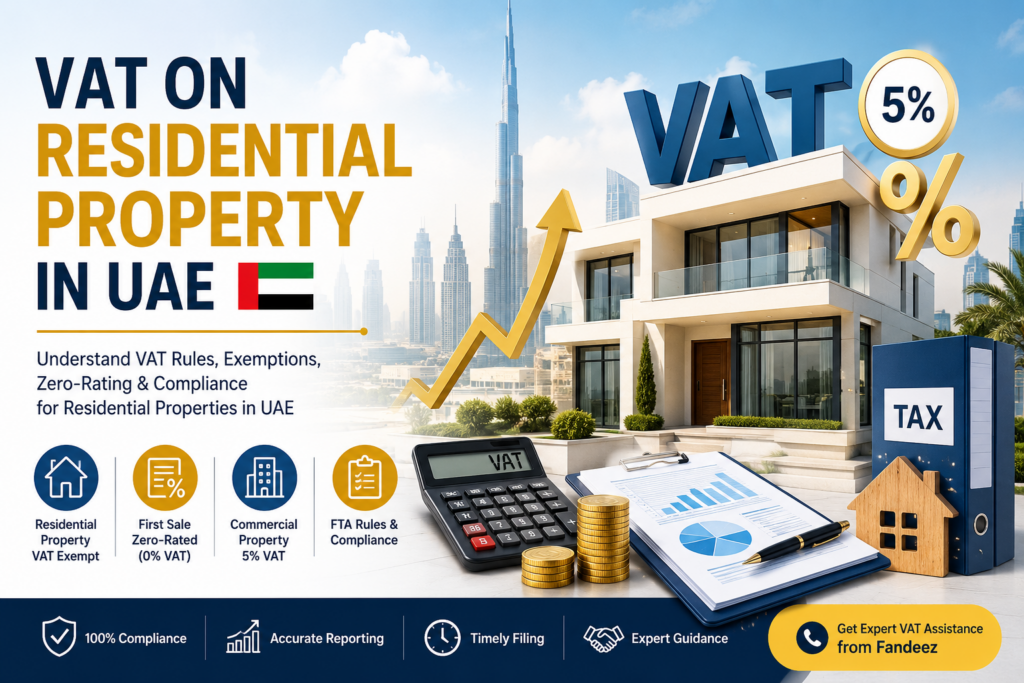
Contrary to what many new investors think, buying a home to live in or renting an apartment does not automatically incur a 5% surcharge. The FTA has categorized real estate into three distinct treatment buckets: Standard-rated (5%) , Zero-rated (0%) , and Exempt.
Understanding where UAE VAT on Residential Property applies is the difference between a profitable investment and an unexpected tax liability.
What is VAT on Residential Property in UAE?
VAT is a consumption tax levied on the supply of goods and services. In the UAE, the standard rate is 5%. However, when we look specifically at Residential Property VAT UAE, the transaction does not always fall under this standard rate.
Contrary to what many new investors think, buying a home to live in or renting an apartment does not automatically incur a 5% surcharge. The FTA has categorized real estate into three distinct treatment buckets: Standard-rated (5%) , Zero-rated (0%) , and Exempt.
Understanding where UAE VAT on Residential Property applies is the difference between a profitable investment and an unexpected tax liability.
Understanding UAE Residential Property VAT Rules (The Three Tiers)
To master VAT rules for residential property in the UAE, you must understand how the FTA classifies supplies. According to the Residential Property VAT Regulations UAE, the treatment depends entirely on the “supply” (sale or lease) and the “status” of the property.
1. Taxable Supplies (Standard Rated – 5%)
This applies strictly to commercial properties. If you are renting an office, a retail shop, or a warehouse, you will pay 5% VAT on the rent. Additionally, short-term residential leases (less than 6 months) provided to tourists or non-residents are treated as “commercial”, thus attracting 5%.
2. Zero-Rated Supplies (0%)
This is the “good news” category for home buyers. The first supply of a new residential property (sale or long-term lease) is zero-rated. This means the buyer pays no VAT, but the developer can recover the VAT they paid on construction materials.
3. Exempt Supplies
This is where most confusion lies. Subsequent sales (reselling a home that was already bought from a developer) and long-term residential leases (standard annual tenancy contracts) are exempt. No VAT is charged on the rent or sale price. However, the landlord/seller cannot recover any VAT they paid on expenses related to that property.
VAT Rates Applicable to Real Estate in UAE
To visualize this clearly, here is the rate breakdown for UAE Real Estate VAT:
Transaction Type | Property Type | VAT Rate | Can Seller Reclaim Input VAT? |
First Sale (New) | Residential | 0% | Yes |
Resale (Used) | Residential | Exempt | No |
Long-term Lease | Residential | Exempt | No |
Short-term Lease (<6 months) | Residential (Serviced) | 5% | Yes |
Sale or Lease | Commercial (Office/Shop) | 5% | Yes |
Bare Land | Undeveloped | Exempt | No |
Source: FTA Regulations
Types of Properties and Their VAT Treatment
Not every building is treated equally under the Residential Property Tax UAE framework. Here is how the FTA defines different asset classes:
Residential Properties
These are villas, apartments, and townhouses designed for families to live in. As noted, the first supply is 0%, and subsequent supplies are exempt.
Commercial Properties
Includes offices, warehouses, and retail units. Everything here is 5% VAT. If you lease a warehouse, you must issue a tax invoice for 5% every quarter .
Mixed-Use Properties
This is a high-risk area for owners. If a building has retail shops on the ground floor and apartments above, the VAT treatment is split. Input VAT on construction costs must be apportioned. You can recover VAT linked to the commercial part but not the residential part .
Serviced Apartments & Hotels
These are not treated as residential property. Even if a person lives there long-term, the services provided (cleaning, concierge) classify it as a “hotel,” and the supply is standard-rated at 5% .
VAT on Rent in UAE: The Landlord’s Guide
One of the most frequent questions we receive at Fandeez concerns VAT on Rent in UAE. The answer changes based on the tenant and the contract duration.
Residential Rent (Standard Lease)
If you rent out your villa to a family for a one-year contract (renewable), this is an exempt supply.
- Do I charge VAT? No.
- Can I recover VAT on maintenance? No. The maintenance fees, agent commissions, and utility deposits you pay include VAT, but you cannot deduct this as a landlord because your income is exempt .
Commercial Rent
If you rent office space, you must register for VAT if your total rental income exceeds AED 375,000. You will charge your tenant 5% VAT on the rent and an additional 5% on service charges.
The “Short-Term” Trap (Airbnb)
Leasing a property on a monthly or weekly basis to tourists (who lack Emirates IDs) reclassifies the property as commercial. You must charge 5% VAT on that rental income. Many landlords using platforms like Airbnb miss this and face fines .
First Sale of Residential Property and Zero-Rating
Developers have the best position under the law. The first supply of a residential building (or unit) is zero-rated if it occurs within 3 years of completion .
Why does this matter?
- For Developers: You can register for VAT, charge your customer 0%, but still claim a refund for the 5% VAT you paid to contractors, engineers, and material suppliers.
For Buyers (Off-Plan): You pay no VAT on the purchase price. However, if you buy the property and sell it before taking handover (assignment of sale), you must check the VAT implications—often, the “first supply” status remains with the developer.
VAT Exemption on Residential Property UAE: The Hidden Cost
While an exemption sounds good (no tax charged), it is actually a disadvantage for businesses. This is known as “blocked input tax.”
Scenario:
Ahmed buys a villa to rent out. The purchase was a resale, so no VAT was charged.
- Ahmed pays AED 10,000 in maintenance fees to a cleaning company. That invoice includes 5% VAT (AED 476).
- Because Ahmed’s rental income is exempt, he cannot claim that AED 476 back from the FTA. It is a pure cost.
Contrast with Commercial:
If Ahmed owned a shop, he would charge 5% VAT to his tenant, collect it, and offset the VAT on his cleaning bill. Residential Property Tax UAE is a “dead end” for VAT recovery .
Residential Property Tax UAE: Common Misconceptions
There is a major difference between VAT and Municipal Fees.
Fee Type | Rate | Applicability |
VAT | 0% or Exempt | On the property transaction/rent itself (Residential). |
Municipal / Housing Fee | 5% | On the annual rental value (Added to DEWA bills). |
The Mistake: Many tenants see a 5% charge on their DEWA bill and think it is VAT on rent. It is actually the Municipal Housing Fee. As of 2026, VAT is not charged on standard residential rent, but the Housing Fee is still applied by the Dubai government .
FTA Definition of Residential Property
To qualify for the VAT Exemption Residential Property UAE rules, the building must meet strict criteria:
- Intended for dwelling: It must be fixed to the ground.
- Exclusions: The following are NOT residential properties for VAT purposes:
- Hotels, motels, and B&Bs.
- Hospitals and educational dormitories (specific rules apply).
- Serviced apartments (where services go beyond just accommodation).
- Movable homes or caravans .
VAT Compliance for Real Estate Businesses
If you are a real estate investor with a portfolio of mixed-use assets, compliance is mandatory.
The Mandatory Registration Threshold
If your annual taxable supplies (commercial rent + first supply of new residential) exceed AED 375,000, you must register for VAT. If you only rent out residential villas (exempt), you generally do not need to register .
Record Keeping
The FTA expects you to keep:
- Ejari contracts: To prove the lease type.
- Tax Invoices: For all maintenance and service charges.
- Apportionment calculations: For mixed-use assets.
Common VAT Mistakes in Real Estate Transactions
Through our work at Fandeez, we see these mistakes costing investors thousands:
- Treating Resale as Zero-Rated: Investors buy a property, renovate it, and sell it. They think “no VAT” means zero-rated. Wrong. It is exempt. They cannot recover renovation VAT.
- Ignoring Short-Term Lets: Running an Airbnb without adding 5% VAT on the booking fee for tourists.
- Apportionment Errors: Attempting to claim all construction VAT on a mixed-use building without a fair apportionment for the residential section .
How Property Owners and Investors Can Stay Compliant
Navigating the Residential Property VAT Regulations UAE requires strategy, not just bookkeeping.
- Separate Your Entities: If you own a commercial shop (taxable) and a residential villa (exempt), consider holding them in different corporate entities. This allows the commercial entity to reclaim VAT without being tainted by the exempt residential income.
- Review Contracts: Ensure your lease agreements for commercial tenants clearly state that VAT is to be added to the rent.
- Use the “First Supply” Window: If you are developing a property, time your “first supply” certificates carefully. The 3-year window is strict.
Why Choose Fandeez for UAE VAT and Tax Advisory Services
The rules surrounding UAE VAT on Residential Property are nuanced. A simple error in classification—calling a residential unit commercial, or vice versa—can trigger an FTA audit and penalties.
At Fandeez, we don’t just file returns; we provide strategic tax advice tailored to the volatile real estate market.
Our Real Estate VAT Services include:
- VAT Health Checks: Reviewing your current property portfolio to identify missed input VAT recovery or risky exempt supplies.
- Mixed-Use Apportionment: We handle the complex calculations for buildings with retail and residential units, ensuring you recover every dirham you are entitled to.
- Short-Term Let Compliance: Setting up the correct invoicing systems for hotel apartments and Airbnb operators.
- FTA Audit Support: Representing you in front of the Federal Tax Authority to defend your VAT position.
Don’t let VAT complexities erode your rental yields. Whether you are a landlord, tenant, or developer, understanding VAT on Residential Property in UAE is your first step to financial efficiency.
Frequently Asked Questions
Is VAT charged on residential property in UAE?
Generally, no. The sale of residential property is either zero-rated (for the first sale by a developer within 3 years of completion) or exempt (for subsequent resales). You should not see a VAT line item on a resale home purchase .
Is residential rent subject to VAT?
For standard annual tenancy contracts (long-term), no. Residential rent is exempt from VAT. However, if the lease is short-term (daily, weekly, monthly) to a non-resident without an Emirates ID, it is subject to 5% VAT .
What is the VAT rate for commercial property?
All commercial property transactions (sales and leases) are subject to the standard rate of 5% .
What qualifies as a residential property under FTA rules?
A building fixed to the ground intended for occupation as a main place of residence. It excludes hotels, motels, hospitals, and serviced apartments where extra services are provided .
Can developers recover input VAT?
Yes. For the first supply of a new residential unit (zero-rated), developers can recover all input VAT paid on construction costs. For commercial properties (5%), they can also recover input VAT .
Conclusion
The UAE Residential Property VAT framework is designed to protect the average homeowner and tenant from tax burdens while taxing commercial activities. The golden rule to remember is: First sale is zero, resale is exempt, and commercial is 5%.
However, the “gray areas”—such as short-term lets, mixed-use developments, and service charges—require expert navigation. By ensuring you correctly classify your supplies, you can avoid penalties and, in the case of developers, secure significant cash refunds from the FTA.
Ready to master your real estate tax strategy?
Contact Fandeez today. Our team of senior tax experts will provide a personalized audit of your property portfolio, ensuring you are fully compliant with the Residential Property VAT Regulations UAE while optimizing your financial outcomes.
Call us now or visit our website to schedule your consultation.